

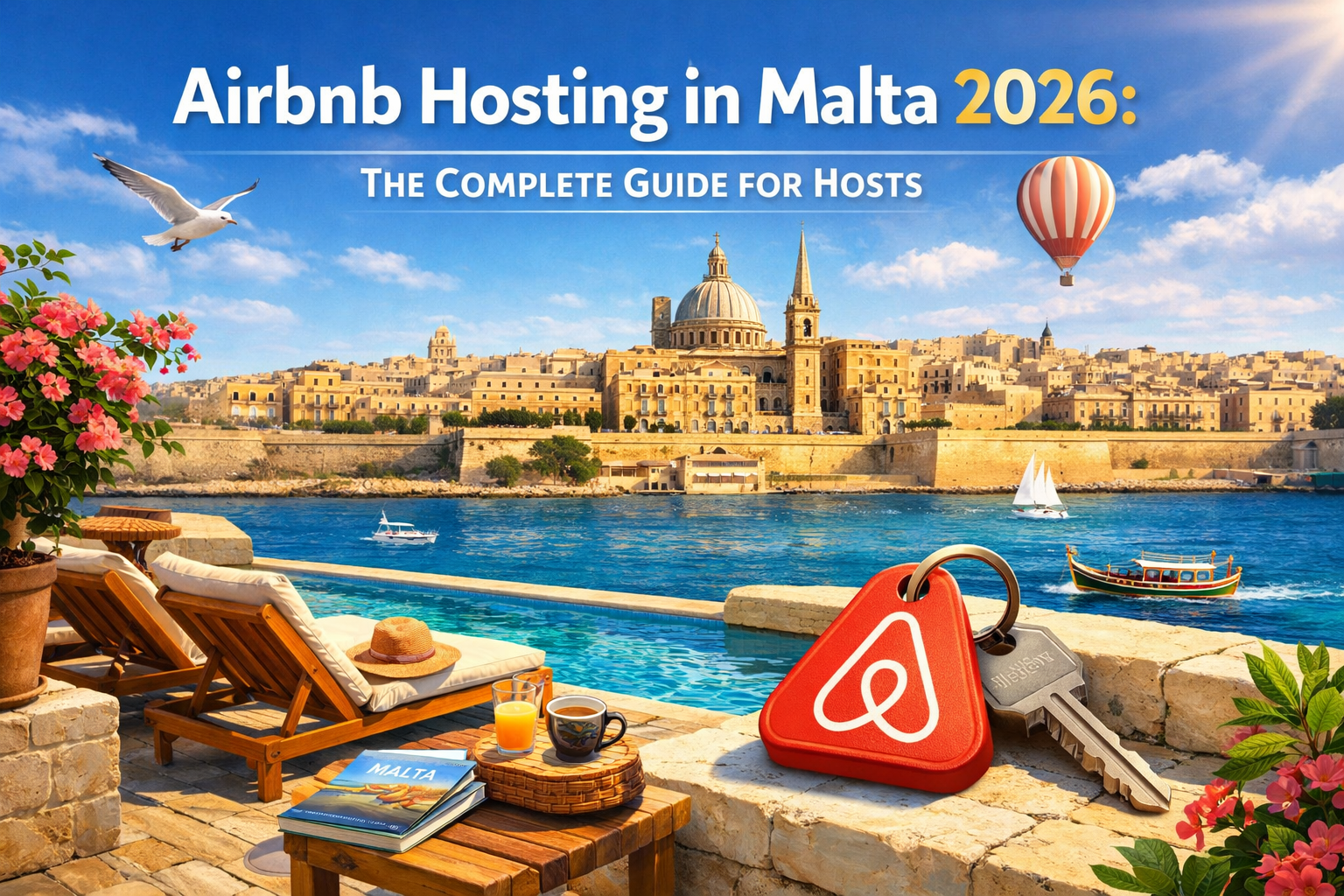
Malta has 9,100+ active Airbnb listings generating a median €30,000 per year in revenue, with 79% average occupancy and a €112 average daily rate. An estimated 25% of those listings operate without the legally required MTA license. That is about to become a serious problem: Regulation (EU) 2024/1028 takes effect on 20 May 2026, requiring platforms like Airbnb and Booking.com to share detailed monthly host data with national authorities for the first time. Malta is also drafting regulations for a three-year hosting ban for unlicensed operators. This guide covers what it takes to host legally and profitably in Malta in 2026, from MTA licensing and VAT obligations through pricing, operations, and realistic net income.
Is Airbnb hosting in Malta still profitable in 2026?
A typical one-bedroom apartment in Malta generates around €30,000 in gross annual revenue at 79% occupancy and a €112 average daily rate. After platform fees, cleaning, linen, utilities, licensing, VAT, and income tax, realistic net income is 50-60% of gross, or roughly €15,000-€18,000 per year.
Top-performing areas push those numbers significantly higher. Valletta leads with 85% occupancy, a €132 average daily rate, and approximately €39,000 in annual gross revenue. St Julian’s follows at 80% occupancy with a €133 ADR and roughly €35,000 per year. These figures come from full-year averages; the reality is extreme seasonality. July and August occupancy can hit 95%+, while January and February often drop below 40% for average listings.
Roughly 97% of Malta’s Airbnb guests are international, with French visitors forming the largest single nationality group. This means your listing competes on a global stage, and the remote-worker segment (drawn by Malta’s year-round mild climate and competitive cost of living) is growing fast. For a deeper look at monthly expenses, see the real cost of living in Malta in 2026.
Sample P&L: one-bedroom apartment in Sliema
| Line item | Annual amount |
|---|---|
| Gross rental income (79% occupancy, €119 ADR) | €34,300 |
| Airbnb service fee (3% host-only) | -€1,029 |
| Turnover cleaning (~180 turnovers × €35 avg) | -€6,300 |
| Linen service (~180 turnovers × €12 avg) | -€2,160 |
| Utilities (electricity, water, internet) | -€2,400 |
| MTA license fee | -€130 |
| Maintenance & replacements | -€1,800 |
| VAT at 7% on accommodation | -€2,401 |
| Income tax (15% flat rate on gross rental) | -€5,145 |
| Net income | €12,935 |
That works out to roughly 38% net margin, which is conservative. Hosts who self-manage, handle their own linen, and optimize pricing for peak season typically land closer to 50%. But this is the honest math before you commit.
What licenses and registrations do you need to host in Malta?
Every property rented for short stays under 90 days in Malta requires a Holiday Furnished Premises License from the Malta Tourism Authority (MTA). Operating without one is illegal. The annual fee is €130 per unit in Malta and €104 per unit in Gozo, with higher fees for villas with pools and converted farmhouses.
The MTA licensing process step by step
Applications are submitted through the MTA’s Licensing Management System (LMS). You’ll need to provide property layout plans, an architect’s declaration (mandatory for pre-1967 buildings), and evidence of fire safety compliance including smoke detectors, fire extinguishers, and emergency exit signage. The MTA requires a minimum bathroom-to-guest ratio, adequate sanitation, and basic furnishing standards.
The typical process runs: application submission, vetting (approximately five working days), document submission, property inspection, and license issuance. Your MTA license number must be displayed on every listing across Airbnb, Booking.com, and any other platform.
As of 2025, Malta had approximately 7,500 licensed short-let establishments with around 80,000 bed covers. Only 177 illegal units were formally identified in 2025, despite estimates that roughly a quarter of all listings lack proper licensing. That enforcement gap is closing fast.
What changes with EU Regulation 2024/1028 in May 2026?
From 20 May 2026, Regulation (EU) 2024/1028 requires online platforms to transmit standardised monthly activity data for every listing to national single digital entry points. Each host must hold a unique registration number displayed on all listings, and platforms must verify these numbers. Unlicensed operators will be flagged automatically for the first time. The MTA is separately drafting regulations to impose a three-year hosting prohibition on operators caught without a valid license. The era of operating under the radar in Malta is ending.
How much tax do Airbnb hosts actually pay in Malta?
Malta Airbnb hosts face three tax layers: income tax, VAT at a reduced 7% rate, and ECO tax. Undeclared rental income discovered by authorities is taxed at a 35% penalty rate plus fines and accumulated interest.
Income tax: two options
Hosts choose between a 15% flat rate on gross rental income or standard progressive rates (0-35%) on net income after deductions. The flat rate is filed via the TA24 form with a deadline of 30 April each year. It is simple but allows zero deductions for mortgage interest, ground rent, or maintenance. The progressive rate option allows a 20% maintenance allowance plus deductions for interest and ground rent, which may be better if expenses are high. You cannot mix methods: whichever you choose applies to all your rental properties for that tax year. More detail is available from Malta Tax & Customs and in the Airbnb Malta tax guide.
VAT at 7%, not 18%
Short-let accommodation requiring an MTA license qualifies for a 7% reduced VAT rate under the Malta Travel and Tourism Services Act, not the standard 18%. This is one of the most commonly misunderstood obligations for new hosts. There is no VAT registration threshold in Malta for this activity: if you hold an MTA license, you must register for VAT and submit quarterly returns.
ECO tax
The Environmental Contribution is currently €0.50 per person per night, capped at €5 per stay. Hosts collect this from guests and remit it to the authorities. It is separate from VAT and income tax.
Platform fees
Airbnb charges hosts a 3% service fee under the split-fee model, or 14-16% under host-only pricing. Booking.com typically charges 15-18% commission. These are deducted before payout and are not tax-deductible under the 15% flat rate option.
What actually drives bookings for Malta Airbnb listings?
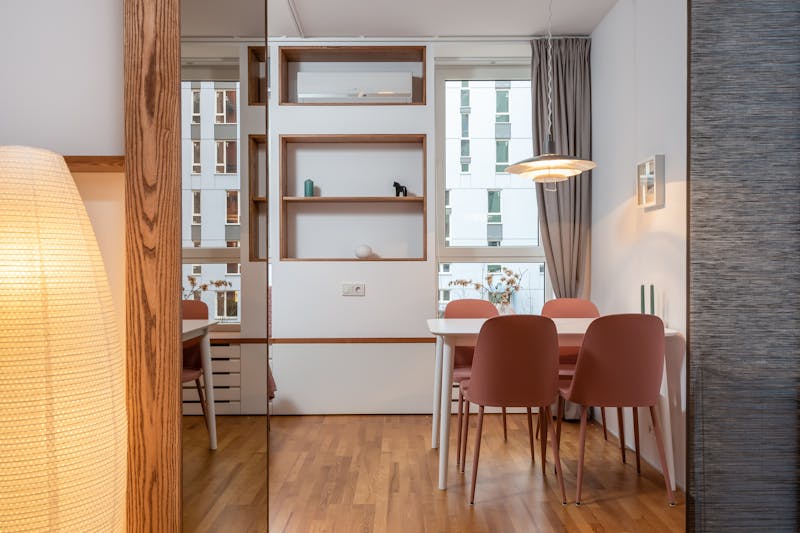
Professional photography is non-negotiable. Malta’s limestone interiors and abundant natural light photograph beautifully, and listings with professional shots earn measurably higher click-through rates. Highlight your balcony or terrace (the single biggest draw for Malta guests), sea views, air conditioning (essential May through October), and rooftop access.
Malta-specific amenities separate good listings from great ones. A dehumidifier is operational equipment, not a bonus. Blackout curtains matter when summer sunrise hits at 5:30am. A portable bathroom fan, a water filter jug (Malta’s hard water tastes noticeably different), beach towels, and local SIM card information all earn mentions in positive reviews. State your WiFi speed in Mbps; remote workers checking in for a month will filter on this.
Your guest guidebook is a five-star review machine. Go beyond TripAdvisor’s top ten. Include specific restaurant recommendations by cuisine, the nearest pharmacy, how to buy and use a Tallinja bus card, beach recommendations sorted by type (sandy, rocky, sheltered), and local festa dates if your listing is near a parish church. Consider adding French-language sections, given that French visitors are the largest nationality group.
For pricing, dynamic pricing tools like PriceLabs, Wheelhouse, and Beyond Pricing adjust your nightly rate to demand patterns. Set a two-night minimum during peak season and offer weekly or monthly discounts in the November-to-March slow period to attract remote workers. For other useful apps for living and working in Malta, including host tools, we have a separate guide.
How do you run turnover operations without losing your mind?
Same-day turnovers are the default in Malta’s short-let market. Checkout is typically 10am or 11am, check-in at 3pm or 4pm, giving you a four-to-five-hour window to clean, restock, and prepare for the next guest. This is where most self-managing hosts fail.
The cleaner problem
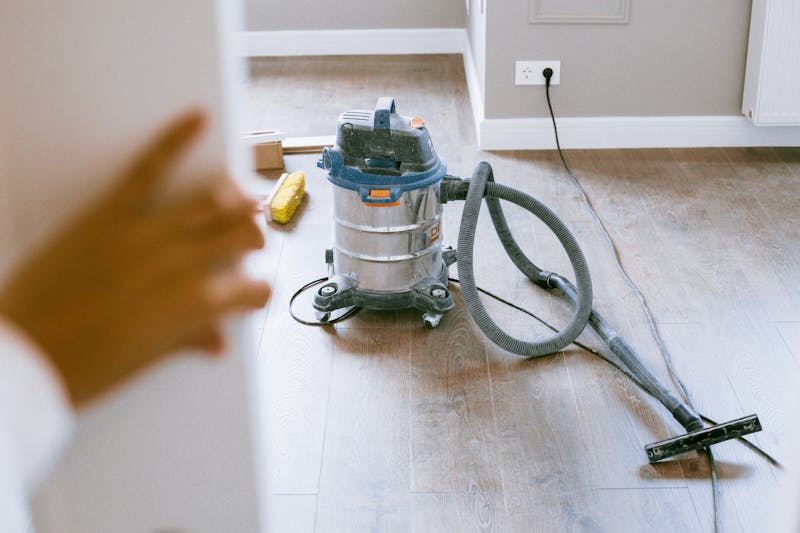
Finding reliable turnover cleaners in Malta is the single biggest operational headache for Airbnb hosts. Facebook Group cleaners are cheap but unreliable: they cancel last-minute, do inconsistent work, and disappear without notice. Property management companies handle cleaning but charge 20-35% of your gross revenue. Finding your own regular cleaner works until they are sick, on holiday, or unavailable, and you are scrambling at 1pm with guests arriving in two hours.
Rozie.app addresses the on-demand side of this problem: verified, background-checked cleaners with transparent pricing before you book and seven-day payment protection. It works as a primary solution for hosts with moderate booking frequency, or as a reliable backup when your regular cleaner is unavailable. For a breakdown of typical cleaning costs in Malta, see our pricing guide.
Linen, maintenance, and key management
Most Malta hosts use a linen rental and laundry service rather than washing in-unit. Typical cost is €8-€15 per set, and several providers operate island-wide with same-day turnaround.
Maintenance in Malta has island-specific realities that catch new hosts off guard. Hard water at 200-600 PPM calcium carbonate is among the highest in Europe. Kettles, coffee machines, washing machines, and shower heads all need descaling every four to six weeks, and budget for replacements. Humidity between 60% and 95% makes mold inevitable in ground-floor maisonettes and north-facing bathrooms without windows; dehumidifiers must run continuously. Saharan dust events, known locally as il-qilla, coat every outdoor surface with fine red-orange dust multiple times per year. Budget €100-€200 per month for ongoing maintenance.
Smart locks or key lockboxes are standard for self-check-in. Guests expect it, and it eliminates the need for key exchanges that tie you to specific arrival times. Fast guest communication is critical for maintaining Superhost status. Use templates for 90% of messages and keep WhatsApp available for urgent issues.
Should you self-manage or use a property management company?
Property management companies in Malta (Easy Landlord, GoHome, Victor Estate, Gobnb, and others) typically charge 20-35% of gross revenue. They handle everything: listings, pricing optimisation, guest communication, cleaning, maintenance, and key exchange. Quality varies significantly. Ask for references and check the reviews on their own managed listings before signing.
Self-managing keeps all revenue minus direct costs, but you are on call 24/7, handling every cleaner no-show and 2am lockout personally. On €30,000 gross, a PM company takes €6,000-€10,500. Self-managing saves that but costs your time and attention.
A hybrid approach is increasingly common: self-manage listings and guest communication (which templates make efficient), outsource cleaning (via a regular cleaner with Rozie as backup, or fully on-demand) and contract maintenance separately. This captures most of the cost savings while reducing the operational burden.
| Factor | Self-manage | Property management company |
|---|---|---|
| Cost | Direct costs only (cleaning, linen, maintenance) | 20-35% of gross revenue |
| Time commitment | High, especially during peak season | Minimal, fully hands-off |
| Revenue control | Full control over pricing and availability | PM sets pricing (sometimes suboptimally) |
| Cleaning reliability | Depends on your cleaner network | Handled, but quality varies by PM |
| Guest communication | You handle all messages and issues | PM handles (response quality varies) |
| Scalability | Difficult beyond 2-3 properties | Scales easily, PM manages multiple units |
Where is the money? A neighbourhood guide for Malta Airbnb hosts
Revenue potential varies dramatically by area. Valletta is the most profitable location with 633 active listings, 85% occupancy, a €132 average daily rate, and approximately €39,000 in annual gross revenue. Its UNESCO heritage appeal drives strong year-round demand, especially from cultural tourists and remote workers.
| Area | Active listings | Occupancy | Median ADR | Est. annual gross | Key characteristics |
|---|---|---|---|---|---|
| Valletta | 633 | 85% | €132 | ~€39,000 | Heritage appeal, strong year-round demand, compact apartments |
| St Julian’s | 938 | 80% | €133 | ~€35,000 | Nightlife, restaurants, Paceville. High competition |
| Sliema | 1,161 | 79% | €119 | ~€34,000 | Most competitive market, seafront promenade, top 25% earn €194+/night |
| Mellieħa | 454 | ~75% | €142 | ~€31,000 | Higher ADR, very seasonal (peak August, dead February) |
| Gozo | 1,332 | ~65% | €105 | ~€25,000 | Cheaper license (€104), rural/quiet stays, ferry logistics challenge |
| Suburban (Mosta, Rabat, San Ġwann) | Varies | ~70% | €78-€109 | ~€20,000-€28,000 | Less competition, longer stays, fewer turnovers, lower operational cost |
Sliema has the most supply (1,161 listings) and is the hardest market to stand out in, but the top 25% of Sliema hosts earn €194+ per night. Mellieħa commands the highest median ADR at €142 but is highly seasonal: a summer goldmine and a winter ghost town. Gozo has 1,332 listings and a cheaper license (€104 vs €130), with growing demand for rural and quiet stays, though ferry logistics add friction for guests. For an overview of how different areas compare for residents and tenants, see our guide on how to find an apartment in Malta. Suburban areas like Mosta, Rabat, and San Ġwann offer lower ADRs (€78-€109) but significantly less competition, longer average stays, and fewer turnovers, which means lower operational costs. Revenue data sourced from Airbtics.
What mistakes do first-time Malta Airbnb hosts make?
The most common and most consequential mistake is operating without an MTA license. An estimated 25% of Malta’s Airbnb listings do this today, but the EU data-sharing regulation taking effect in May 2026 changes the calculus entirely. Platforms will report your activity to national authorities monthly. Getting caught will no longer require a physical inspection.
Not registering for VAT is the second most frequent error. There is no registration threshold for MTA-licensed accommodation: if you have the license, you must register and file quarterly. Hosts who discover this retroactively face back-payments plus penalties.
Pricing mistakes cost hosts thousands. Setting low nightly rates during Malta’s July-August peak, when demand supports genuine premium pricing, leaves money on the table. Conversely, not offering monthly discounts in winter means empty calendars when remote workers are actively searching for affordable long stays.
Operational oversights are equally damaging. Ignoring hard water damage until your washing machine dies. Having no backup cleaner for a same-day turnover. Posting generic listing photos when Malta’s natural light and limestone textures are begging for professional photography. Not providing functioning air conditioning, or worse, listing AC that does not actually work. Skipping the guest guidebook, when personalised local tips are the single easiest path to five-star reviews.
Frequently asked questions about Airbnb hosting in Malta
Do I need an MTA license to list on Airbnb in Malta?
Yes. Any property rented for short stays under 90 days requires a Holiday Furnished Premises License from the Malta Tourism Authority. The annual fee is €130 per unit in Malta and €104 in Gozo. Your license number must appear on all platform listings.
How much tax do Airbnb hosts pay in Malta?
Hosts pay income tax (either 15% flat on gross or progressive rates on net income), 7% VAT on accommodation, and ECO tax (€0.50 per person per night, capped at €5 per stay). Undeclared income is taxed at 35% plus penalties.
What is the average Airbnb income in Malta?
The median gross annual revenue across Malta is approximately €30,000 at 79% occupancy and €112 ADR. After all costs and taxes, realistic net income is 50-60% of gross, or roughly €15,000-€18,000 per year for a typical one-bedroom.
Can I run an Airbnb from a rented apartment in Malta?
Only with your landlord’s explicit written consent. Most residential leases in Malta prohibit sub-letting. You will also still need an MTA license, VAT registration, and to meet all property standards. Rental arbitrage is legally possible but practically difficult.
How do I handle turnover cleaning for same-day guest changeovers?
Build a reliable cleaning system with a primary cleaner and a backup option. The turnover window in Malta is typically four to five hours (checkout 10-11am, check-in 3-4pm). Many hosts use on-demand platforms like Rozie.app as a backup or primary cleaning solution, supplemented by a linen service for bedding and towels.
Is Airbnb in Gozo worth it?
Gozo has 1,332 listings with lower occupancy than mainland Malta but a cheaper MTA license (€104) and growing demand for rural stays. The ferry logistics add guest friction, and seasonality is pronounced. It works best for hosts targeting longer stays and guests seeking quiet retreats.
What are the new EU short-let regulations affecting Malta in 2026?
Regulation (EU) 2024/1028 takes effect on 20 May 2026. It requires platforms like Airbnb and Booking.com to transmit monthly booking data to national authorities, verify host registration numbers, and enable removal of non-compliant listings. Malta must also establish penalties for violations by the same date.
Do I need to charge VAT as an Airbnb host in Malta?
Yes. Short-let accommodation under an MTA license is subject to 7% VAT (reduced rate for tourist accommodation), not the standard 18%. There is no registration threshold: holding an MTA license triggers mandatory VAT registration and quarterly returns.
What is ECO tax and who pays it?
The Environmental Contribution is €0.50 per person per night, capped at €5 per stay. It applies to all tourist accommodation in Malta. Hosts collect it from guests and remit it to the authorities. It is separate from income tax and VAT.
Getting your turnover operations right
Whether you self-manage fully, go hybrid, or hand everything to a property manager, reliable turnover cleaning is the single biggest factor in your review scores. One missed clean results in one bad review, and one bad review can cost months of lost bookings at the bottom of search results. If you are hosting in Malta and need a dependable cleaning solution with verified cleaners, transparent pricing, and payment protection, download the Rozie app and book your first turnover clean.