

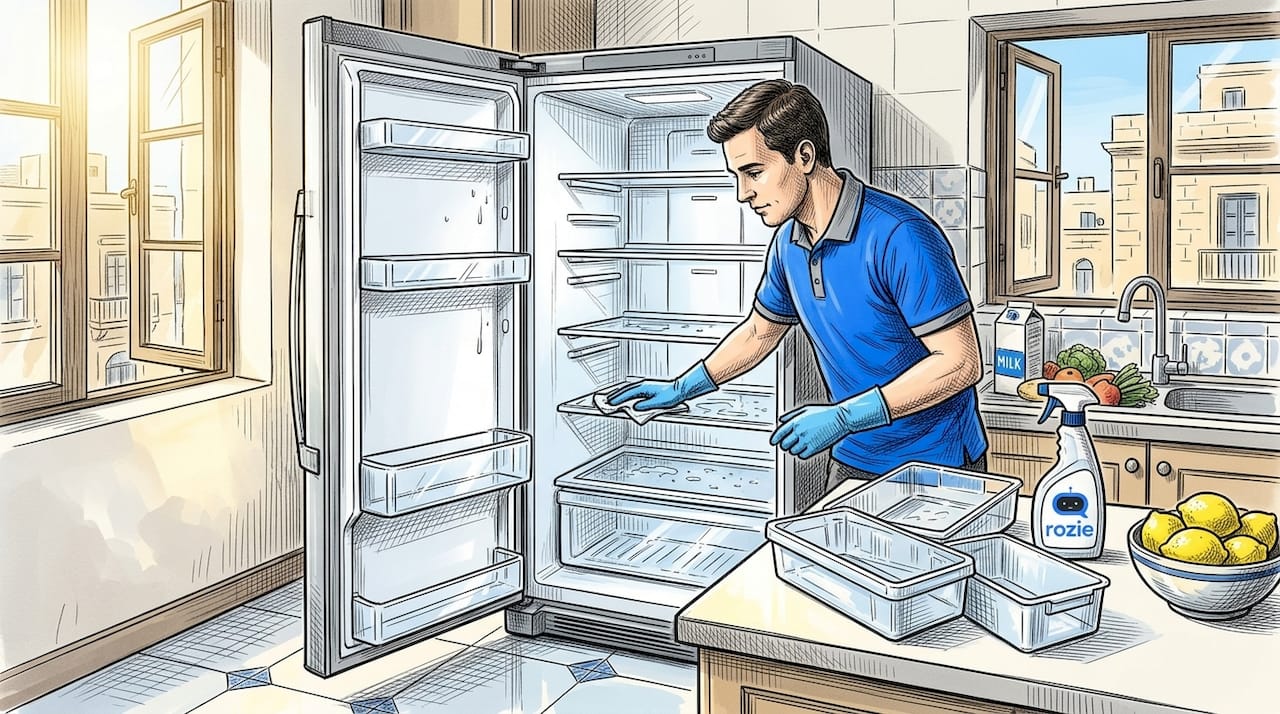
Professional fridge cleaning in Malta costs €10–€20 as an add-on to a standard or deep clean, and it takes a professional cleaner 20–40 minutes to complete. In a climate where humidity sits between 60–95% year-round and hard water leaves mineral deposits on every surface, your fridge needs more attention than a quick wipe-down. This guide covers everything: how to deep clean your fridge yourself with Malta-safe products, when to call in a professional, what it costs, and how to keep things fresh between cleans.
Why Does Fridge Cleaning Matter More in Malta?
Malta’s environment creates specific conditions that make fridge hygiene more demanding than in most European countries. Three factors combine to make regular fridge cleaning essential rather than optional here.
Humidity drives mould growth in rubber seals. Malta’s relative humidity ranges from 60% in summer to 95% in peak winter months (October through February). This moisture finds its way into the rubber gasket seals around your fridge door, creating the perfect breeding ground for black mould. If you’ve ever peeled back the folds of your fridge seal and found dark spots, that’s the humidity at work. Left untreated, mould in gaskets compromises the door seal, forcing your compressor to work harder and shortening the appliance’s lifespan.
Hard water leaves limescale on dispensers and drip trays. According to the USDA’s food safety guidelines, maintaining clean refrigerator components is essential for preventing bacterial growth. Malta’s tap water contains 200–600 PPM calcium carbonate depending on your area, classified as “very hard.” If your fridge has a water dispenser or ice maker, mineral buildup clogs nozzles and creates orange-tinged deposits that affect water taste and flow. Even fridges without dispensers accumulate calcium residue around drip trays and condensation channels.
Saharan dust (il-qilla) coats condenser coils. Several times a year, red Saharan dust events blanket Malta’s outdoor surfaces — and the fine particles enter homes through open windows. Dust accumulating on your fridge’s rear condenser coils reduces cooling efficiency by up to 25%, according to appliance manufacturers. A fridge working harder to maintain temperature uses more electricity and wears out faster.
Key takeaway: Malta’s humidity, hard water, and Saharan dust events create a triple threat for your fridge. Quarterly deep cleans aren’t overkill here — they’re the minimum.
Book a Fridge Clean on Rozie →
How Often Should You Clean Your Fridge in Malta?
A full fridge deep clean every three months keeps most Malta households in good shape, with light maintenance weekly. Adjust the schedule based on where you live and the season.
| Task | Frequency | Malta-Specific Notes |
|---|---|---|
| Wipe shelves and check expiry dates | Weekly | Prioritise after weekend grocery shops at PAVI or Smart Supermarket |
| Clean rubber gasket seals | Fortnightly | Essential Oct–Feb when humidity peaks at 80–95% |
| Full interior deep clean | Every 3 months | Schedule before Easter, before summer, after il-qilla events |
| Clean condenser coils | Every 6 months | More often if you live near a construction site or main road |
| Descale water dispenser (if applicable) | Every 3–6 months | Monthly in high-hardness areas (Mosta, Qormi, Birkirkara) |
Coastal areas like Sliema, St Julian’s, and Bugibba face the additional challenge of salt air, which accelerates corrosion on external fridge handles and hinges. If you live along the seafront, wipe the exterior monthly with a damp cloth to prevent pitting.
If that schedule looks ambitious for your lifestyle, you’re not alone — most Rozie users tell us they’d rather spend their weekend at Golden Bay than scrubbing fridge seals. That’s exactly why fridge cleaning exists as a bookable extra on the app.
How Do You Deep Clean a Fridge Step by Step?
A thorough fridge deep clean takes 45–90 minutes for a standard household unit. Follow this sequence for the best results using products available at any Malta supermarket.
What supplies do you need?
You don’t need anything exotic. Gather these before starting: bicarbonate of soda (baking soda), a mild dish soap (any brand from PAVI or Smart Supermarket works), white vinegar (for non-stone surfaces only — never use on limestone countertops), microfibre cloths, a soft toothbrush for gasket folds, and warm water. For stubborn limescale on drip trays or dispensers, HG limescale remover (widely available at Homemate stores across Malta) is effective and safe for food-contact surfaces after rinsing.
Step 1: Empty and sort
Remove everything from the fridge. Discard anything past its use-by date — the FDA recommends storing perishable foods at 4°C (40°F) or below and discarding anything that has been above that temperature for more than two hours. Group items on the counter and cover perishables with a damp towel to keep them cool while you work.
Step 2: Remove shelves and drawers
Take out all removable shelves, drawers, and racks. Let glass shelves reach room temperature before washing — placing cold glass under hot water can cause cracking. Soak everything in warm water with a few drops of dish soap for 10–15 minutes, then scrub and rinse. For Malta households, pay extra attention to the vegetable crisper drawer — humidity encourages faster mould growth on produce remnants here.
Step 3: Clean the interior
Mix two tablespoons of bicarbonate of soda into one litre of warm water. This creates a gentle, non-toxic solution that neutralises odours while cleaning. Wipe all interior walls, the ceiling, and the floor of the fridge. Use a soft toothbrush dipped in the solution to reach corners and crevices. Avoid abrasive sponges on the interior lining — they scratch the surface, creating grooves where bacteria hide.
Step 4: Tackle the gasket seals
This is the step most people skip — and it matters most in Malta. Pull back the rubber folds of the door gasket and clean inside with a cloth dipped in the baking soda solution. If you spot black mould (common between October and February when humidity exceeds 80%), apply a paste of baking soda and water, let it sit for 15 minutes, then scrub gently with the toothbrush. Rinse thoroughly and dry completely. A dry seal is a mould-resistant seal.
Step 5: Clean the exterior and coils
Wipe down the exterior with a damp cloth and mild soap. For stainless steel fridges, wipe in the direction of the grain. Pull the fridge away from the wall and vacuum the condenser coils at the back or underneath — this is where il-qilla dust and household lint accumulate. Clean coils improve cooling efficiency and lower your electricity bill, which matters in Malta where energy costs run higher than the EU average.
Step 6: Reassemble and restock
Return dry shelves and drawers. Restock food following proper food safety placement: raw meat and fish on the bottom shelf (to prevent drips contaminating other foods), dairy and eggs on middle shelves, and ready-to-eat items on top shelves. Store fruit in the low-humidity drawer and vegetables in the high-humidity drawer if your fridge has these settings.
Rather skip the DIY? A verified cleaner on Rozie handles all six steps in 20–40 minutes — including the gasket mould treatment and drip tray descaling that most people skip. Select “fridge” as an extra when booking, and the price shows before you confirm.
What Does a Professional Fridge Cleaning Include?
A professional fridge clean goes beyond what most people achieve at home. Verified cleaners on platforms like Rozie include fridge cleaning as a bookable extra alongside a general or deep clean — you select it during the booking process and see the added cost before confirming.
| Task | DIY | Professional |
|---|---|---|
| Interior shelf and wall wipe-down | ✔ | ✔ |
| Gasket seal mould removal | Sometimes skipped | ✔ (included as standard) |
| Drawer and rack deep scrub | ✔ | ✔ |
| Drip tray cleaning and descaling | Rarely done | ✔ |
| Condenser coil dusting | Rarely done | On request |
| Exterior and handle sanitisation | ✔ | ✔ |
| Food organisation advice | ✗ | Some cleaners offer |
| Time required | 45–90 min | 20–40 min |
The time difference comes from experience and equipment. Professional cleaners work faster because they clean fridges regularly and know which products work best on specific types of buildup — critical in Malta where limescale and mould compound each other.
For a full breakdown of add-on pricing across all cleaning types in Malta, see the complete Malta cleaning cost guide.
How Much Does Fridge Cleaning Cost in Malta in 2026?
Professional fridge cleaning in Malta costs €10–€20 when booked as an add-on extra to a general or deep clean. Standalone fridge-only bookings are rare — most providers include it as part of a broader kitchen or deep cleaning package.
| Service Type | Typical Cost (Malta, 2026) | Fridge Included? |
|---|---|---|
| General clean + fridge extra | €35–€65 total | As a paid add-on (€10–€20) |
| Deep clean + fridge extra | €90–€150 total | As a paid add-on (€10–€20) |
| Full kitchen deep clean | €40–€80 | Usually included |
| End-of-tenancy clean | €80–€200 | Usually included |
On marketplace apps like Rozie, you select fridge cleaning as an extra during booking — the total price updates on screen before you confirm, so there are no hidden costs. This transparency matters because traditional agencies in Malta typically require a phone call for quotes, adding an unnecessary step for something as straightforward as a fridge clean.
Bundling saves money. If you need oven, fridge, and window cleaning, booking them together as extras on a single visit is cheaper than scheduling separate appointments. Each additional extra typically costs €10–€25, and you pay one callout rather than multiple.
Wondering what selecting extras and confirming the price actually looks like? Finding a reliable cleaner in Malta the traditional way means scrolling through Facebook groups, making phone calls, chasing quotes, and hoping the person who shows up actually does a good job. Most busy professionals don’t have time for that — and it’s exactly the problem Rozie was built to solve. No calls, no chasing. You pick a date, select your extras (like fridge cleaning), see the final price upfront, and get matched with a verified, background-checked cleaner. Here’s the full booking process in under 60 seconds:
Try Rozie Free — See Prices Instantly →
For more detail on deep cleaning prices across Malta, including area-specific variations for Sliema, Birkirkara, and Gozo, check our full price breakdown.
How Do You Keep Your Fridge Clean Between Deep Cleans?
Maintaining a clean fridge week-to-week is simpler than most people make it. These five habits prevent the need for emergency deep cleans and keep odours under control in Malta’s warm climate.
Line shelves with cling film or reusable liners. Spills stay contained — when something drips, you replace the liner instead of scrubbing the shelf. This alone saves 20+ minutes per month.
Keep an open box of baking soda on the middle shelf. Replace it every 30 days. It absorbs odours that accumulate faster in Malta’s humidity, especially from fresh fish and local cheeses.
Wipe spills immediately. A 10-second wipe with a damp cloth prevents a 10-minute scrub later. Pay particular attention to the bottom shelf where raw meat drips can harbour bacteria.
Check expiry dates every Sunday. Build it into your routine before your weekly grocery shop. Discard anything past its date, and move items nearing expiry to the front so they get used first.
Leave space for air circulation. An overpacked fridge doesn’t cool evenly. Leave at least 2–3 cm between items and avoid blocking the rear vents. This is especially important during Malta’s summer when your fridge works hardest to maintain temperature in ambient heat above 35°C.
Even with these habits, most Malta households benefit from a professional deep clean every quarter — it catches the buildup you can’t reach or don’t notice. Rozie users often bundle a fridge extra onto their regular cleaning for as little as €10, keeping things hygienic without adding another task to the to-do list.
For more practical tips on keeping your entire home clean with minimal effort, browse our Malta cleaning guides.
Not enough hours in the day? That’s the #1 reason 22,700+ people across Malta use Rozie. No phone calls, no quote-chasing, no guesswork. Pick a time, choose your extras, see the price, done. Your fridge (and your weekend) will thank you.
Download Rozie — Book in 60 Seconds →

Frequently Asked Questions About Fridge Cleaning in Malta
How often should I schedule professional fridge cleaning in Malta?
Every three months is ideal for most Malta households. If you live in a high-humidity area or have a large family, quarterly professional cleans keep mould and odours under control. Between professional visits, a weekly wipe-down of shelves and a fortnightly gasket clean are enough to maintain hygiene.
Can I use vinegar to clean my fridge in Malta?
White vinegar is safe for cleaning fridge interiors, rubber seals, and removable parts. It’s effective against mould and mild limescale. However, never use vinegar on limestone countertops or floors near your fridge — Malta’s globigerina limestone is pH-sensitive and acid will etch the surface permanently. Stick to baking soda solutions for stone-adjacent cleaning.
What is the best way to remove limescale from a fridge water dispenser?
Apply a food-safe descaler like HG limescale remover (available at Homemate stores and PAVI across Malta) to the dispenser nozzle and drip tray. Let it sit for 15–30 minutes, then scrub gently and rinse thoroughly. In areas with the hardest water — Mosta, Qormi, and St Paul’s Bay — repeat monthly to prevent mineral buildup from affecting water taste and flow.
How much does it cost to add fridge cleaning to a booking in Malta?
Fridge cleaning typically costs €10–€20 as an add-on extra to a general or deep clean in Malta. On Rozie, you select it during the booking process and see the total price before confirming — no hidden fees. Bundling fridge with oven and window extras on one visit saves money compared to separate bookings.
What should a professional fridge clean include?
A proper professional fridge clean covers: full interior wipe-down of all walls, shelves, and compartments; removal and scrubbing of drawers and racks; rubber gasket seal cleaning with mould treatment; drip tray cleaning; and exterior handle sanitisation. Some cleaners also descale water dispensers on request. The whole process takes 20–40 minutes for a professional one-off clean.
Is it safe to clean a fridge with baking soda?
Baking soda (bicarbonate of soda) is one of the safest and most effective fridge cleaners. A solution of two tablespoons per litre of warm water cleans without leaving chemical residue near your food. It also neutralises odours, which is particularly useful in Malta where warm ambient temperatures cause food smells to intensify faster than in cooler climates.
How do I prevent mould in my fridge door seals during Malta’s wet season?
Between October and February, Malta’s humidity regularly exceeds 80%, creating ideal conditions for mould growth in fridge gaskets. Dry the seals thoroughly after cleaning, keep the fridge door closed as much as possible, and clean the gasket folds fortnightly with a baking soda paste. If mould persists, check that the seal is intact — a damaged gasket lets in warm, moist air that accelerates mould growth. For a deeper kitchen clean that includes all appliances, a full deep cleaning session covers the fridge along with every other surface.
Recommended
- Top 8 Window Cleaning Malta Services in 2026 for Busy Professionals Seeking Reliable Solutions | Rozie – Malta’s Best Cleaning Services
- How to Choose a Cleaning Service in Malta (2026 Guide)
- How to Choose Cleaning Services: Find the Right Fit | Rozie – Malta’s Best Cleaning Services
- Cleaning cost Malta 2026: Price calculator + hourly rates