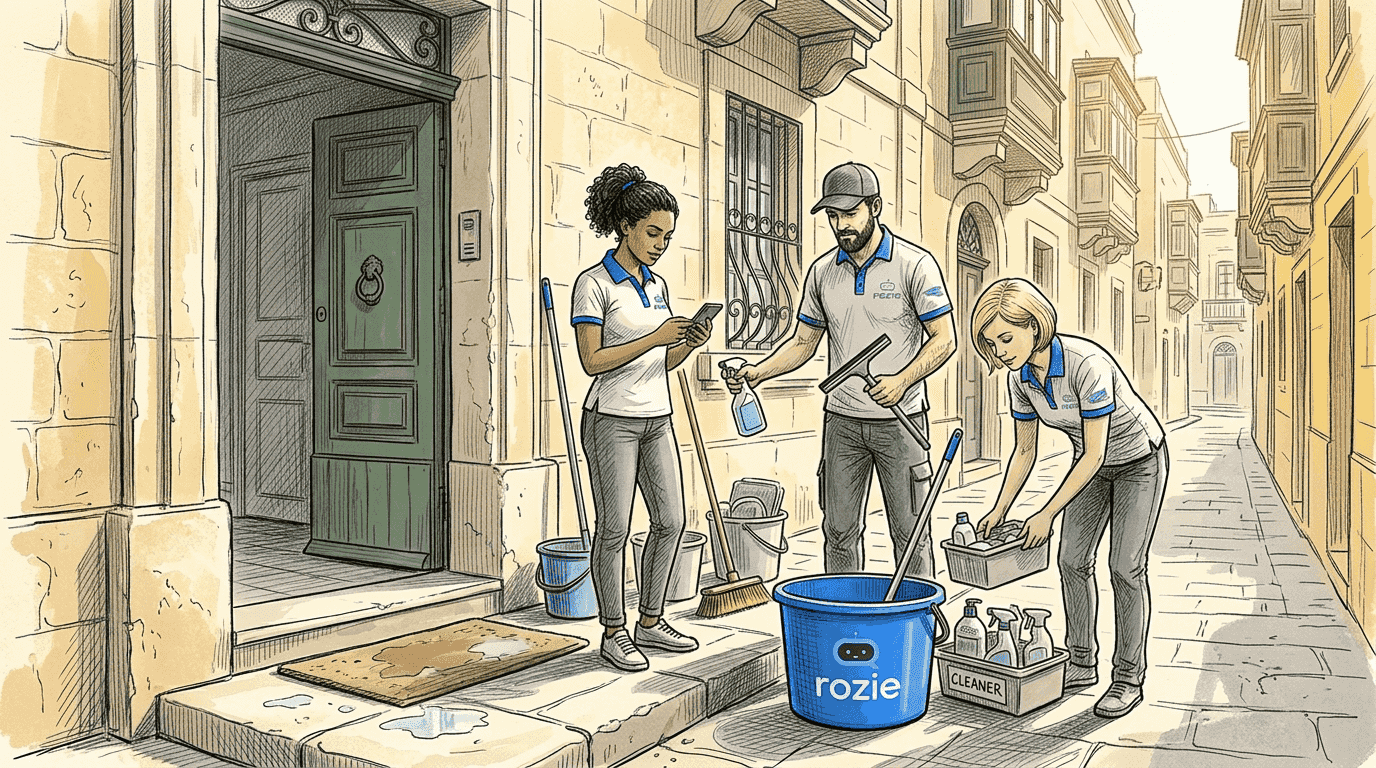



Finding trusted cleaners in Malta requires more than a Google search and a gut feeling. With over 50 registered cleaning providers on the island — plus hundreds of independent operators advertising on Facebook groups and classifieds — the difference between a vetted professional and an unreliable hire comes down to eight specific verification steps that most people skip. This guide covers exactly what “trusted” means in Malta’s cleaning market, the red flags that signal problems, realistic pricing benchmarks in euros, and how to secure a verified cleaner without wasting hours on phone calls and quote requests.
Whether you’re an expat settling into a Sliema apartment, a landlord managing short-lets in St Julian’s, or a family in Mosta looking for weekly help, the process is the same — and getting it right the first time saves you money, stress, and the risk of letting an unvetted stranger into your home.
- What makes a cleaner “trusted” in Malta?
- What are the 8 checks you should run before hiring a cleaner?
- What red flags should you watch for when hiring cleaners in Malta?
- Where can you find reliable cleaners in Malta?
- How much do trusted cleaners cost in Malta in 2026?
- Why does Malta require cleaners with local expertise?
- What legal protections exist when hiring cleaners in Malta?
- How do you book a verified cleaner through an app?
- Frequently asked questions
What makes a cleaner “trusted” in Malta?
A trusted cleaner in Malta is one who has passed identity verification, holds legal work status on the island, carries references or platform ratings from real clients, and operates with transparent pricing — not someone who simply answered a Facebook post. Trust in this context means accountability: if something goes wrong, there’s a documented trail and a support structure to resolve it.
Malta’s cleaning market sits in an unusual position. The island has roughly 500,000 residents, a large expat community, and one of Europe’s densest short-let rental markets. Demand for cleaning help is high, but the supply side is fragmented. You’ll find everything from established companies with ISO certifications and decades of history to solo operators working cash-in-hand with no formal vetting at all.
That fragmentation is exactly why trust matters more here than in larger markets. In London or Barcelona, a bad hire from a platform means you leave a one-star review and book someone else. In Malta’s smaller community, an unvetted cleaner who damages your globigerina limestone floors with acidic products — or worse, has access to your home without any background check — creates problems that are harder to fix and more personal to deal with.
The key trust signals to look for fall into three categories:
- Verification — Has the cleaner’s identity been confirmed? Do they have legal work authorisation in Malta? Has anyone checked their background before they enter your home?
- Transparency — Can you see the price before booking? Are reviews from real, verified clients? Is there a clear cancellation and complaint process?
- Accountability — If the cleaner damages property, misses appointments, or delivers poor work, is there a system to address it? Payment protection, insurance, or a platform guarantee all serve this function.
What are the 8 checks you should run before hiring a cleaner?
Before giving anyone access to your home in Malta, run these eight verification checks. Skipping even one increases your risk of unreliable service, property damage, or financial loss — particularly in a market where informal arrangements are common and legal recourse for cash-in-hand hires is limited.
1. Identity and work authorisation
Malta’s Employment and Industrial Relations Act (EIRA) applies to all workers on the island, including cleaning professionals. Any cleaner working in Malta should hold valid identification and — if they’re a third-country national — a valid work permit issued through Identità (Malta’s identity services agency). Hiring someone without legal work status exposes both you and them to legal consequences.
Platforms like Rozie handle this verification before a cleaner can accept bookings. If you’re hiring independently, ask to see ID and don’t feel awkward about it — legitimate professionals expect the question.
2. Background checks
A background check goes beyond ID verification. It confirms the person has no criminal record that would make them unsuitable for entering private homes. In Malta, the Police Conduct Certificate (issued by the Malta Police Force) is the standard document for this purpose.
Most established cleaning companies and platforms conduct these checks during onboarding. Independent cleaners may not have one unless you request it. If you’re hiring directly, asking for a recent conduct certificate is reasonable and common practice among property managers on the island.
3. Real reviews from verified clients
Check reviews on independent platforms — not just the cleaner’s own website or social media. Look for specifics: did the reviewer mention the cleaner arriving on time, handling particular tasks well, or communicating effectively? Generic praise like “great service” from unverifiable accounts carries little weight.
On platforms with verified booking systems, every review is tied to a completed job. This is significantly more reliable than testimonials on a company website, which can be curated or fabricated. Rozie’s review system, for example, only allows ratings from clients who actually completed a booking.
4. Transparent pricing before you commit
A trustworthy cleaner or service shows you the cost before you confirm the booking. In Malta, many traditional cleaning companies require you to call or email for a quote — which isn’t inherently a red flag, but it does make comparison harder and leaves room for unexpected charges.
The benchmark for transparency: you should know the total cost, what’s included, and what counts as an extra before any work begins. Malta cleaning cost benchmarks can help you judge whether a quote is realistic.
5. Clear cancellation and complaint process
What happens if the cleaner cancels last minute? What if you’re not satisfied with the work? A trusted provider has documented policies for both scenarios. Look for specific commitments — re-cleaning guarantees, defined cancellation windows, and a support team you can actually reach.
6. Insurance or payment protection
Accidents happen. A cleaner might scratch a marble countertop, break a decorative item, or damage a delicate limestone surface. Without insurance or some form of payment protection, you have no recourse beyond an awkward conversation.
Professional companies in Malta typically carry liability insurance. Platform-based services like Rozie offer 7-day payment protection — meaning you can raise issues after the clean and have them resolved before the payment is released. Cash-in-hand arrangements offer neither.
7. Communication channels
Can you reach the cleaner or the service provider easily? In Malta, WhatsApp is the default communication channel for most service businesses. A trusted provider offers at least one reliable channel for pre-booking questions, day-of-clean coordination, and post-service follow-up.
If your only point of contact is a Facebook Messenger thread that goes unanswered for days, that’s a warning sign — not just about communication, but about accountability.
8. Malta-specific cleaning knowledge
This is the check most people forget. Malta’s homes have unique materials and environmental conditions that generic cleaning knowledge doesn’t cover. A trusted cleaner working on the island should know that vinegar and acidic cleaners damage globigerina limestone (the porous stone found in most Maltese buildings), that hard water at 350–600 PPM requires specific limescale treatment, and that coastal humidity above 60% accelerates mould growth in poorly ventilated spaces.
Ask a potential cleaner how they’d handle limestone floors or persistent limescale in a bathroom. Their answer tells you whether they have genuine local experience or are working from generic checklists.
What red flags should you watch for when hiring cleaners in Malta?
Cash-only payment with no receipt, refusal to provide identification, and vague pricing that changes after the work is done are the three most common warning signs in Malta’s cleaning market. Any one of these should make you reconsider the hire — all three together are a clear signal to walk away.
Beyond those obvious issues, watch for these Malta-specific red flags:
- No cancellation policy. If a cleaner can’t tell you what happens when they cancel or you cancel, there’s no structure behind the service. You’ll learn this the hard way when they don’t show up before your Airbnb guests check in.
- Claiming to use “natural” cleaners without specifics. In Malta, where limestone surfaces are everywhere, the wrong “natural” product (like vinegar, lemon juice, or any acid-based solution) can etch and permanently damage floors, countertops, and wall cladding. Ask what products they actually use. pH-neutral products from brands like Lithofin or HG — both available at Homemate and PAVI — are the safe choice for local stone.
- No online presence beyond a Facebook page. A business page with a few photos and no reviews, website, or booking system suggests a casual operation with limited accountability.
- Pressure to commit before seeing a price. Phrases like “we’ll work it out after” or “it depends on what we find” without any estimate indicate unclear pricing practices.
- Unwillingness to provide references. Any cleaner with a track record of good work should have clients willing to vouch for them. If they can’t provide even one reference, question why.
Where can you find reliable cleaners in Malta?
There are four main channels for finding cleaners in Malta: on-demand booking apps, established cleaning companies, Facebook groups, and personal referrals from friends or colleagues. Each has distinct advantages and risks, and the right choice depends on how much vetting work you’re willing to do yourself.
On-demand cleaning apps
Apps like Rozie handle the trust problem systematically. Every cleaner on the platform undergoes identity verification, background checks, and professional evaluation before they can accept bookings. You see transparent pricing before confirming, read ratings from verified clients who actually completed a booking, and benefit from 7-day payment protection if anything goes wrong.
The practical advantage is speed and convenience. You set your location, choose a date and time, add any extras you need (deep cleaning, fridge, oven, windows, balcony), and select from cleaners who’ve submitted offers. The entire process takes a few minutes — and you skip the phone-tag phase that traditional companies require.
Rozie currently has over 22,700 users, 140+ active verified cleaners, and a 4.8-star App Store rating from 508 reviews. For expats who don’t have a local network of recommendations yet, it’s the most efficient way to find a vetted professional without doing all the background work yourself.
Established cleaning companies
Malta has several well-known cleaning companies with years of operation and broad service menus covering residential, commercial, and specialist cleaning. These companies employ or contract their staff directly, often provide training, and some hold quality certifications.
The trade-off is typically flexibility and transparency. Most require you to call or email for a quote, which adds time to the process. Pricing is rarely published online, making comparison difficult. And scheduling tends to work around their availability, not yours.
These companies work well for recurring commercial contracts or specialist jobs (post-construction cleaning, high-rise window work, yacht cleaning) where you need a team rather than an individual. For standard residential cleaning, they’re often more than you need.
Facebook groups
The “Nannies and Cleaners Malta” Facebook group is the island’s largest informal marketplace for cleaning services. Thousands of members post recommendations, and independent cleaners advertise their availability directly.
The advantage is breadth — you’ll find the widest selection of independent cleaners here. The risk is that there’s no verification layer. You’re responsible for checking references, confirming identity, agreeing on pricing, and handling any disputes yourself. For people comfortable with that legwork who want to build a direct relationship with an independent cleaner, it works. For anyone who prefers built-in accountability, it’s a starting point for research rather than a booking channel.
Personal referrals
Still the gold standard for trust — if someone you know and respect recommends their cleaner, that carries more weight than any online review. The limitation in Malta’s expat community is that new arrivals don’t have this network yet. Building it takes time, which is why apps and groups fill the gap while you’re establishing yourself on the island.
How much do trusted cleaners cost in Malta in 2026?
Trusted cleaners in Malta charge between €10 and €25 per hour in 2026, depending on whether you book an independent cleaner (€10–20/hr) or go through a professional agency (€15–25/hr). A standard cleaning session for a two-bedroom apartment typically runs €25–60 for regular maintenance and €60–120 for a deep clean. These rates reflect verified, accountable service — not cash-in-hand arrangements that may be cheaper upfront but offer zero protection.
| Service type | Typical cost range (2026) | What’s included |
|---|---|---|
| Regular cleaning (independent) | €10–20/hr | Dusting, mopping, bathroom, kitchen surfaces, general tidying |
| Regular cleaning (agency/app) | €15–25/hr | Same tasks + verification, support, payment protection |
| Deep clean (2-bedroom apartment) | €60–120 | Grout scrubbing, limescale removal, inside appliances, windows |
| End-of-tenancy clean | €80–200 | Full property reset for deposit return |
| Airbnb turnover clean | €40–80 | Linen change, bathroom sanitisation, kitchen reset, floor clean |
| Extras (per item) | €10–25 each | Interior windows, balcony, oven, fridge, kitchen cabinets |
Prices in areas like Sliema, St Julian’s, and Valletta can run 15–20% above these averages due to higher demand, parking difficulties, and the prevalence of larger or more complex properties along the seafront. Inland areas like Birkirkara, Mosta, and Naxxar tend to sit at the lower end of the range.
A key pricing insight: the cheapest option is rarely the most cost-effective. An unvetted cleaner charging €8/hr who damages a limestone countertop or doesn’t show up for your Airbnb turnover costs you far more than a verified professional at €15/hr who delivers consistent results. For detailed cost breakdowns including extras and add-ons, check the full Malta cleaning cost guide.
Why does Malta require cleaners with local expertise?
Malta’s climate, water quality, and building materials create cleaning challenges that don’t exist in most other European countries. A cleaner imported from a UK-focused training programme or following generic international checklists will miss — or actively damage — surfaces and systems that require Malta-specific knowledge.
Globigerina limestone
Most Maltese buildings use globigerina limestone, a soft, porous stone with a neutral to slightly alkaline pH. Acidic cleaners — vinegar, citrus-based products, bathroom descalers with hydrochloric acid — etch the surface permanently. The correct approach is pH-neutral cleaners, specifically formulated stone care products (Lithofin MN Wash & Clean is widely available at Homemate), and immediate blotting of any acidic spills including wine, tomato sauce, and lemon juice.
Hard water and limescale
Malta’s tap water contains 350–600 parts per million (PPM) of calcium carbonate — significantly harder than most European countries. This means limescale builds up fast on taps, shower screens, glass, and inside appliances. A cleaner who understands this treats it proactively: applying limescale-specific products (HG Professional Limescale Remover, sold at Smart Supermarket and PAVI) on chrome and glass surfaces while avoiding those same products on limestone.
Humidity and mould
Year-round humidity of 60–80% — higher in coastal towns like Sliema, Marsascala, and Birżebbuġa — creates persistent mould risks in bathrooms, behind wardrobes, and around single-glazed windows. Seasonal spikes from October through February make this worse. A knowledgeable cleaner checks these spots routinely, uses targeted anti-mould treatments, and can advise on ventilation improvements that prevent recurrence.
Salt air and Saharan dust
Coastal properties face salt spray that corrodes metal fixtures, clouds windows within weeks, and leaves a fine residue on balconies and terraces. Saharan dust events (known locally as il-qilla) deposit a distinctive red-orange dust across the island several times a year, particularly in spring and early summer. Properties facing south or southwest get the worst of it. After a dust event, a standard wipe-down isn’t enough — surfaces need thorough washing to prevent the fine particles from scratching during regular cleaning.
What legal protections exist when hiring cleaners in Malta?
Malta’s Employment and Industrial Relations Act (EIRA) governs all employment relationships on the island, including domestic cleaning. The Private Cleaning Services Wages Council Wage Regulation Order sets specific minimum pay rates, leave entitlements, and working conditions for the cleaning sector. These legal frameworks protect both you and the cleaner — understanding them helps you make better hiring decisions.
Why legal status matters for you as a client
If you hire a cleaner who isn’t legally authorised to work in Malta, you could face complications. While enforcement typically targets employers rather than household clients, the practical risk is more immediate: an unregistered worker has no insurance, no employment protections, and no accountability structure. If they’re injured in your home or damage your property, you have no documented arrangement to fall back on.
When you book through a regulated platform or established company, the provider handles employment compliance, tax obligations, and insurance — removing that risk entirely.
What the Wage Regulation Order means
The Private Cleaning Services Wages Council Wage Regulation Order establishes minimum pay rates for cleaning workers in Malta. These rates are adjusted periodically to reflect cost-of-living increases. As a client, this matters because it sets a floor: if a provider is charging you well below market rates, there’s a real question about whether their cleaners are being paid legally. Ethical hiring supports fair wages, and fair wages attract better, more reliable professionals.
Payment protection and dispute resolution
Platform-based services often add protections beyond what the law requires. Rozie, for example, offers 7-day payment protection — you pay at booking, but the cleaner receives payment only after you’ve had time to confirm the work was done to standard. This creates a built-in incentive for quality and a straightforward resolution path if there’s an issue.
For direct hires, you have fewer formal protections. Written agreements — even a simple WhatsApp message confirming the scope, price, and schedule — provide some documentation if a dispute arises.
How do you book a verified cleaner through an app?
Booking a verified cleaner through Rozie takes under five minutes and follows four steps: set your location, choose any extras you need, pick your preferred date and time, and select from cleaners who submit offers for your job. The entire process mirrors booking a taxi through Bolt or ordering food through Wolt — familiar to most Malta residents and expats.
Here’s what happens at each step:
- Set your location. Enter your address so cleaners in your area can respond. Whether you’re in a Valletta townhouse, a Sliema seafront apartment, or a farmhouse in Gozo, the platform matches you with cleaners who operate in that locality.
- Choose your service and extras. Select regular cleaning, deep cleaning, or specific extras: fridge, oven, kitchen cabinets, terrace, balcony, or inside windows. Each extra has a defined scope so both you and the cleaner know what’s included.
- Pick your date and time. You set the schedule that works for you — including weekends. No need to fit around a company’s availability windows.
- Review offers and book. Cleaners submit offers for your job. You see their rating, reviews from previous clients, and the total price before you confirm. No phone calls, no waiting for email quotes.
After booking, the in-app chat lets you coordinate details with your cleaner directly — access instructions, specific priorities, or any last-minute changes. Customer support is available 7 days a week via WhatsApp if you need help at any point.
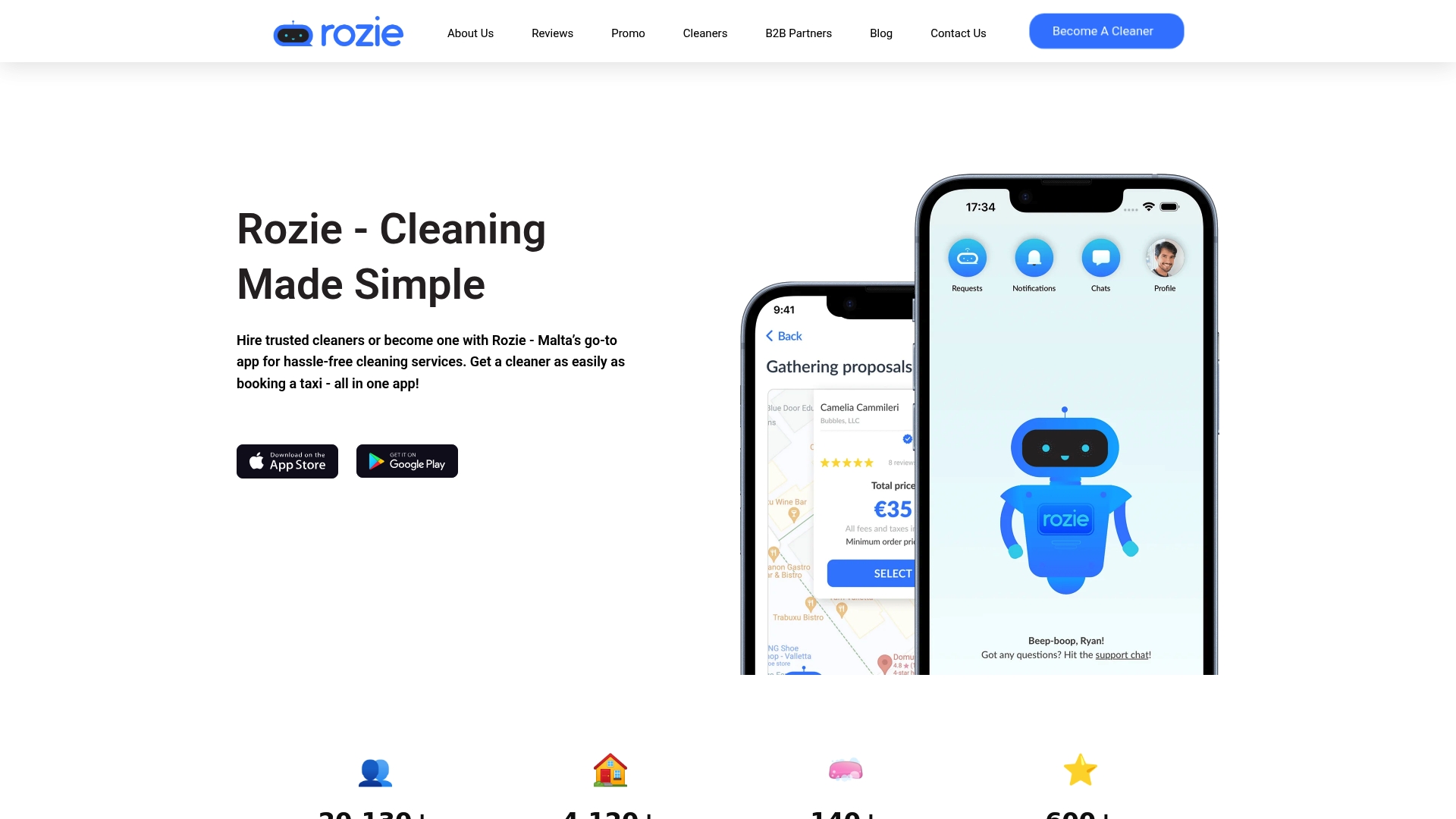
Ready to book a trusted cleaner? Download Rozie and get verified cleaning help in Malta — with transparent pricing, real reviews, and 7-day payment protection on every booking.
Frequently asked questions
How do I verify if a cleaner in Malta is trustworthy?
Check for identity verification, a recent Police Conduct Certificate, ratings from verified past clients, and transparent pricing shown before you commit. Platforms with built-in verification processes handle these checks automatically. If hiring independently, request documentation directly and follow up on at least one reference.
What should I do if a cleaner damages something in my home?
Document the damage with photos immediately and contact the service provider within 24–48 hours. If you booked through a platform with payment protection, file a claim through their support system. For direct hires, your options depend on whether you have a written agreement and whether the cleaner carries insurance. This is one of the strongest arguments for using a platform with built-in protections.
Is it safe to hire a cleaner through Facebook groups in Malta?
Facebook groups like “Nannies and Cleaners Malta” can connect you with good independent cleaners, but you bear full responsibility for vetting. There’s no identity verification, no payment protection, and no dispute resolution. Many people use groups to research and then book through more structured channels for the actual service.
How much should I expect to pay for a weekly cleaner in Malta?
A weekly cleaning session for a two-bedroom apartment typically costs €25–60 depending on the scope and whether you hire independently or through a platform. Recurring bookings sometimes come at slightly better rates since cleaners value schedule consistency. Budget €40–80 per week for a three-bedroom property with standard cleaning.
Can I book a cleaner in Malta for the same day?
Yes. Same-day cleaning in Malta is available through on-demand platforms, typically with a minimum 4-hour notice window. Availability depends on your location and the time of day — mornings fill up faster, especially in popular areas like Sliema and St Julian’s.
What cleaning products work best for Maltese homes?
Use pH-neutral cleaners on any limestone surface (Lithofin MN Wash & Clean is the go-to product, available at Homemate). For limescale, use HG Professional Limescale Remover on chrome and glass only — never on stone. For mould in high-humidity areas, targeted anti-mould sprays work better than bleach, which damages grout over time. Avoid vinegar on any natural stone surface.
What’s the difference between an independent cleaner and a cleaning company in Malta?
Independent cleaners work directly with you, typically at lower rates (€10–20/hr) but without formal insurance, guaranteed replacements if they’re unavailable, or structured complaint processes. Cleaning companies charge more (€15–25/hr) but provide trained teams, insurance, and operational structure. App-based platforms like Rozie sit in between — connecting you with verified independent professionals while providing the accountability layer (payment protection, ratings, support) that direct hiring lacks.
Recommended
- How to Find a Trusted Cleaner Near You in Malta (2026 Guide) | Rozie – Malta’s Best Cleaning Services
- Top 7 Cleaners in Malta for 2026: Best Options Reviewed | Rozie – Malta’s Best Cleaning Services
- Top 4 Airbnb Host Cleaning Services in Malta 2026 | Rozie – Malta’s Best Cleaning Services
- Why Choose Professional Cleaners in Malta Today | Rozie – Malta’s Best Cleaning Services
- Lawn Care Services Calgary | Snow Shoveling Calgary
- TEFL Courses in Valletta, Malta | TEFL Institute