

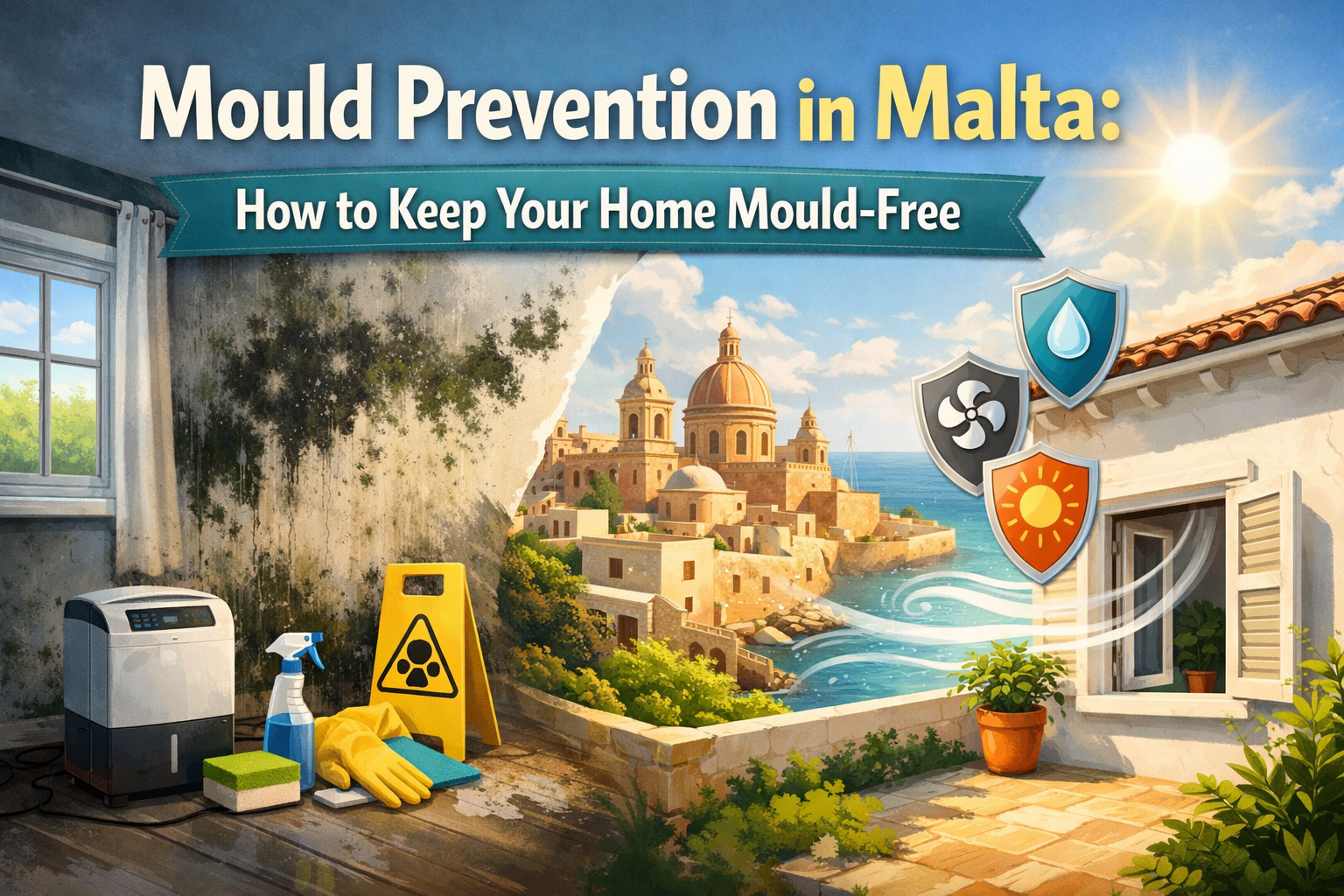
If you’ve lived in Malta for even one winter, you already know mould isn’t a question of if but where. From the limestone townhouses of Valletta to modern high-rises in Sliema, almost every property on the island faces the same battle. The Maltese even have an affectionate word for it: il-moffa.
In this guide
Why is mould so common in Malta?
Where does mould appear first?
How do you prevent mould in a Malta apartment?
Which products work on Maltese surfaces?
Seasonal mould prevention calendar
Professional mould treatment costs
Why Is Mould So Common in Malta?
Malta’s relative humidity averages 75% year-round and peaks at 85–95% between October and February, according to climate data from the Water Services Corporation Malta. That alone creates ideal mould conditions — but three additional factors make the island uniquely vulnerable.
🧱 Limestone walls absorb and hold moisture.
Most Maltese buildings use globigerina limestone, a porous sedimentary rock that acts like a sponge. During humid months, thick traditional walls (common in Valletta, Mdina, and the Three Cities) retain dampness for weeks. Modern apartments face condensation from temperature differentials between AC interiors and hot exteriors.
💨 Poor ventilation in many properties.
Older Maltese buildings were designed for natural airflow through high ceilings and internal courtyards, but modern renovations often block original ventilation paths. Ground-floor apartments and north-facing rooms are particularly affected — less sunlight, less air movement, more mould.
🌊 Salt air compounds the problem.
Coastal properties in Sliema, St Julian’s, Bugibba, and Marsaskala face salt-laden air that increases moisture retention on surfaces. Combined with humidity, this creates a micro-environment where mould establishes itself faster than in inland areas like Mosta or Rabat.
Where Does Mould Appear First in Maltese Homes?
Mould in Malta follows predictable patterns. Knowing where to look means catching it early — before surface spots become deep infestations that require professional remediation costing €200–€500.
💡 Pro tip
A digital hygrometer — €10–€15 at Homemate or Smart Supermarket — is the single best early-warning tool. Place one in your bathroom and one in your bedroom. When readings consistently exceed 70%, act immediately: open windows, run a dehumidifier, or both.
Key takeaway: Mould in Malta isn’t a sign of a dirty home — it’s a climate condition. Even spotless apartments develop mould if humidity isn’t actively managed. The difference between a mould-free home and a mould-plagued one is almost always ventilation and monitoring, not cleaning frequency alone.
How Do You Prevent Mould in a Malta Apartment?
Effective mould prevention in Malta combines daily habits, the right products, and seasonal adjustments. Here’s a room-by-room strategy that accounts for the island’s specific conditions.
Ventilation — the single most important habit
Cross-ventilation for 15–20 minutes daily is non-negotiable. Open windows on opposite sides of the apartment to create airflow — cracking a single window in one room achieves very little. During the October-to-February humidity peak, ventilate during the warmest part of the day (11am–2pm) when outdoor humidity is at its lowest. Avoid ventilating on rainy or foggy days, which can actually increase indoor moisture.
If your apartment lacks cross-ventilation (common in single-aspect flats in Sliema and Gzira), a dehumidifier becomes essential. A mid-range unit (€120–€200) with 12–20 litre daily capacity handles a standard 2-bedroom apartment. Run it in the most affected room with doors closed. You’ll be startled by how quickly the collection tank fills — some Malta residents report emptying 3–5 litres per day during winter.
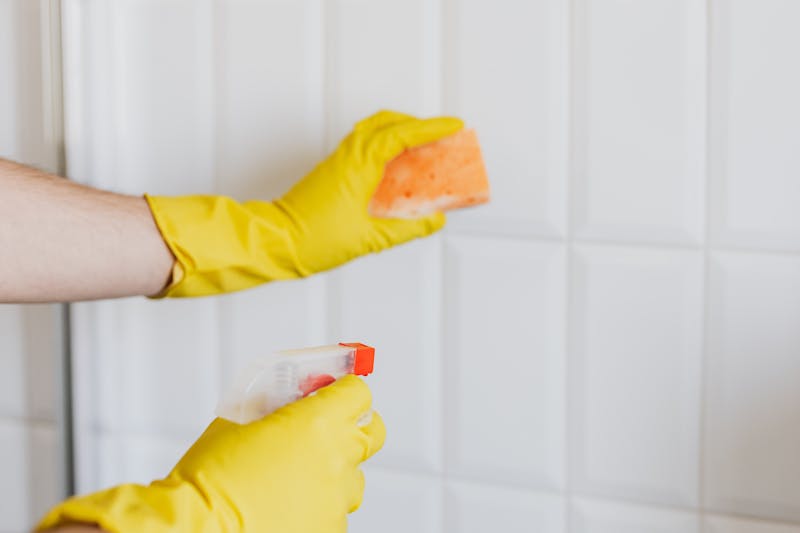
Bathroom — Malta’s mould ground zero
Bathrooms in Malta develop mould faster than in almost any other European country due to the combination of shower steam and ambient humidity that rarely drops below 60%. After every shower, run an extractor fan for at least 20 minutes (if you have one) or leave the window open. Use a squeegee on tiles and glass — this 30-second habit prevents moisture from sitting on surfaces long enough to feed mould spores.
Treat grout lines and silicone seals with a dedicated anti-mould spray (Cillit Bang Black Mould Remover, €4–€6 at PAVI) every two weeks during humid months. Don’t wait for visible black spots — by the time mould is visible, the spore colony is already established. Preventive application is far more effective than reactive cleaning.
For a comprehensive room-by-room approach, our Malta apartment cleaning checklist covers every zone including bathroom-specific mould prevention steps.
Bedrooms and living areas
Move wardrobes and large furniture at least 5–10 cm away from exterior walls. This gap allows air to circulate behind the furniture, preventing the trapped-moisture conditions where mould thrives. In bedrooms, open wardrobe doors for a few hours each week to let air circulate around clothing and leather goods — mould on leather belts, bags, and jackets is one of the most common complaints among Malta expats.
Silica gel sachets (available at Homemate) or even cat litter placed in shallow containers inside wardrobes absorbs excess moisture effectively. Some Malta residents swear by this method — it’s cheap, low-maintenance, and genuinely works for enclosed spaces.
Kitchen
Always use the extractor fan or open a window while cooking. Mediterranean cooking generates significant steam — boiling pasta, simmering sauces — and without extraction, that moisture coats walls, ceilings, and cabinet interiors. Check under the sink monthly for slow leaks, as even a small drip in Malta’s humidity creates a mould colony within days.
Rather skip the DIY? A verified cleaner on Rozie handles mould-prone areas as part of a regular or deep clean — including grout treatment, behind-furniture inspection, and limescale removal that most people skip. It’s 2–3 hours of professional attention that buys you months of mould-free living.
Which Cleaning Products Work for Mould on Maltese Surfaces?
The wrong product on the wrong surface causes permanent damage. Malta’s globigerina limestone is pH-sensitive and acid-reactive — vinegar, which is recommended in countless online mould guides, will etch and dull limestone permanently. Here’s what actually works on the surfaces found in Maltese homes.
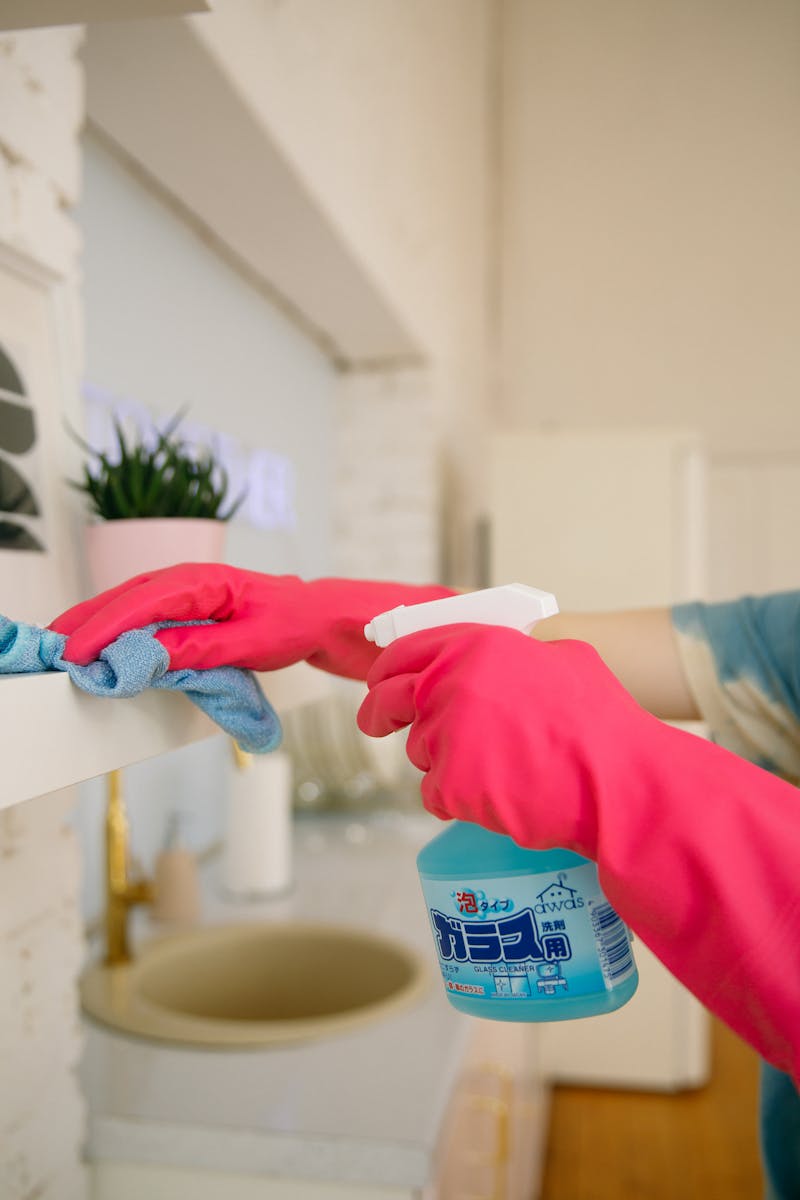
You can find Lithofin and HG products at PAVI, Smart Supermarket, and Homemate stores across Malta. For persistent mould that returns within days despite treatment, the issue is almost always inadequate ventilation rather than insufficient cleaning — no product can outperform a structural moisture problem.
The World Health Organization’s guidelines on dampness and mould confirm that persistent indoor mould is linked to respiratory symptoms, allergic reactions, and asthma aggravation — making prevention a health priority, not just a cosmetic one.
What’s the Seasonal Mould Prevention Calendar for Malta?
Mould prevention in Malta isn’t a one-time project — it follows the island’s climate cycle. Timing your efforts to match seasonal patterns makes prevention far more effective and less expensive than reacting to outbreaks.
If that schedule looks ambitious for your lifestyle, you’re not alone — most Rozie users tell us they’d rather spend their weekend at Golden Bay than inspecting grout lines. A fortnightly professional clean during the October-to-February peak, with mould-prone areas as a specific focus, keeps things manageable without eating into your free time. For a full breakdown of what regular cleaning costs on the island, see our Malta cleaning cost guide.
Finding a reliable cleaner in Malta the traditional way means scrolling through Facebook groups, making phone calls, chasing quotes, and hoping the person who shows up actually does a good job. Most busy professionals don’t have time for that — and it’s exactly the problem Rozie was built to solve. No calls, no chasing. You pick a date, select your extras (like deep cleaning), and within minutes verified cleaners send you competitive offers with exact prices. Every booking is backed by up to €1,000,000 in professional liability insurance underwritten by Lloyd’s. Here’s the full booking process in under 60 seconds:
Get Cleaning Offers on Rozie →
How Much Does Professional Mould Treatment Cost in Malta?
Professional mould cleaning in Malta costs €80–€200 for a standard deep clean that includes mould treatment, depending on the property size and severity. Dedicated mould remediation services (for serious infestations affecting walls and ceilings) range from €200–€500 and involve specialist equipment. Prevention is dramatically cheaper: a fortnightly regular clean at €55–€85 per visit — with specific attention to mould-prone areas — avoids the expensive remediation altogether.
💰 Prevention vs. remediation — the maths
Fortnightly clean (6 months)
€660–€1,020
Mould remediation + repaint
€350–€650
Regular cleaning costs more over six months — but you also get a consistently clean home, not just mould removal. Prevention keeps you healthy and clean. Remediation fixes damage after it happens.
If mould has already established itself on painted walls, expect to budget an additional €50–€150 for repainting with anti-mould paint after the professional clean. On limestone walls, professional treatment using pH-neutral products is essential — DIY attempts with the wrong product (especially vinegar or acidic cleaners) cause irreversible etching that costs €300+ to restore through resurfacing.
For a full breakdown of professional cleaning rates across Malta, including deep cleaning and extras pricing, see our deep cleaning price guide for Malta.
Can You Mould-Proof a Malta Apartment Long-Term?
Complete mould elimination in Malta’s climate is unrealistic — but reducing mould risk by 80–90% is achievable with the right combination of structural improvements and maintenance habits. Here are the most cost-effective long-term investments, ranked by impact per euro spent.
Dehumidifier (€120–€200): The single highest-impact purchase for any Malta apartment. A quality unit with automatic humidity control runs itself — set it to maintain 50–55% relative humidity and empty the tank daily during winter. Some units offer continuous drain options via hose, which eliminates the manual emptying.
Extractor fans (€80–€250 installed): If your bathroom or kitchen lacks mechanical extraction, installing one is a permanent fix that pays for itself within one winter. Choose a unit rated for the room size and ideally one with a humidity sensor that activates automatically.
Anti-mould paint (€25–€45 per 2.5L): When repainting, use a paint formulated with fungicides. Apply after treating any existing mould — painting over active mould does nothing except hide it temporarily. Available at most paint stores across Malta.
Thermal insulation panels (€150–€400 per room): For persistent condensation on exterior walls, calcium silicate panels (like B/SANA, available through local suppliers like Attard Bros) create a thermal barrier that prevents the wall surface from reaching dew point. This is the most effective structural solution for heritage properties in Valletta and the Three Cities.
After any renovation work, including insulation improvements, a thorough post-renovation clean is essential to remove construction dust that would otherwise absorb humidity and accelerate mould growth.
Not enough hours in the day? That’s the #1 reason 22,700+ people across Malta use Rozie to keep their homes clean and mould-free. Verified cleaners, competitive offers within minutes, every booking backed by €1,000,000 professional liability insurance. No phone calls. No guesswork.
Download Rozie — Book in 60 Seconds →

Frequently Asked Questions About Mould Prevention in Malta
Does every apartment in Malta get mould?
Not every apartment, but the vast majority experience some mould growth during the October-to-February humidity peak. Ground-floor units, north-facing rooms, coastal properties, and apartments with poor ventilation are most affected. Even modern buildings in Sliema and St Julian’s develop mould if humidity isn’t actively managed.
Is vinegar safe to use on mould in Maltese homes?
Vinegar is effective on non-stone surfaces like bathroom tiles, glass, and leather. However, it must never be used on globigerina limestone — Malta’s primary building stone is calcium carbonate, which dissolves on contact with acid. Use pH-neutral products like Lithofin MN Wash & Clean on any limestone surface.
How often should I run a dehumidifier in Malta?
During the October-to-February peak, run your dehumidifier daily in the most affected room. Set it to maintain 50–55% relative humidity. During summer months (May–September), you’ll rarely need it unless your apartment has poor ventilation or you live on the ground floor. A mid-range unit costs €120–€200 and typically lasts 5–8 years.
Can a professional cleaner help prevent mould?
Yes — regular professional cleaning that specifically targets mould-prone areas (bathroom grout, behind furniture, window frames, AC filters) is one of the most effective prevention strategies. A fortnightly deep clean during winter months costs €55–€85 per visit on platforms like Rozie, where verified cleaners send you offers within minutes.
What’s the best anti-mould paint available in Malta?
Several anti-mould paints are available through local paint stores. Look for formulations containing built-in fungicides — brands like Dulux, Leyland, and local suppliers all offer mould-resistant options at €25–€45 per 2.5L tin. Apply only after treating and completely removing existing mould from the surface.
Is mould in Malta a landlord’s responsibility?
Under Malta’s Private Residential Leases Act (Cap. 604), landlords are responsible for structural maintenance, which includes addressing causes of mould such as leaking pipes, inadequate ventilation, or missing damp-proofing. Mould caused by tenant behaviour (drying clothes indoors without ventilation, never opening windows) is typically the tenant’s responsibility. Document mould issues with photos and written communication from the start of the tenancy.
When should I call a professional mould remediation service?
If mould covers an area larger than 1 square metre, appears on multiple walls or ceilings, returns within days despite treatment, or is accompanied by a persistent musty smell even after cleaning — professional remediation is warranted. In Malta, specialist mould removal services cost €200–€500 depending on the extent of the infestation and typically include moisture source identification.
For more Malta cleaning guides, tips, and practical advice, browse the full Rozie cleaning blog.