

A pre-Easter deep clean in Malta typically takes 8–12 hours for an average apartment and costs €80–200 when hiring a professional through a verified platform like Rozie. With March humidity averaging 65–70%, porous globigerina limestone floors, and hard water running at 350–600 PPM calcium carbonate, Maltese homes need a cleaning approach built for local conditions — not generic advice copied from UK or US guides. This room-by-room guide covers everything from limestone-safe product choices to realistic scheduling, so your home is genuinely ready for Easter gatherings without burning your entire weekend.
Contents
- Why does pre-Easter deep cleaning matter in Malta?
- What tools and products do you need for a Malta deep clean?
- How do you deep clean a Malta home room by room?
- Should you DIY or book a professional pre-Easter clean?
- What mistakes ruin a Malta deep clean?
- How do you know your deep clean actually worked?
- Frequently asked questions
Why does pre-Easter deep cleaning matter in Malta?
Easter is Malta’s biggest home-hosting occasion after Christmas, and the tradition of a spotless house before Holy Week runs deep across the islands. A proper deep clean before Easter removes 3–6 months of embedded dust, limescale, and allergens that regular weekly cleaning simply cannot reach — particularly in a climate where 60–80% year-round humidity accelerates mould growth and mineral buildup on every surface.
The timing matters more than most people realise. Malta’s winter months (October through February) bring peak humidity that pushes moisture into soft furnishings, grout lines, and behind appliances. By March, that moisture has left behind mildew spots in bathrooms, musty odours in wardrobes, and a fine film of mineral dust on windows. A deep clean before Easter tackles these accumulated problems in one focused effort rather than spreading ineffective surface cleaning across weeks.
There’s also a practical hosting dimension. If you’re welcoming family for Easter lunch or hosting overnight guests during the long weekend, high-traffic areas like kitchens, bathrooms, and living rooms need to handle increased use. Grease buildup on oven interiors, limescale rings on bathroom fixtures, and dust embedded in upholstery are all immediately noticeable to guests — and all require deep cleaning techniques rather than a quick wipe-down.
For households with children or anyone with respiratory sensitivities, the health payoff is significant. HEPA-filtered deep vacuuming combined with thorough surface sanitisation can reduce household allergens dramatically, making a real difference in bedrooms where you spend 7–8 hours breathing the air. The WHO guidelines on indoor air quality identify dampness and microbial growth as key risk factors for respiratory symptoms and asthma — both prevalent concerns in Malta’s humid climate, especially after Saharan dust events common in late winter.
What tools and products do you need for a Malta deep clean?
A Malta-specific deep clean requires pH-neutral products for limestone surfaces, a dedicated limescale remover for hard water deposits, and tools designed to handle fine mineral dust rather than just household dirt. Getting the right supplies before you start prevents mid-clean trips to the shops and avoids the most common mistake in Maltese homes: using acidic cleaners on globigerina limestone.
Essential equipment
Your core toolkit should include a vacuum with HEPA filtration (critical for Malta’s fine dust particles), microfiber cloths in multiple colours to avoid cross-contamination between rooms, a scrub brush set with soft and medium bristles, an extendable duster for ceiling fans and high corners, and a quality flat mop system — sponge mops leave too much water on porous limestone floors.
Malta-specific cleaning products
| Surface / Task | What to use | What to avoid | Where to buy in Malta |
|---|---|---|---|
| Globigerina limestone floors | pH-neutral stone cleaner (Lithofin MN Easy Clean, Fila Cleaner) | Vinegar, lemon juice, or any acid-based cleaner — these etch limestone permanently | Homemate, Scan Malta |
| Bathroom limescale | HG Limescale Remover or citric acid solution (diluted, on ceramic and chrome only) | Bleach alone (doesn’t dissolve limescale), abrasive scouring pads on chrome | PAVI, Smart Supermarket |
| Kitchen grease | Alkaline degreaser or baking soda paste for tough spots | Abrasive powder cleaners on stainless steel | PAVI, Homemate |
| Windows (salt spray and mineral deposits) | Distilled water + small amount of dish soap, finished with a squeegee | Standard glass cleaner on hard-water-stained glass (won’t cut through mineral film) | Any supermarket |
| Tile grout | Baking soda + hydrogen peroxide paste, or oxygen bleach solution | Acid-based grout cleaners near limestone borders | PAVI, Klikk |
When to schedule your clean
March in Malta typically brings humidity of 65–70%, lower than the October–February peaks of 75–80%. Aim to schedule your deep clean for a day with lower humidity and some breeze — check the forecast for days when the Gregale (northeast wind) isn’t pushing moisture inland. Morning starts are ideal: natural light reveals dust and streaks far better than artificial lighting, and cleaned surfaces get maximum drying time before evening humidity rises.
If Easter falls in early April, the last two weeks of March offer the best window. Book professional help 2–3 weeks before Easter Sunday — demand for cleaning services in Malta spikes heavily in the final week before Easter, with the best-rated cleaners fully booked 10–14 days out.
How do you deep clean a Malta home room by room?
A systematic top-to-bottom, room-by-room approach prevents re-cleaning surfaces and cuts total time by roughly 25–30% compared to scattered, haphazard cleaning. The sequence below is optimised for Malta’s climate: it prioritises ventilation timing and accounts for drying speeds on limestone and tile surfaces.
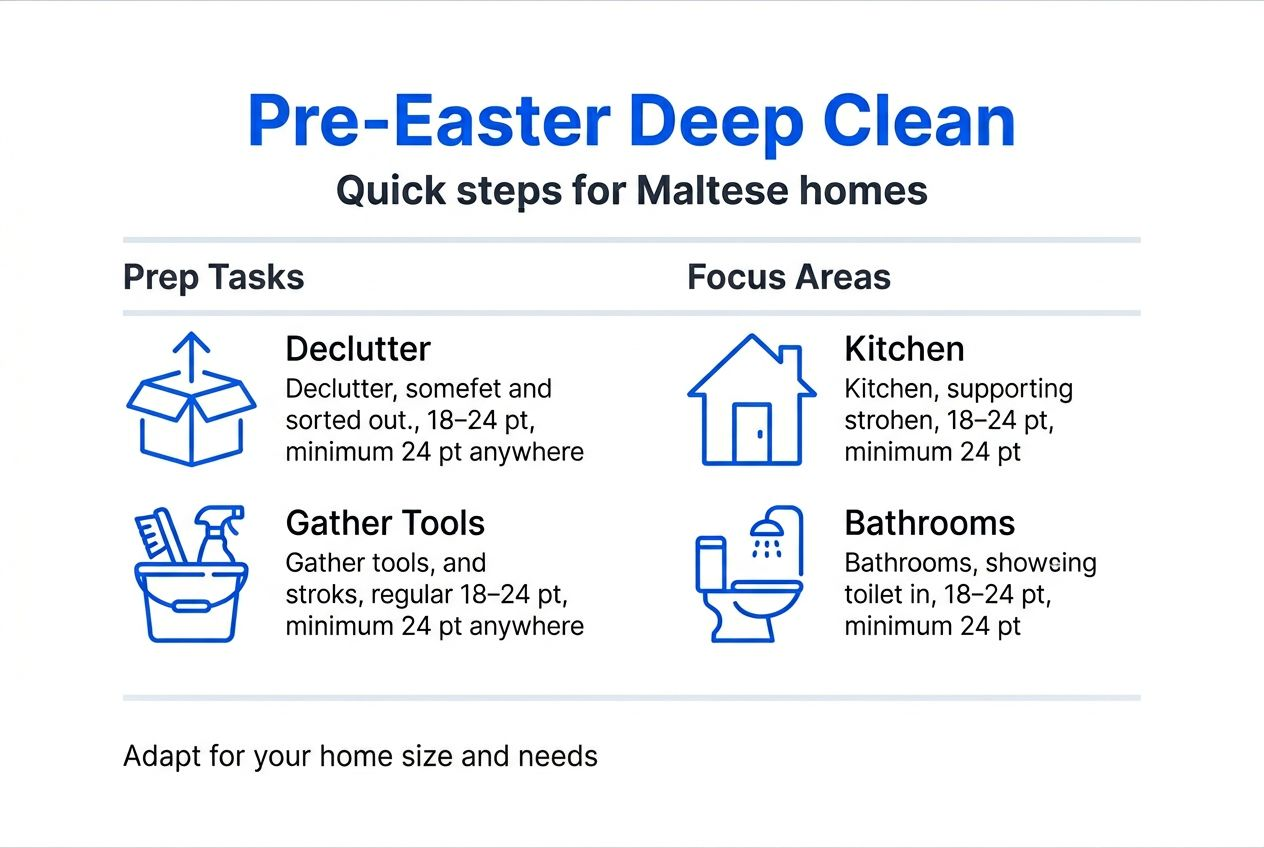
Step 1: Declutter first (30–60 minutes)
Before touching a single cleaning product, walk through every room and clear surfaces. Remove items from countertops, side tables, and bathroom shelves. Sort into keep, donate, and discard piles. You cannot effectively clean around clutter, and attempting to do so adds 20–30% to your total cleaning time. This step alone transforms the feel of a home before any actual cleaning begins.
Step 2: Kitchen deep clean (2.5–3 hours)
Start with the kitchen — it’s the most labour-intensive room and the one Easter guests will spend the most time in. Open windows for cross-ventilation before you begin.
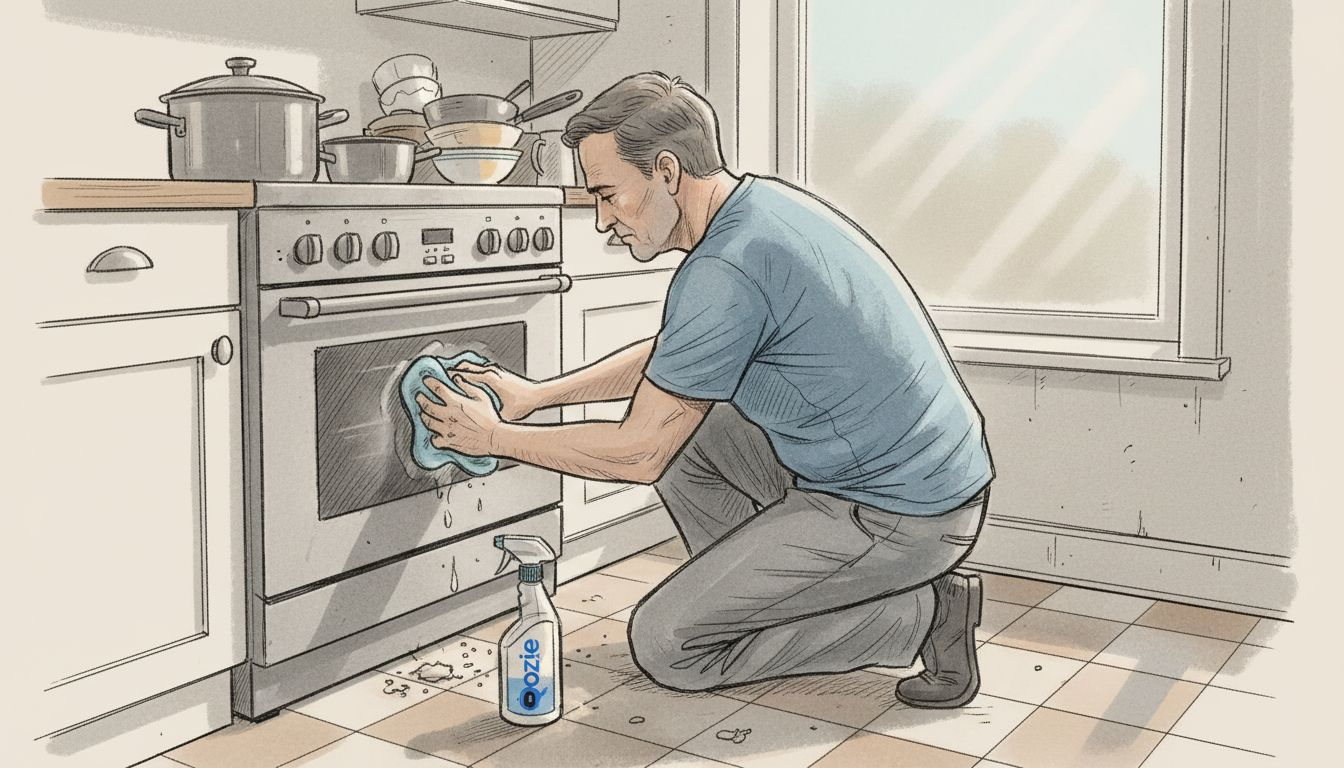
Tackle appliance interiors first, since grease-dissolving products need dwell time. Apply oven cleaner to the interior and close the door, then move to the fridge: empty it completely, remove shelves and drawers, and wipe the interior with a baking soda solution (2 tablespoons per litre of warm water). Clean the microwave by heating a bowl of water with lemon juice for three minutes — the steam loosens splatter for easy wiping.
While oven cleaner works, degrease the stovetop, backsplash tiles, and cabinet fronts. Range hood filters are the most-neglected item in Maltese kitchens — soak metal mesh filters in hot water with dish soap and a tablespoon of baking soda for 15 minutes, then scrub gently. Finish by returning to the oven, wiping down the interior, cleaning the oven door glass (inside and out), and mopping the kitchen floor last.
Step 3: Bathroom deep scrub (1.5–2 hours per bathroom)
Malta’s hard water at 350–600 PPM means limescale is your primary enemy here. Apply limescale remover to showerheads, taps, and tile surfaces and let it sit for 10–15 minutes while you tackle other tasks. Scrub grout lines with a baking soda and hydrogen peroxide paste using an old toothbrush — this is tedious but transforms the entire look of a bathroom.
Clean the toilet thoroughly (including behind the base and under the rim), scrub the shower enclosure or bathtub, and wipe down all cabinet interiors. Check the extractor fan for dust buildup — a clogged fan in Malta’s humid climate is a direct path to mould recurrence. Finish with the mirror and floor, working backwards toward the door.
Step 4: Living areas and bedrooms (2–3 hours)
Vacuum all upholstered furniture using brush and crevice attachments — this removes months of embedded dust and allergens from sofas and armchairs. Wash or steam-clean curtains if possible; at minimum, vacuum them with an upholstery attachment. In Malta’s climate, curtains absorb significant humidity and dust, particularly in coastal areas like Sliema or Marsascala where salt spray compounds the problem.
Wipe down baseboards, door frames, and light switches. Move furniture to vacuum underneath — the dust collected under beds and sofas after a Maltese winter is substantial. Clean windows inside and out, including tracks and sills. Globigerina limestone window sills need gentle treatment: use a soft brush rather than abrasive pads, which can crumble the stone.
Step 5: Floor treatment (1–1.5 hours)
Vacuum or sweep thoroughly before any wet mopping. For limestone tile floors — standard in most Maltese apartments — use a pH-neutral stone cleaner diluted according to the product instructions, applied with a well-wrung flat mop. Excess water is limestone’s enemy: it seeps into the porous stone and can cause efflorescence (white salt deposits) as it dries. Use minimal water and ensure good airflow for quick drying.
For ceramic tile floors, you can use slightly more water and a standard floor cleaner. Pay extra attention to corners and the edges along walls where dust accumulates. High-traffic areas near entrances may need a second pass with a slightly stronger dilution.
Step 6: Ventilation and final inspection (30–45 minutes)
Keep all windows open for at least 2–3 hours after finishing. Position portable fans to create cross-ventilation if there’s no natural breeze. This is especially critical in bathrooms and the kitchen, where residual moisture from cleaning can settle into surfaces and undo your mildew-removal work within days. Walk through each room in good natural light, checking for streaks on windows, missed spots behind appliances, and any areas needing a touch-up.
| Room | Priority tasks | Time estimate | Malta-specific note |
|---|---|---|---|
| Kitchen | Oven interior, fridge, range hood filters, grease on backsplash and cabinets | 2.5–3 hours | Limescale around sink taps; check behind fridge for dust buildup |
| Bathroom | Limescale removal, grout scrubbing, extractor fan, cabinet interiors | 1.5–2 hours each | Hard water deposits require dedicated limescale remover, not general bathroom spray |
| Bedrooms | Mattress vacuuming, under-furniture cleaning, curtain care, wardrobe wipe-down | 1–1.5 hours each | Check wardrobes for humidity-related musty odours; air mattresses on balcony if possible |
| Living room | Upholstery vacuuming, window cleaning, baseboard wiping, furniture moving | 2–2.5 hours | Salt spray residue on coastal-area windows; dust ceiling fan blades |
| Floors | Full vacuum/sweep followed by mopping with appropriate cleaner | 1–1.5 hours | Minimal water on limestone; pH-neutral products only |
Should you DIY or book a professional pre-Easter clean?
A full apartment deep clean takes 8–12 hours of focused work for one person. For a busy professional, that’s an entire weekend gone. Hiring a verified cleaner in Malta costs €80–200 for a typical 2–3 bedroom apartment deep clean, depending on the property’s condition and any extras like oven, fridge, or window cleaning.
When DIY makes sense
If you enjoy cleaning, have a full weekend available, and your home hasn’t accumulated severe buildup, a DIY deep clean can be satisfying and cost-effective. It works best for smaller apartments (1–2 bedrooms) where the total time commitment stays under 8 hours. The essential house cleaning tips for Malta in our separate guide cover the techniques in detail.
When hiring a professional saves you money (and sanity)
For homes larger than 2 bedrooms, properties that haven’t had a deep clean in 6+ months, or anyone who simply values their weekend time, professional help delivers better results in less time. Professional cleaners bring commercial-grade equipment and know how to handle Malta-specific challenges — they won’t accidentally etch your limestone with the wrong product.
Through Rozie, you can book a verified, background-checked cleaner in a few taps. The app shows transparent pricing before you confirm, so there are no surprise charges. You select extras like oven cleaning, fridge interior, inside windows, balcony, or terrace — and the cleaner arrives prepared for exactly what you need. Payment is protected for 7 days, and you can communicate directly through in-app chat to specify priority areas or share access details.

Pre-Easter deep clean cost comparison
| Approach | Estimated cost | Time investment | Result quality |
|---|---|---|---|
| Full DIY | €30–60 (products and supplies) | 8–12 hours of your time | Good if you have the right products and technique |
| Professional via Rozie (1–2 bed apartment) | €80–150 | 0 hours — you’re free | Excellent — verified cleaners with local expertise |
| Professional via Rozie (3+ bed / villa) | €150–300 | 0 hours | Excellent — may require longer session or two cleaners |
For accurate pricing based on your specific home, the Malta cleaning cost calculator gives personalised estimates by property size and service type.
Tip: Book your pre-Easter clean at least 2 weeks before Easter Sunday. Malta’s top-rated cleaners on Rozie fill up fast during the holiday period, and early booking gives you the widest choice of time slots and professionals.
What mistakes ruin a Malta deep clean?
The most expensive mistake in a Maltese deep clean is using acidic products on globigerina limestone. Vinegar, lemon juice, and commercial bathroom cleaners with hydrochloric acid react with the calcium carbonate in limestone, causing permanent etching and discolouration that no amount of polishing can reverse. The Natural Stone Institute recommends only neutral, non-acidic cleaners for all calcareous stones including limestone. Always check product pH before applying to any stone surface — it should be between 7 and 9.
Seven mistakes to avoid
Cleaning windows on a humid or sunny day. In Malta, direct sun causes cleaning solution to evaporate before you can squeegee it off, leaving mineral streaks. High humidity slows evaporation too much, trapping moisture. The sweet spot is an overcast morning or late afternoon when the UV index is below 5.
Skipping ventilation during and after cleaning. In Malta’s humidity, moisture from cleaning products and wet surfaces needs active airflow to evaporate. Without cross-ventilation, you’re creating the exact conditions for mould to return within days — especially in bathrooms. Keep windows open for a minimum of 2–3 hours after finishing.
Using too much water on limestone floors. Excess water seeps into porous globigerina stone and causes white efflorescence marks as it dries. Use a well-wrung flat mop and the minimum amount of diluted pH-neutral cleaner needed. If you see standing water on the floor, you’ve used too much.
Mixing cleaning products. Combining bleach with ammonia-based cleaners produces toxic chloramine gas. Mixing bleach with acid-based products creates chlorine gas. In enclosed Maltese apartments with limited ventilation, this is genuinely dangerous. Use one product at a time and rinse between applications.
Rushing the job. A deep clean attempted in 3–4 hours instead of the realistic 8–12 will leave residue, miss critical areas, and create the illusion of clean that fades within a week. If you don’t have a full day, either spread the work across two sessions or book a professional cleaner through Rozie who can do it properly.
Using too much product. More cleaner does not mean cleaner surfaces. Excess product leaves a sticky residue film that actually attracts dirt faster. Follow dilution instructions on the label precisely, and remember that technique (proper scrubbing, dwell time, rinsing) matters far more than product volume.
Neglecting the “invisible” areas. Behind the fridge, inside range hood filters, under bathroom sinks, and on top of kitchen cabinets — these are the zones where 6 months of buildup creates odours and hygiene issues. If you’re skipping these, you’re doing a surface clean, not a deep clean.
How do you know your deep clean actually worked?
A successful pre-Easter deep clean produces visible, measurable results that last 4–6 weeks before gradual reaccumulation begins. Here’s what to look for when you’ve finished — or when evaluating a professional cleaner’s work.
Grout lines should be visibly lighter and closer to their original colour. If grout still looks dark after scrubbing, it may need professional steam cleaning or regrouting — a sign the buildup has gone beyond what manual scrubbing can address.
Bathroom fixtures should shine without visible limescale rings or water spots. Run your finger along chrome taps and showerheads — they should feel smooth, not rough or chalky. In Malta’s hard water environment, achieving this requires dedicated limescale remover, not just general bathroom spray.
Windows should be streak-free from both sides. Test by looking through them at an angle against sunlight — any remaining film or streaks will be immediately visible. Coastal properties in Sliema, St Julian’s, or Marsascala should expect to repeat window cleaning more frequently due to salt spray.
Air quality is the most noticeable improvement. After thorough vacuuming with HEPA filtration, surface sanitisation, and proper ventilation, you should notice a measurably fresher smell — particularly in bedrooms and living areas. The Asthma and Allergy Foundation of America recommends controlling indoor allergens through regular deep cleaning as one of the most effective interventions for improving indoor air quality. If musty odours persist after cleaning, check for hidden mould behind furniture or in HVAC ducts.
Appliance interiors should be free of baked-on residue and unpleasant odours. The oven door glass should be clear (inside and out), the fridge should smell neutral, and the microwave interior should be spotless. These are the areas that separate a genuine deep clean from a superficial one.
For ongoing cleanliness between deep cleans, the spring cleaning tips for busy Malta residents guide covers maintenance strategies that keep your home in good shape without requiring another full deep clean until summer.
Frequently asked questions about pre-Easter deep cleaning in Malta
How much does a pre-Easter deep clean cost in Malta?
A professional deep clean for a 2-bedroom Malta apartment costs €80–150, while 3-bedroom homes and larger properties range from €150–300. Pricing depends on the property’s current condition, number of bathrooms, and any extras like oven, fridge, or window cleaning. Independent cleaners generally charge €10–20 per hour, while agencies charge €15–25 per hour. Through Rozie’s cost calculator, you can get a personalised estimate before booking.
What makes a cleaning product safe for Malta’s limestone surfaces?
Limestone-safe products have a pH between 7 and 9 — neutral to mildly alkaline. Any product with pH below 7 is acidic and will react with the calcium carbonate in globigerina limestone, causing permanent etching and discolouration. Look for labels stating “safe for natural stone” or “pH-neutral.” Brands like Lithofin MN Easy Clean and Fila Cleaner are specifically formulated for limestone and are available at Homemate and Scan Malta.
How far in advance should I book a cleaner for Easter?
Book 2–3 weeks before Easter Sunday for the best selection of verified cleaners and preferred time slots. Malta’s Easter cleaning demand peaks sharply in the final 10–14 days before the holiday, and top-rated professionals on platforms like Rozie fill up quickly. Last-minute bookings within a week of Easter often face limited availability.
How long does a full pre-Easter deep clean take?
For a typical 100–120 square metre Malta apartment, expect 8–10 hours for one person working systematically. Larger homes and villas may need 12+ hours or a team of two cleaners. Breaking the work into two half-day sessions (kitchen and bathrooms on day one, living areas and bedrooms on day two) is more effective than attempting everything in one exhausting marathon.
Can I use vinegar to clean limescale in my Malta home?
Only on ceramic tile, chrome fixtures, and glass — never on limestone. White vinegar effectively dissolves limescale on these surfaces, but its acidity (pH 2–3) will permanently damage globigerina limestone floors, countertops, and window sills. For limescale on stone surfaces, use a dedicated pH-neutral limescale remover designed for natural stone, or a professional cleaning service experienced with Malta’s specific materials.
Is eco-friendly cleaning more expensive in Malta?
Eco-friendly deep cleaning typically costs the same or just €5–10 more per session than conventional cleaning. Many verified cleaners on Rozie include eco-friendly, limestone-safe products as standard without additional charges. The small price difference provides significant value through reduced chemical exposure for your family and protection of porous limestone surfaces that harsh chemicals can damage.
What’s the best time of day to deep clean in Malta?
Start in the morning when natural light best reveals dust, streaks, and missed spots that artificial lighting hides. Morning starts also give cleaned surfaces maximum drying time before evening humidity rises. For window cleaning specifically, avoid midday direct sun (it dries solution too fast, causing streaks) and aim for overcast conditions or late afternoon.
Recommended
- 7 Essential Spring Cleaning Tips for Busy People in Malta | Rozie – Malta’s Best Cleaning Services
- Holiday Home Cleaning Steps for a Spotless Stay | Rozie – Malta’s Best Cleaning Services
- Deep Cleaning Benefits – How It Transforms Busy Lifestyles | Rozie – Malta’s Best Cleaning Services
- Holiday Home Cleaning Malta: Step-by-Step Guide for Expats | Rozie – Malta’s Best Cleaning Services