

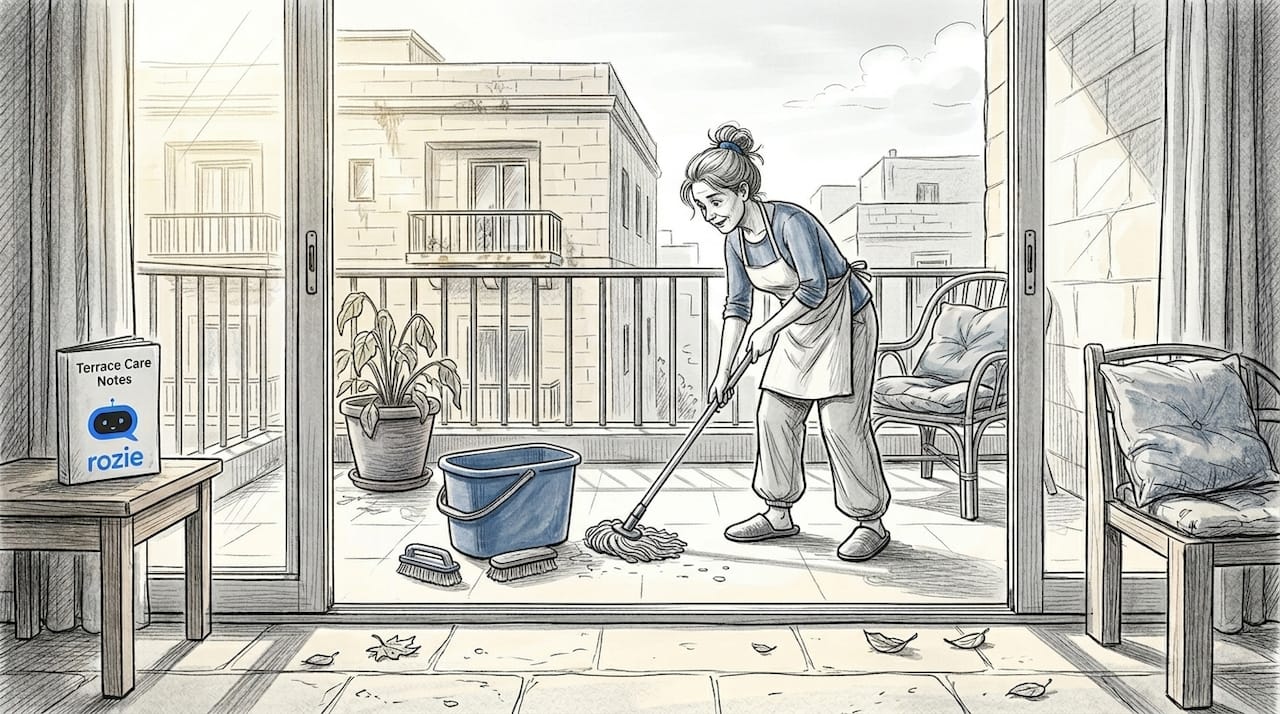
Professional terrace cleaning in Malta costs €10–25 as an add-on to a standard home clean, with a full deep clean running €80–200 depending on property size and condition. Coastal terraces in Sliema, St Julian’s, and Bugibba need fortnightly attention due to salt spray, Saharan dust, and persistent humidity — three factors that make Malta’s outdoor surfaces harder to maintain than almost anywhere else in Europe. This guide covers exactly what terrace cleaning involves, how much you should pay, how often to book, and how to find a verified cleaner who actually knows how to handle Maltese limestone without damaging it.
Table of Contents
- Why is terrace cleaning in Malta different from the rest of Europe?
- What does a professional terrace clean actually include?
- How often should you clean your terrace in Malta?
- How much does terrace cleaning cost in Malta?
- Should you DIY your terrace or hire a professional?
- What should you look for when booking a terrace cleaner in Malta?
- What is the best terrace cleaning checklist for Malta homes?
- Frequently asked questions about terrace cleaning in Malta
Why is terrace cleaning in Malta different from the rest of Europe?
Malta’s climate, geology, and building materials create a combination of outdoor cleaning challenges you simply won’t encounter in northern Europe. The island’s terraces face a year-round assault from salt, mineral-heavy water, extreme humidity, and Saharan dust — each requiring specific products and techniques that generic cleaning advice ignores entirely.
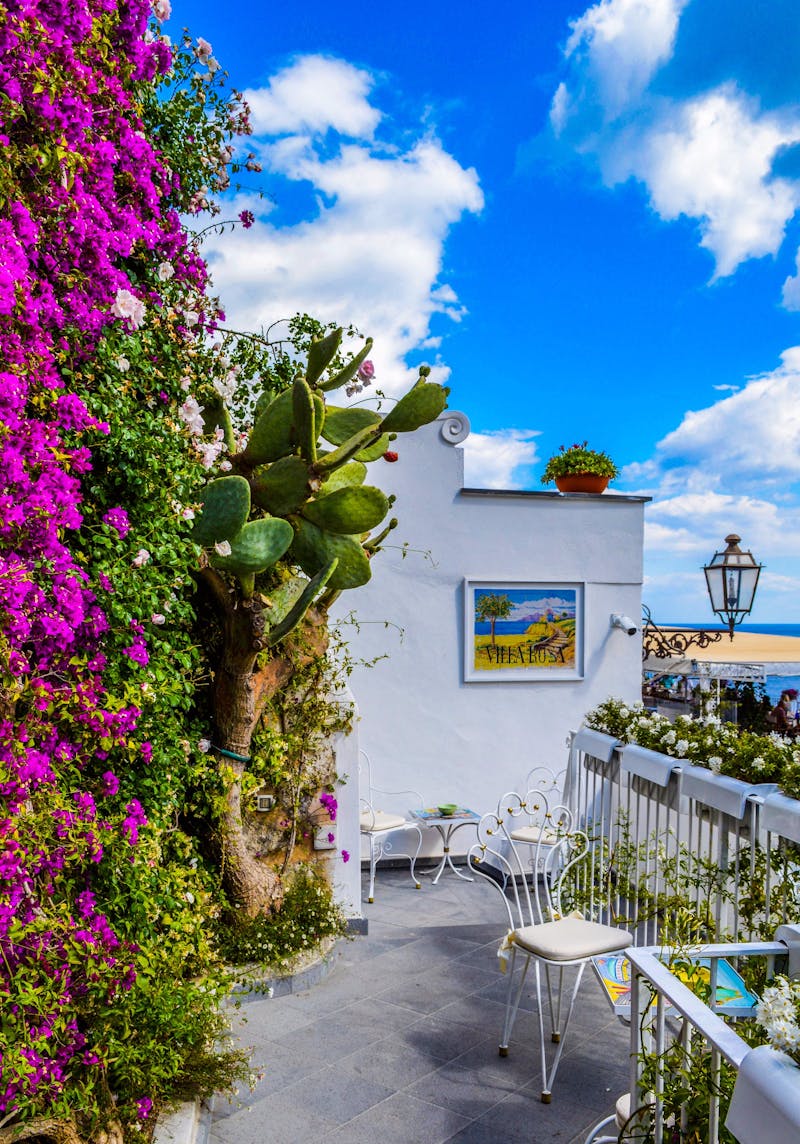
Here is what makes Malta terraces uniquely demanding:
Hard water (200–350 mg/L calcium carbonate). According to the Water Services Corporation Malta, the island’s tap water is rich in calcium and magnesium — minerals that leave chalky white limescale deposits on tiles, railings, outdoor furniture, and drainage outlets. The buildup accelerates on surfaces exposed to sun and evaporation, which describes every terrace on the island.
Humidity above 60% year-round. Malta’s relative humidity ranges from 60–95%, peaking between October and February. The World Health Organization’s guidelines on dampness and mould identify persistent moisture as a primary driver of respiratory health risks from mould exposure — and Maltese terraces with shaded corners, poor drainage, or covered sections are prime mould territory.
Salt air corrosion. Coastal localities like Sliema, St Julian’s, Bugibba, and Marsaskala face constant sea spray that deposits salt on railings, glass, and metal fittings. Left untreated, salt corrodes iron railings and dulls aluminium frames within months.
Saharan dust events (il-qilla). Several times a year, southerly scirocco winds carry fine red-orange Saharan dust across the Mediterranean and coat every outdoor surface in Malta. If the dust is not washed off within 48 hours, it bonds to damp surfaces and becomes significantly harder to remove.
Globigerina limestone. Malta’s traditional building stone is porous and pH-sensitive. Acidic cleaners — including vinegar, citrus-based products, and many supermarket multi-surface sprays — cause permanent etching and discolouration. Terrace tiles made from or laid over limestone need pH-neutral products like Lithofin MN Wash & Clean or HG Natural Stone Cleaner, both available at PAVI, Smart Supermarket, and Homemate stores across Malta.
Key takeaway: Malta’s hard water, salt air, humidity, and acid-sensitive limestone create a “quad threat” for terraces. Generic cleaning advice from UK or US blogs will either fail or actively damage your surfaces. Always use pH-neutral products on Maltese stone — never vinegar.
Book a Terrace Clean on Rozie →
What does a professional terrace clean actually include?
A standard terrace clean covers sweeping, mopping with pH-neutral cleaner, wiping down railings and furniture, and checking drainage — all achievable in 15–30 minutes. A deep clean adds pressure washing, limescale treatment, mould removal, and full drain clearing, and typically takes 1–2 hours depending on terrace size and condition.
| Task | Standard clean | Deep clean |
|---|---|---|
| Sweeping and mopping tiles | ✓ | ✓ |
| Wiping railings and furniture | ✓ | ✓ |
| pH-neutral products on limestone | ✓ | ✓ |
| Checking and clearing drain covers | ✓ | ✓ |
| Pressure washing tiles | ✗ | ✓ |
| Limescale and stain treatment | ✗ | ✓ |
| Mould removal and treatment | ✗ | ✓ |
| Rust-inhibiting treatment on railings | ✗ | ✓ |
| Full drain flush and blockage check | ✗ | ✓ |
| Typical time | 15–30 min | 1–2 hours |
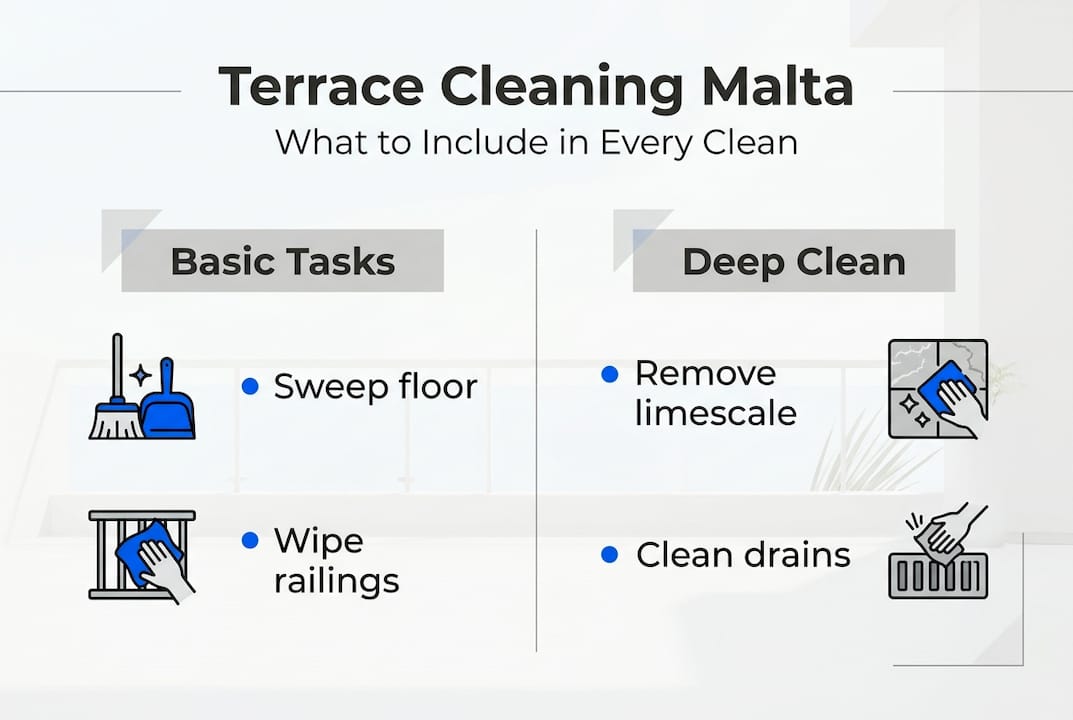
Any cleaner working on a Maltese terrace should know three non-negotiable rules: only pH-neutral products on limestone or natural stone tiles, drain inspection after every clean (Malta’s heavy autumn rains can flood terraces with blocked drains), and rust-inhibiting treatment on iron railings in coastal areas. If a cleaner does not ask about your tile material before starting, that is a red flag.
On marketplace apps like Rozie, terrace cleaning is available as a selectable add-on during booking. The total price updates before you confirm, so you know exactly what you are paying before a cleaner arrives — no surprise charges, no awkward negotiations on the doorstep.
How often should you clean your terrace in Malta?
Coastal terraces in Sliema, Bugibba, and St Julian’s need professional cleaning every two weeks due to accelerated salt and dust buildup. Inland terraces in areas like Rabat, Naxxar, and Mosta can maintain quality with monthly cleaning. Holiday homes should be cleaned before and after every guest stay.
| Location type | Recommended frequency | Extra cleans needed |
|---|---|---|
| Coastal (Sliema, Bugibba, St Julian’s, Marsaskala) | Every 2 weeks | After Saharan dust events, heavy rain, Gregale winds |
| Inland (Rabat, Naxxar, Mosta, Birkirkara) | Monthly | After dust events |
| Holiday homes / short-lets | Before and after each stay | After any vacancy longer than 2 weeks |
If that fortnightly cleaning schedule looks ambitious for your lifestyle, you are not alone — most Rozie users tell us they would rather spend their Saturday at Golden Bay than scrubbing railing salt. Bundling a terrace add-on onto a regular home clean keeps things manageable without adding another task to the to-do list.
Four events should always trigger an unscheduled terrace clean regardless of your regular schedule: visible orange-red Saharan dust coating (usually obvious within hours of an il-qilla event), strong Gregale or scirocco winds carrying sea spray further inland, heavy rain that deposits mud or debris, and any period before guests arrive at a short-let property. Malta’s dust events are tracked and forecasted — booking a clean within 48 hours of the event ending prevents dust from bonding permanently to damp surfaces.
For short-let and Airbnb properties, terrace condition directly affects guest reviews. A dirty terrace with mould on grout lines or salt-encrusted railings is one of the most photographed complaints in guest reviews for Malta listings.
How much does terrace cleaning cost in Malta?
Terrace cleaning in Malta costs €10–25 as an add-on to a standard home clean, or forms part of a full property turnover package priced at €80–200 depending on property size. Deep cleans requiring pressure washing and specialist limescale treatment cost more and can take up to 2–3 hours for large or heavily soiled terraces.
| Service type | Typical cost | Time required | Best for |
|---|---|---|---|
| Terrace add-on (standard clean) | €10–25 | 15–30 min | Regular maintenance, quick refresh |
| Full property turnover (incl. terrace) | €80–200 | 2–4 hours | End-of-tenancy, Airbnb turnovers |
| Deep terrace clean (standalone) | €40–80 | 1–3 hours | Post-dust event, seasonal deep clean |
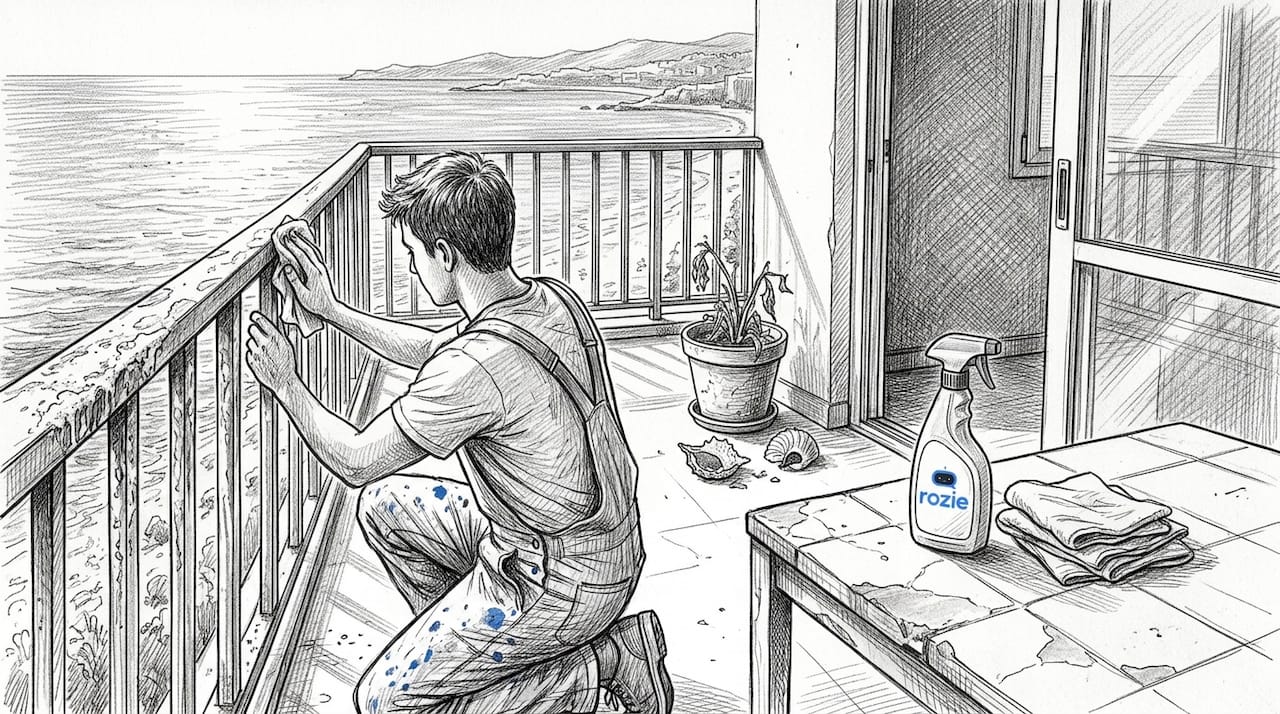
Three factors push costs toward the higher end: coastal location (heavier salt and dust buildup means more labour time), accessibility (rooftop terraces without elevator access take longer), and neglect (a terrace that has not been cleaned in months requires deep-clean-level effort regardless of what you book). For a detailed breakdown of all cleaning rates in Malta, see the complete cleaning cost guide.
On Rozie, you select “terrace” as an extra during booking — the price adjusts in real time before you confirm. There are no hidden costs and no post-booking negotiations. You see the total, you agree to it, and your cleaner arrives prepared for exactly what you booked.
Should you DIY your terrace or hire a professional?
Light maintenance — sweeping, mopping with pH-neutral cleaner, and wiping down furniture — is perfectly safe and effective as a DIY task. Pressure washing, limescale removal, mould treatment, and rust inhibition require professional-grade products and equipment and should be left to experienced cleaners who understand Malta’s specific surface materials.
| Task | DIY safe? | Professional recommended? |
|---|---|---|
| Sweeping and light mopping | ✓ Safe and effective | Not necessary |
| Wiping furniture and railings | ✓ Fine for regular upkeep | Not necessary |
| Pressure washing tiles | ✗ Risk of tile damage at wrong PSI | ✓ Correct PSI for your tile type |
| Limescale and stain removal | ✗ Wrong products cause etching | ✓ Specialist pH-neutral products |
| Drain clearing | ✗ Can miss deeper blockages | ✓ Thorough inspection and flush |
| Mould treatment | ✗ Surface-only fix; regrows fast | ✓ Root-level treatment |
| Rust prevention on railings | ✗ Requires specialist coating | ✓ Rust-inhibiting treatment |
Three things you should never do yourself on a Maltese terrace: use vinegar, lemon juice, or any acid-based cleaner on limestone tiles (causes permanent etching that cannot be reversed), use a pressure washer without knowing the correct PSI for your specific tile type (too high will blast grout out of joints), and ignore rust spots on iron railings (in Malta’s salt air, a small rust patch spreads across an entire railing section within weeks).
Rather skip the DIY? A verified cleaner on Rozie handles everything from the sweep to the drain flush in 20–40 minutes — including the limescale treatment and railing wipe-down that most people put off until it becomes a bigger problem. You select “terrace” as an add-on during booking and the price updates before you confirm.
For a room-by-room approach to your entire apartment — including how the terrace and balcony fit into the full cleaning sequence — see the Malta apartment cleaning checklist.
What should you look for when booking a terrace cleaner in Malta?
The five most important factors when choosing a terrace cleaner in Malta are: verified background checks, limestone-safe product knowledge, transparent pricing before the booking is confirmed, real reviews from previous clients, and experience working in your specific locality (a cleaner who regularly works in Sliema understands salt air in a way someone from an inland area may not).
The most common mistake homeowners make is assuming every cleaner knows how to handle Maltese stone. Many independent operators use general-purpose acidic sprays that are fine on ceramic or porcelain tiles but permanently etch natural limestone. Before booking anyone, confirm they use pH-neutral products on stone surfaces. If they cannot name the product they use, move on.
Finding a reliable cleaner in Malta the traditional way means scrolling through Facebook groups, making phone calls, chasing quotes, and hoping the person who shows up actually does a good job. Most busy professionals do not have time for that — and it is exactly the problem Rozie was built to solve. No calls, no chasing. You pick a date, select your extras (like terrace cleaning), see the final price upfront, and get matched with a verified, background-checked cleaner. Here is the full booking process in under 60 seconds:
Try Rozie Free — See Prices Instantly →
What is the best terrace cleaning checklist for Malta homes?
The most effective terrace cleaning routine in Malta follows a two-tier approach: a standard checklist for every regular clean and a deep-clean addition for monthly sessions or after weather events. Use this checklist yourself for routine upkeep, or share it with your cleaner to set clear expectations before they arrive.
Standard terrace clean (every visit):
Start by sweeping all loose debris, dust, and leaves from tiles — work from the far edge toward the drainage outlet. Mop tiles using a pH-neutral cleaner diluted in water (Lithofin MN Wash & Clean or HG Natural Stone Cleaner are reliable choices available at PAVI and Homemate). Wipe down all railings, walls, and outdoor furniture with a damp cloth. Check and clear drain covers of any debris. Rinse tiles with clean water and allow to air dry.
Deep-clean additions (monthly or after events):
Pressure wash tiles at appropriate PSI for your surface type (limestone requires lower pressure than porcelain — never exceed 1,500 PSI on natural stone). Apply limescale treatment to affected areas, focusing on spots where water pools or evaporates regularly. Treat any visible mould with an outdoor-rated, pH-neutral mould remover — not bleach, which can discolour stone. Flush drains thoroughly to check for deeper blockages. Apply rust-inhibiting treatment to iron railings, paying special attention to joints and bolt points where moisture collects.
Seasonal extras for Malta properties:
After Saharan dust events, rinse tiles before mopping — dry-mopping the fine red dust scratches polished stone surfaces. Before Malta’s October–February humidity peak, check all grout lines for early mould growth and treat proactively. In spring, inspect railings for winter salt damage and treat any new rust spots before they spread. For one-off deep cleans after extended vacancies, book a professional who can handle all checklist items in a single visit.
When booking a professional, share this checklist and confirm which items are included in the quoted price. Clear communication upfront prevents misunderstandings and ensures you get exactly what you paid for.
Not enough hours in the day? That is the number one reason 22,700+ people across Malta use Rozie to book verified cleaners. Every cleaner is background-checked, every price is shown before you confirm, and 7-day payment protection means you are covered if anything falls short. Your terrace deserves better than a quick sweep once a season.

Download Rozie — Book in 60 Seconds →
Frequently asked questions about terrace cleaning in Malta
Can professional terrace cleaning remove Saharan dust and salt stains?
Yes. Professional cleaners use pressure washing at the correct PSI for your tile type combined with pH-neutral cleaning solutions to safely remove Saharan dust deposits and salt stains without damaging limestone or grout. The key is acting within 48 hours of a dust event — once the mineral-rich dust bonds to damp surfaces, removal requires more intensive treatment.
Is it safe to pressure wash limestone terrace tiles?
Limestone can be pressure washed safely at lower PSI settings — generally under 1,500 PSI with a wide-angle nozzle held at least 30 cm from the surface. Higher pressure or narrow nozzles can blast grout from joints and etch the stone surface. An experienced Malta-based cleaner will know the correct settings for globigerina limestone, which is softer and more porous than most European building stones.
How long does a standard terrace clean take?
A standard add-on terrace clean takes 15–30 minutes, covering sweeping, mopping with pH-neutral cleaner, wiping railings and furniture, and checking drain covers. A full deep clean with pressure washing, limescale treatment, and mould removal typically runs 1–2 hours depending on terrace size and condition.
Why should I avoid vinegar on my Malta terrace tiles?
Vinegar is acidic (pH 2–3) and reacts with the calcium carbonate in globigerina limestone, causing permanent etching — dull patches and surface erosion that cannot be reversed. This is one of the most common mistakes in Malta, often caused by following generic cleaning advice from UK or US websites that assumes non-limestone surfaces. Always use pH-neutral products (pH 6.5–7.5) on natural stone.
How often should coastal terraces in Sliema or Bugibba be cleaned?
Fortnightly professional cleaning is the recommended baseline for coastal terraces. Salt spray, humidity, and wind-carried dust accumulate noticeably within two weeks in seafront locations. Additional cleans should be booked after Saharan dust events, heavy rain, or strong Gregale winds that push sea spray further inland.
What is the best way to prevent mould on a shaded Malta terrace?
Ventilation and drainage are the two most effective mould prevention strategies. Ensure water does not pool on tiles after rain by keeping drain outlets clear. Allow air circulation through covered or enclosed terrace areas — solid walls block airflow more than open railings. During Malta’s October–February humidity peak (60–95% relative humidity), check grout lines monthly and treat early mould growth with a pH-neutral mould remover before it spreads.
Can I add terrace cleaning to a regular home cleaning booking on Rozie?
Yes. Terrace cleaning is available as a selectable extra on Rozie. During the booking process, you choose your date and time, then add “terrace” as an extra alongside other options like fridge, oven, or inside windows. The total price updates in real time before you confirm, so there are no surprise charges. For more on what extras are available, see the balcony and terrace cleaning guide.
Browse more guides on keeping your Malta home clean at Rozie’s Malta cleaning resource centre.
Recommended
- How to Choose a Cleaning Service in Malta (2026 Guide)
- Balcony Cleaning Service Malta: Costs, Tips & Booking (2026)
- Top 4 Airbnb Host Cleaning Services in Malta 2026 | Rozie – Malta’s Best Cleaning Services
- Top 8 Window Cleaning Malta Services in 2026 for Busy Professionals Seeking Reliable Solutions | Rozie – Malta’s Best Cleaning Services