

In this guide
Is hiring a cleaner regulated in Malta?
What does it cost to hire a cleaner legally in Malta?
What is a PE number, and do I need one?
Direct hire vs marketplace: how do the legal obligations differ?
What are the risks of hiring informally through Facebook groups?
How do I hire a cleaner safely and legally in Malta?
Most Malta residents who hire a cleaner do it the same way: a Facebook post, a friend’s WhatsApp number, a quick agreement on hourly rate, cash on the kitchen table. It feels simple. But if that cleaner comes back week after week on a schedule you set, using your products, in your home, the law in Malta starts to look at the arrangement differently — and so does the tax department.
This guide walks through what hiring a cleaner in Malta actually involves in 2026: the legal framework, the real cost of compliance if you hire directly, the PE number question, and how marketplace platforms change the legal picture entirely. The aim is to help you make an informed decision before someone has access to your home.
Is hiring a cleaner regulated in Malta?
Yes. Cleaning work in Malta sits inside a defined legal framework. The Employment and Industrial Relations Act (Cap. 452) provides the general rules, and two specific Wage Regulation Orders (WROs) apply directly to cleaners: Subsidiary Legislation 452.40 (Domestic Service) and Subsidiary Legislation 452.76 (Private Cleaning Services). These set minimum wages, working hours, leave entitlements, and overtime rules for the sector.
The distinction between the two WROs matters. S.L. 452.40 covers domestic service — cleaners working inside private households on a regular basis. S.L. 452.76 covers cleaners employed by private cleaning service companies. If you engage a cleaner directly on a recurring schedule, you are most likely in the domestic service category, which carries household-employer obligations. The Department of Industrial and Employment Relations (DIER) publishes the current wage rates and conditions for each sector.
Why this matters in practice.
The “informal cash arrangement” most households use isn’t unregulated — it’s just non-compliant. If the relationship looks like employment (regular hours, your direction, your tools, your home), the legal obligations apply whether or not anyone has registered them.
What does it cost to hire a cleaner legally in Malta?
The legal floor in 2026 is €229.44 per week — roughly €994 per month for a full-time employee aged 18 or over. That figure comes from DIER’s official national minimum wage rates, which took effect on 1 January 2026 and include the annual Cost of Living Adjustment plus the increase under the 2023 National Agreement.
Direct full-time employment, however, doesn’t stop at the headline wage. On top of the basic rate, employers in Malta must pay statutory bonuses (€135.10 twice a year), allowances (€121.16 twice a year), employer social security contributions of around 10% of gross pay, paid annual leave (216 hours in 2026 for a 40-hour week), and paid sick leave. Most households don’t need a full-time cleaner. They need a few hours a week, which can be pro-rated — but the per-hour cost of legal employment is still meaningfully higher than the cash figure most people benchmark against.
The rates shown are 2026 figures for indicative comparison. For a deeper breakdown of how cleaning prices in Malta are typically built up — by home size, locality, and extras — see the Malta cleaning cost guide.
What is a PE number, and do I need one?
A PE number is your Permission to Employ registration — the identifier the Office of the Commissioner for Revenue issues to anyone who employs another person in Malta. If you engage a cleaner as a domestic employee rather than as an independent service provider, you are expected to register as their employer and obtain a PE number before they start work. That registration is what lets you submit FS3/FS5 forms, deduct income tax under the FSS system, and pay employer social security contributions.
The grey area most households fall into is whether a few hours a week counts as employment at all. The honest answer is: it depends on the substance of the arrangement, not the label. Regular schedule, your home, your supplies, your direction — those facts point toward employment. Occasional one-off work where the cleaner brings their own products, sets their own scope, and invoices you points toward a self-employed services relationship. When in doubt, the safe path is either to formalise (PE number, contract, payroll) or to book through a marketplace where the cleaner operates as an independent service provider.
Pro tip
If your cleaner already has a self-employment registration with Jobsplus and the Commissioner for Revenue, the relationship can legitimately be a service contract rather than employment. Ask to see their self-employed registration before assuming.
Direct hire vs marketplace: how do the legal obligations differ?
The single biggest practical question for most Malta residents is whether to hire a cleaner directly or book through a platform. The cost difference is real, but the legal difference is usually larger. When you book through a marketplace like Rozie, the cleaner sending offers is operating as an independent service provider running their own work. You are buying a defined service (a clean on a specific date for an agreed price), not engaging an employee. The platform handles vetting, payment, and dispute resolution.
When you hire someone directly on a recurring basis, you take on the employer position — and that comes with paperwork, tax filings, leave administration, and exposure if anything goes wrong. For full-time arrangements that workflow can be worth it. For three hours a week, it almost never is.
Where the legal weight actually sits
Direct recurring hire
Employer role
PE number, FSS, SSC, leave, bonuses
Marketplace booking
Service customer
Pay per job, no payroll obligations
For most Malta households, the marketplace route removes the legal complexity without sacrificing reliability — provided the platform actually verifies cleaners and protects payments.
What are the risks of hiring informally through Facebook groups?
The informal route is the most common path in Malta and the most risky one. The cleaner you found through a community group probably has no business registration. There is no contract, no insurance, no record of payment, and no way to verify they are authorised to work in Malta. If something goes wrong, your options are limited and your exposure is the opposite.
- No liability cover. If the cleaner damages a limestone counter or scratches a glass panel, you absorb it. Independent cleaners almost never carry professional liability insurance.
- No background verification. You are giving someone keys to your home based on a phone number and a profile photo.
- Tax exposure. If the arrangement becomes regular and someone classifies it as undeclared employment, the unpaid social security contributions and any penalties fall on you as the household employer.
- No backup. When a single cleaner cancels or stops responding, there is no replacement. For Airbnb hosts and busy parents, this is a real operational risk.
- No dispute resolution. Cash arrangements leave both sides without recourse. There is no platform to mediate, no documented service spec, and no payment protection.
Malta is genuinely a safe place to live — but personal safety doesn’t substitute for the contractual and insurance protections you’d expect when a stranger is in your home for several hours a week. The UK Foreign Office’s travel guidance for Malta notes low overall crime levels, which is reassuring background context, but it doesn’t change the specific risk math of an unverified domestic worker arrangement.
How do I hire a cleaner safely and legally in Malta?
Whether you go the direct-employment route or the marketplace route, the same practical checks apply. The goal is to land on an arrangement where the cleaner’s status is clear, your obligations are documented, and there’s a recovery path if something doesn’t go as expected.
- Decide your hiring model first. Recurring full-time cleaner = employment, with all the obligations that follow. Per-job booking through a marketplace = service relationship. Don’t try to have both at the same time.
- If hiring directly, register before they start. Apply for a PE number through the Commissioner for Revenue. Get a written contract specifying hours, rate, leave, and notice period. Set up a way to pay social security contributions.
- If using a platform, check that verification is real. Background checks, identity verification, payment protection, and insurance should be platform features, not marketing language. Ask what the platform actually does, not what it claims.
- Document the property condition. For end-of-tenancy work especially, take timestamped photos before and after. This protects your deposit and gives the cleaner clear evidence of what was delivered.
- Start with a trial booking. For any new arrangement — direct hire or marketplace — be present for the first clean. It’s the easiest way to confirm whether the fit works before handing over keys.
- Confirm insurance coverage. A platform-based booking should include liability cover that applies during the service. A direct hire usually carries none unless the cleaner is independently insured.
Key takeaway: The cheapest hire in Malta is rarely the cheapest cleaning. Cash-in-hand arrangements that don’t account for legal exposure, insurance, or backup cover can become expensive quickly when something goes wrong.
For most households, the lowest-friction path is using a verified platform. For specifics on what to look for in a provider, see the Rozie guide to choosing a reliable cleaning company in Malta and the deeper breakdown in finding a trusted cleaner near you.
How does Rozie handle the legal and verification side?
Most Malta residents who try to do this properly run into the same wall: finding a cleaner who is verified, available on your schedule, and operating as a registered self-employed service provider rather than a cash-only arrangement is genuinely hard if you’re working through Facebook groups and phone numbers. The traditional route means hours of calls, vague quotes, and uncertainty about who is actually authorised to do the work.
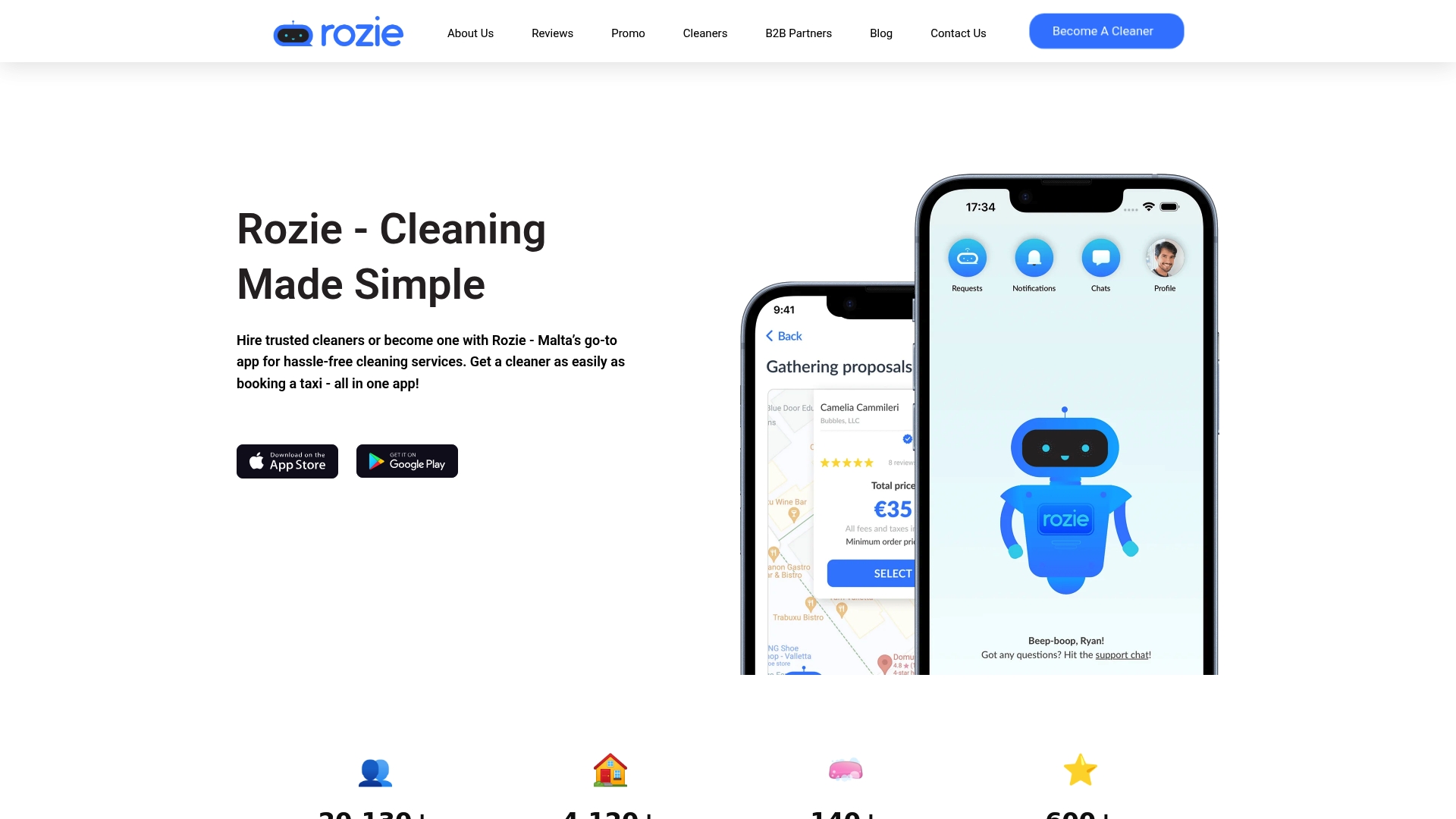
Rozie was built to remove that friction. You post the job once, verified cleaners send you offers within minutes with exact prices, and every booking is backed by 7-day payment protection and professional liability cover up to €1,000,000 per occurrence underwritten by Lloyd’s Insurance Company S.A. — Rozie covers the deductibles, so you pay no excess if something happens. Each cleaner on the platform is vetted before being listed, which means you’re booking a verified independent service provider rather than entering an undeclared employment relationship.
Here is the full booking process in under 60 seconds:
Compare Cleaning Offers on Rozie →
Pro tip
Before your first booking, write out exactly what you want cleaned — including extras like fridge, oven, inside windows, or balcony. The clearer your job description, the more accurate the offers you receive, and the less chance of mid-job pricing disputes.
If you want to explore more cleaning-related guides for Malta, browse the full cleaning in Malta archive.
The short version: If you need a cleaner for three hours a week or an Airbnb turnover, marketplace booking is almost always the right call. If you need a full-time live-out cleaner who functions as part of the household, you’re hiring an employee — and the PE number, contract, and payroll setup are not optional.
Book a Verified Cleaner on Rozie →
Frequently asked questions
Do I really need a PE number to hire a cleaner in Malta?
If you engage a cleaner as a domestic employee on a regular schedule, yes — household employers in Malta are expected to register with the Commissioner for Revenue and obtain a PE number to handle FSS tax and social security contributions. If you book through a marketplace where the cleaner operates as an independent service provider, you don’t need one because there’s no employment relationship.
What is the minimum wage for a cleaner in Malta in 2026?
The national minimum wage for full-time employees aged 18 and over is €229.44 per week, effective from 1 January 2026, which works out to roughly €994 per month. Specific Wage Regulation Orders for domestic service (S.L. 452.40) and private cleaning services (S.L. 452.76) may set additional sector-specific minimums, plus statutory bonuses and allowances on top.
Is it illegal to pay a cleaner in cash in Malta?
Cash payment itself isn’t illegal, but undeclared regular employment is. The issue isn’t the payment method — it’s whether the arrangement is registered, whether the cleaner is operating as self-employed or as an employee, and whether the legal obligations (minimum wage, SSC, leave) are being met. Cash arrangements are usually red flags because they typically signal that none of those conditions are documented.
What does Rozie’s insurance actually cover?
Eligible bookings on Rozie include Trust & Support protection for accidental property damage and bodily injury caused directly by the cleaner during the booked service. Cover is provided through professional liability insurance up to €1,000,000 per occurrence, underwritten by Lloyd’s Insurance Company S.A. Rozie covers all deductibles, so users pay no excess. Terms, exclusions, evidence requirements, and reporting timeframes apply.
How quickly can I get a cleaner through Rozie?
Most cleaning requests on Rozie receive offers from verified cleaners within 5–15 minutes of posting. Same-day cleans depend on local availability, but next-day bookings are typical across most Malta localities. You compare offers and accept the one that fits your budget and timing.
What’s the difference between hiring a cleaner directly and going through an agency?
Hiring directly means you become the employer with all the legal obligations that follow — PE number, contract, leave, SSC. An agency handles employment on its own side and charges you a service fee that typically lands in the €15–€25/hr range. A marketplace like Rozie sits between the two: cleaners are independent service providers sending job-specific offers, so you pay per clean without taking on employer status, but rates can be more competitive than agency pricing because there is no fixed margin.
Can I trust cleaners I find on Facebook groups in Malta?
Some are excellent, many are reliable, and some are not. The structural problem isn’t the people — it’s that there’s no verification, no background check, no insurance, and no recourse if something goes wrong. If you do use a Facebook recommendation, ask for evidence of self-employment registration with Jobsplus and the Commissioner for Revenue before agreeing to recurring work, and start with a trial booking when you’re present.