

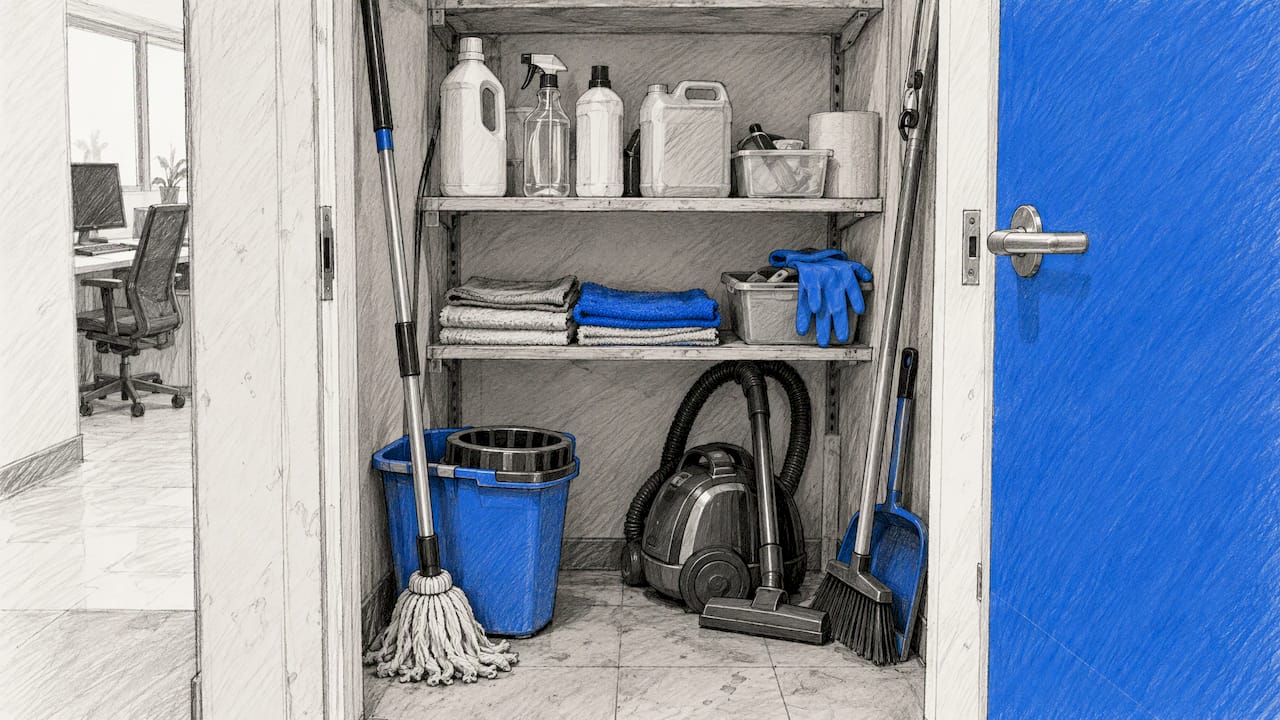
A good office cleaning kit comes down to five groups: cleaners and disinfectants, wiping and floor tools, paper and soap products, waste supplies, and basic protective gear. Get those right and a small office can stay tidy with a closet’s worth of stock. Below is the full list, what each item is for, how much to keep on hand and how to use it safely.
We see offices of every size through Rozie, and the pattern is the same: the teams that stay on top of cleaning are not the ones with the most products. They are the ones who know what each product is for and who restock before the shelf is empty.
TL;DR
- Start with a neutral all-purpose cleaner, a disinfectant for high-touch points, glass cleaner and a degreaser for kitchen areas.
- Microfiber cloths, a mop and bucket, a broom and dustpan, a vacuum and wet-floor signs cover almost every surface and floor.
- Stock enough to clean the whole office at least twice before you reorder, and keep paper, soap and liners topped up.
- Read the label and the Safety Data Sheet: disinfectants only work if they stay wet on the surface for their stated contact time.
- If supplies, time or storage are the problem, a verified cleaner can bring their own kit.
Table of Contents
- The core office cleaning products list
- Tools and equipment for routine cleaning
- Paper, soap and waste supplies
- Protective gear and safety supplies
- Using disinfectants properly
- What to clean, and with what
- Building your kit by office size
- Our perspective
- When it makes sense to bring in a cleaner
- Book a verified office cleaner in Malta
- FAQ
- Sources
The core office cleaning products list
This is the shortlist most offices need. Anything beyond it is a specialty item for a particular surface or a particular problem.
| Product | What it is for | Where it earns its place |
|---|---|---|
| Neutral all-purpose cleaner | Everyday soil on desks, counters, doors, walls | Every room |
| EPA-registered disinfectant or wipes | High-touch points after cleaning | Switches, handles, phones, keyboards |
| Glass and mirror cleaner | Windows, partitions, mirrors | Reception, meeting rooms, restrooms |
| Degreaser | Grease and food residue | Kitchenette, microwave, fridge exterior |
| Floor cleaner | Hard floors | Corridors, entrance, kitchen |
| Toilet bowl cleaner and brush | Bowls and under the rim | Restrooms |
| Odor eliminator | Bins, restrooms, shared fridge | Restrooms, kitchenette |
| Hand soap and sanitizer | Hygiene | Restrooms, entrance, kitchen |
The general shape of this list matches what a home-improvement retailer’s office checklist recommends: surface cleaners and all-purpose disinfectants, degreasers, floor cleaners, mold and mildew removers, toilet cleaners, odor eliminators, trash cans with liners and paper towels. A commercial cleaning equipment maker’s supplies list adds glass cleaners, stain removers, spray bottles, dusters and dust masks.
Cleaner or disinfectant: they are not the same job
Cleaning removes dirt, grease and organic material. Disinfecting kills germs on a surface that is already clean. The CDC’s guidance on cleaning supplies names liquid soap, enzymatic cleaners and detergents as the products that lift organic material and suspend grease through water, scrubbing and friction. For most environmental cleaning it recommends a neutral detergent with a pH of 6 to 8 that dissolves readily in warm and cold water.
In practice that means: clean first with your neutral all-purpose cleaner, then disinfect only the surfaces people touch most. Spraying disinfectant on a dusty desk wastes product and does little.
Pick a few products and do them well
A cupboard full of single-purpose bottles is a common mistake. Match each product to a surface and a goal, and check that the cleaner is compatible with what you are cleaning. One janitorial checklist recommends matching general-purpose cleaners, floor cleaners, degreasers, disinfectants and odor-control products to the surface and the cleaning objective, while checking compatibility, contact time and Safety Data Sheets.
Tools and equipment for routine cleaning
Products do half the work. The other half is the tool in your hand.
Cloths, dusters and wipes
- Microfiber cloths: the workhorse for desks, screens’ surrounds, glass and counters. Buy plenty so you can swap a clean one in often.
- Microfiber duster with an extension pole: for blinds, vents, shelves and tops of cabinets.
- Disposable cloths or wipes: for restrooms, where you do not want to carry germs back to a reusable cloth.
- Scrubbing pads and a soft brush: for kitchenette sinks and stubborn marks.
- Spray bottles, clearly labeled: if you dilute concentrates, label every bottle with the product name and date.
For bulk wiping needs, some offices and facilities teams buy industrial wiping rags by the bale instead of paper towels for heavy-duty jobs. Even so, keep a separate, color-coded set for restrooms and another for the kitchen.
Floor care
- Mop and bucket (or a flat microfiber mop system): one for general floors, a separate head for restrooms.
- Broom and dustpan, plus a dust mop: for hard floors before wet mopping.
- Vacuum cleaner: a HEPA-filter model is worth it if you have carpet and people with allergies. The CDC notes HEPA-filter vacuums as an addition to routine supplies where policy requires them.
- Wet-floor signs: the CDC lists buckets, mops or squeegees with floor cloths, and wet-floor or caution signs among its basic floor-cleaning supplies. The University of South Carolina’s routine office checklist requires a safety sign before any floor work.
- Floor scrubber or buffer: only for large offices with big hard-floor areas.
Carts and organization
A small cleaning cart sounds like a luxury until you stop walking back to the closet eight times per cleaning. The same janitorial checklist notes that carts and route-specific organization improve efficiency, and that color-coding helps prevent accidental transfer between areas. Even a two-person office benefits from a simple rule: red cloths for restrooms, blue for desks, green for the kitchen.
Paper, soap and waste supplies
These are the items people notice most when they run out.
- Toilet paper, hand soap, hand sanitizer and paper towels: the home-improvement checklist lists all four as the restroom and kitchen staples.
- Trash cans and can liners: buy liners in the sizes your bins actually take, and keep a spare roll in each bin base.
- Tissues and napkins: often forgotten, then needed during a client visit.
- Air fresheners or odor neutralizers: use these after the cause is cleaned, not instead of cleaning.
A workplace supplier’s facility catalogue groups this category the same way: mops and wiping products, soaps and sanitizers, paper products, air fresheners, restroom products, cleaning and disinfecting solutions, trash-can liners, and safety and PPE products. It is a handy way to arrange your own storage shelves too.
How much to keep in stock
The retailer’s checklist suggests keeping enough supplies to clean the entire office at least twice before replenishing. That buffer covers a late delivery or a busy week. Write the reorder point on the shelf itself, for example “reorder when one roll of liners is left.”
Protective gear and safety supplies
Cleaning products are chemicals, and a few inexpensive items keep your team comfortable and safe.
- Disposable gloves and rubber gloves: the CDC lists rubber gloves, masks and wet-floor signs among useful safety supplies.
- Eye protection: the University of South Carolina checklist specifies safety glasses, goggles or a face shield when you are splashing or spraying.
- Dust masks: useful when dusting high shelves or emptying a vacuum.
- Enhanced cleaning gear: for a deeper clean after an illness outbreak, the university’s enhanced cleaning checklist adds a HEPA vacuum, a disposable gown or liquid-splash suit and an N95 respirator alongside eye protection and gloves.
Never mix cleaning products. Do not combine bleach-based products with other cleaners unless the label says it is safe, and store everything in its original container with the label facing out.
Labels and Safety Data Sheets
In the United States, OSHA’s Hazard Communication standard requires employers to give employees information about the hazardous chemicals they are exposed to. For an office, that practically means keeping the Safety Data Sheet for each product somewhere your cleaning staff can find it, and keeping product labels intact. Outside the U.S., check your own country’s workplace chemical rules.
Using disinfectants properly
This is where most offices lose the benefit of the product they bought.
- Clean first. Wipe visible dirt off with your neutral cleaner.
- Apply the disinfectant to the surface so it is visibly wet.
- Wait the full contact time. The EPA explains that contact time is how long the product needs to work, and it is on the label (see the EPA’s disinfectant guidance). The University of South Carolina checklist says the same: the disinfectant must stay on surfaces for the manufacturer’s specified dwell time.
- Let it dry or wipe as directed, and check whether the surface needs a rinse (food-contact surfaces often do).
Choose an EPA-registered product for the surfaces you plan to treat, and read the label for which surfaces it is approved for.
What to clean, and with what
The university checklist lists the high-touch points that deserve the most attention: light switches, thermostats, blinds, doors and handles, windows, phones, monitors, keyboards, mice and non-upholstered chairs. Here is a simple map.
| Surface | Product | Tool |
|---|---|---|
| Desks and tables | Neutral cleaner, then disinfectant on high-touch areas | Microfiber cloth |
| Keyboards, phones, mice | Disinfecting wipe approved for electronics | Disposable wipe |
| Glass and mirrors | Glass cleaner | Microfiber cloth or squeegee |
| Hard floors | Floor cleaner | Dust mop, then mop and bucket |
| Carpet and mats | Vacuum | Vacuum with HEPA filter if possible |
| Kitchenette | Degreaser, then disinfectant | Scrub pad, cloth |
| Restrooms | Toilet bowl cleaner, disinfectant | Brush, color-coded cloths |
| Bins | Odor neutralizer | Fresh liner |
A daily and weekly rhythm
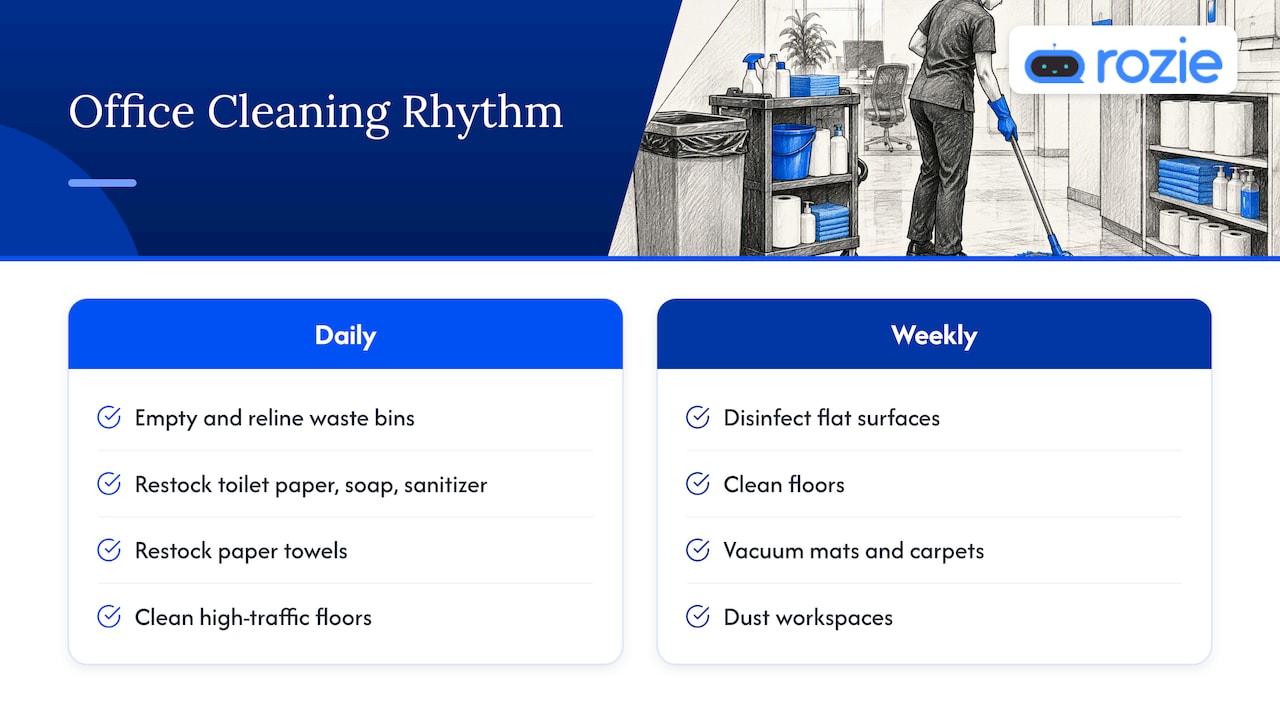
The retailer’s checklist describes a daily routine that includes emptying and relining waste bins, restocking toilet paper, soap, sanitizer and paper towels, cleaning high-traffic floors, disinfecting high-touch points, removing food waste, cleaning drinking fountains or water coolers, and disinfecting both sides of toilet seats. Its weekly routine covers disinfecting flat surfaces, cleaning floors, vacuuming mats and carpets, dusting workspaces, cleaning refrigerator and microwave interiors, cleaning glass and mirrors, sanitizing restroom fixtures and buffing high-traffic floors.
If you want to turn this into a real schedule, our guide on making your office cleaning schedule ready for a two-week pilot walks through it, and our office cleaning tips for busy professionals cover the shortcuts.
Building your kit by office size
You do not need everything on day one. Here is a sensible way to grow.
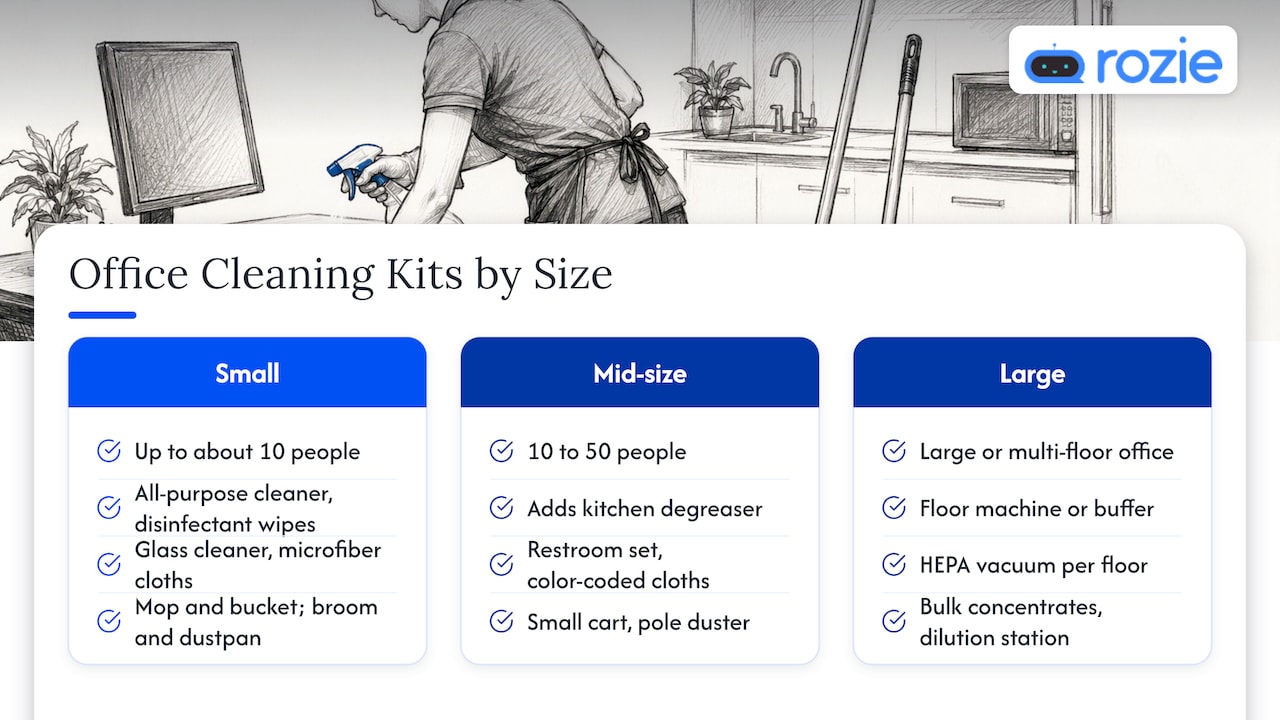
Small office (up to about 10 people): all-purpose cleaner, disinfectant wipes, glass cleaner, a pack of microfiber cloths, a mop and bucket, a broom and dustpan, a vacuum, gloves, trash liners, soap and paper towels. That is it.
Mid-size office (10 to 50 people): add a degreaser for the kitchen area, a restroom set with color-coded cloths, a small cart, a duster with a pole, spare mop heads and wet-floor signs in every corridor.
Large or multi-floor office: add a floor machine or buffer, a HEPA vacuum per floor, bulk concentrates with a dilution station, and a central storage room with labeled shelves and Safety Data Sheets. At this size, many teams decide it is smarter to hand the work to professionals rather than manage inventory.
Storage that saves money
Store chemicals away from food and out of direct sun, with the heaviest items on low shelves. Label the shelf with par levels. Keep a short stock sheet on the door and have one person own it. Most supply waste comes from products opened twice because nobody saw the first bottle.
Our perspective
We built Rozie because we saw how much of cleaning comes down to trust and logistics, not just products. An office can own the perfect supplies list and still end up with dull floors if nobody has time to use it.
That is why we think the best answer for many busy teams is a mix: keep the small daily basics in your own kitchenette, like soap, paper towels and a few wipes, and let a vetted professional handle the deeper work. On Rozie you can compare offers from verified, background-checked cleaners and cleaning companies, see the quote upfront and pay securely through the app, with payment protection and damage insurance cover up to €1,000,000.
We are proud that cleaners on the platform are verified before they onboard, and we are grateful to every client who gives them a chance. Our support team is available seven days a week, because a clean office should never feel like one more thing to chase.
Alex
When it makes sense to bring in a cleaner
A supplies list is the right place to start, but it has a cost: time, storage space, training and reordering. Consider outside help when:
- Nobody on your team wants the restroom and kitchen rota.
- Floors need machine work you do not want to buy.
- You are spending more time ordering supplies than cleaning.
- You are in Malta and want vetted people with their own equipment.
If you want to compare the two approaches, our guide to office versus home cleaning explains how the needs differ, and our commercial cleaning guide for Malta covers what to expect from a professional service. For your own home, see our house cleaning supplies checklist.
Book a verified office cleaner in Malta
If your office is in Malta, you can skip the shopping list. On Rozie you can compare offers from verified cleaners and cleaning companies for office and commercial cleaning, chat with them in the app, choose extras and pay securely through the platform. Prices are agreed upfront with each provider, so you see the quote before you book.
Tell us about your space, and let the offers come to you.
FAQ
What are the must-have office cleaning products?
A neutral all-purpose cleaner, a disinfectant for high-touch surfaces, glass cleaner, a degreaser for the kitchen area, toilet bowl cleaner, hand soap, paper towels and trash liners. Add microfiber cloths, a mop and bucket, a broom and a vacuum for the tools side.
How much cleaning stock should an office keep?
A useful rule from a major retailer’s checklist is enough to clean the whole office at least twice before restocking. Write a reorder level on each shelf so nobody has to guess.
Do I need a separate disinfectant if I have an all-purpose cleaner?
Usually yes. A cleaner removes dirt and grease, while a disinfectant is meant to kill germs on a clean surface. Use the disinfectant on high-touch points and let it stay wet for the contact time printed on the label.
What protective gear do cleaners need in an office?
Disposable or rubber gloves, and eye protection when spraying or splashing. Add a dust mask for dusty jobs and wet-floor signs for floors. Keep Safety Data Sheets for every product where staff can find them.
Is it cheaper to buy supplies or hire a cleaner?
It depends on office size and how much time your team spends. Supplies are only part of the cost, since storage, ordering and labor add up. Comparing a few upfront quotes shows you the real difference for your space.
Sources
- Essential Office Cleaning Supplies List, The Home Depot
- A Complete Commercial Cleaning Supplies List, Nilfisk
- Cleaning Supplies and Equipment, CDC
- Office Space Routine Cleaning, University of South Carolina
- Office Space Enhanced Cleaning, University of South Carolina
- The Essential Janitorial Supplies and Equipment Checklist, Global Industrial
- Facility services and safety products, UniFirst
- 1910.1200 Hazard Communication, OSHA
- Selected EPA-Registered Disinfectants, EPA
- Recycled industrial wiping rags