

In this guide
What does a good apartment cleaning schedule look like?
Which rooms need cleaning most often?
What should you clean every day?
How do you split weekly cleaning by day?
How do you fit deep cleaning into a weekly routine?
Which jobs belong on a monthly and seasonal calendar in Malta?
In what order should you clean?
Which cleaning products do you actually need?
Do you need to disinfect your apartment?
How do you keep damp and mould out of a Malta apartment?
How should you adjust the schedule to your life?
What does a good apartment cleaning schedule look like?
A good apartment cleaning schedule has four layers: a short daily reset, one focus task per weekday, a monthly list of bigger jobs, and a seasonal list for the heavy work. In a one- or two-bedroom flat in Malta that means about 10 minutes a day, 15 to 30 minutes on weekdays, one or two hours a month and a half day a few times a year.
The same structure is used by consumer-advice bodies in Europe. A cleaning-plan checklist from Verbraucherzentrale NRW splits the home into general areas, living room, bedroom, bathroom and kitchen, and gives each task its own interval. The version in this guide is simply sized for a typical Maltese apartment, with tiled floors, a small kitchen and often a balcony facing the street or the sea.
Which rooms need cleaning most often?
The kitchen and bathroom need cleaning most often, usually once or twice a week, because they are warm, damp and touched all day. Living areas and bedrooms can follow a weekly dust and floor routine, and everything else can go on a monthly or seasonal list. Light switches, door handles and taps deserve a wipe in the weekly round too.
The German federal health portal gesund.bund.de points to kitchens, bathrooms and toilets as the places to clean more often, because microorganisms multiply there more readily. A retailer’s cleaning plan from Switzerland suggests about once or twice a week for kitchen and bathroom, with less frequent attention for the rest.
The U.S. Centers for Disease Control and Prevention advises households to clean high-touch surfaces regularly, such as light switches, doorknobs and countertops, and to clean more often if young children or people with weakened immune systems live at home. In Malta’s summer, when windows stay open and the kitchen heats up fast, the bin and the sink area need the most frequent attention.
What should you clean every day?
Every day, clean only what makes tomorrow easier: dishes, the kitchen counters and sink, visible spills, the rubbish, the bed and the entryway. This daily reset takes about 10 minutes and stops mess from piling up into a weekend job. The rule of thumb is simple: if a task takes less than a minute, do it now.
Housework feels heavy for a lot of people. A Vorwerk survey of 1,000 people in Austria in May 2024 found that 30% saw daily housework as a strong or fairly strong burden. Its advice is to start with the visible mess and use a 60-second rule for small jobs, which is exactly what the daily reset does.
- Wash the dishes or load the dishwasher, then wipe the sink.
- Wipe the kitchen counters and the hob.
- Take the rubbish out if the bin is full. In summer, do it daily, as heat makes bins smell fast.
- Make the bed and put clothes in the laundry basket.
- Clear the entryway: shoes, bags and post.
For a printable version of these jobs, use our printable daily cleaning checklist for Malta homes.
Short on time this month?
Keep the daily reset and hand one weekly session to a professional. On Rozie you post the job once and verified cleaners in Malta send offers with exact prices, usually within 5 to 15 minutes. Find a cleaner and compare offers before you accept.
How do you split weekly cleaning by day?
Split weekly cleaning by giving each weekday one theme: bathroom on Monday, dusting on Tuesday, vacuuming on Wednesday, kitchen and mopping on Thursday, catch-up and laundry on Friday. Each theme adds 15 to 20 minutes to the daily reset, so a one- or two-bedroom Malta apartment stays clean without a long weekend session.
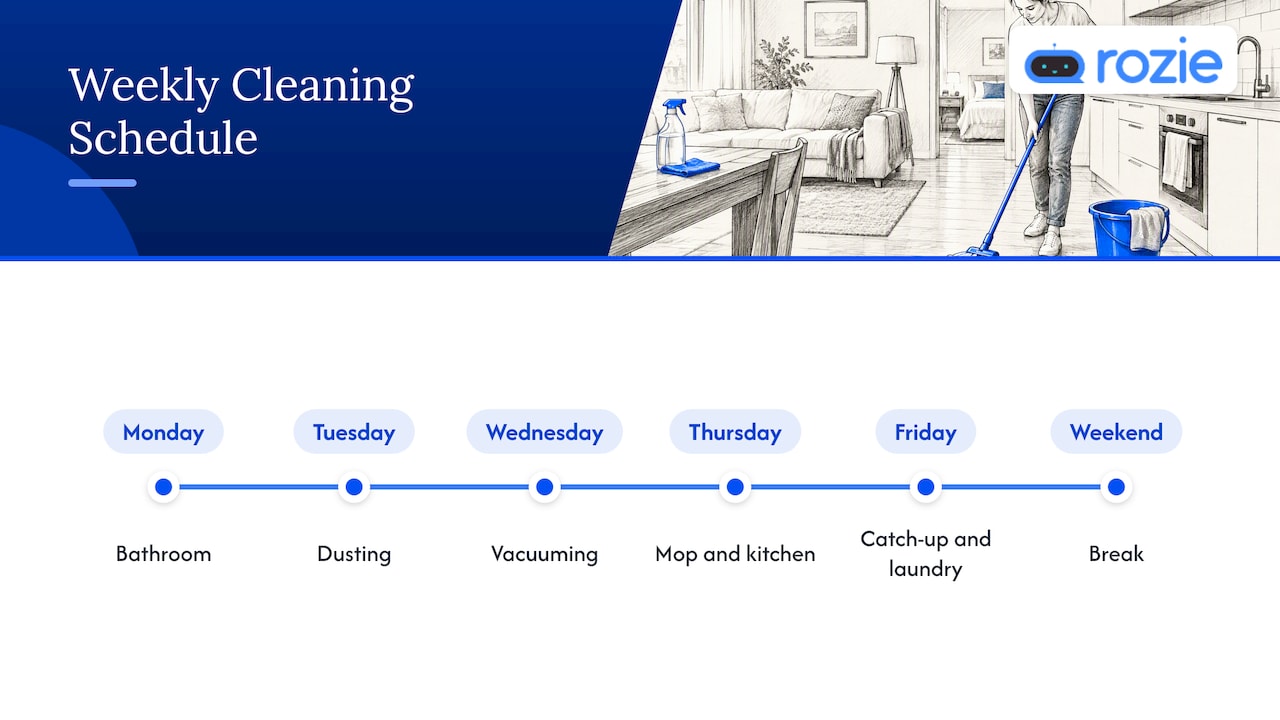
Monday: bathroom
Clean the toilet, sink, shower and mirror, and wipe the taps. Spray the shower walls first and let the cleaner work while you do the toilet, then rinse. Malta’s hard water leaves white limescale on taps and glass quickly, so a weekly wipe saves you a long descaling job later.
Tuesday: dust
Dust shelves, the TV unit, frames, window sills and the tops of furniture, working from high to low. A slightly damp microfibre cloth captures the fine limestone dust that settles in Maltese homes instead of moving it around.
Wednesday: vacuum
Vacuum rugs, the edges of tiled floors and the sofa if you have pets. Empty the canister or check the bag, because a full one loses suction.
Thursday: kitchen and mop
Wipe appliance fronts, cabinet doors and the splashback, then mop the floors last. Plan your route so you finish at the door and nobody walks on wet tiles.
Friday: catch-up and laundry
Use Friday for whatever slipped during the week. If nothing did, wash bedding and towels and keep the weekend free.
How do you fit deep cleaning into a weekly routine?
Fit deep cleaning into a weekly routine by adding one extra deep-clean task each week instead of doing everything at once. Week one is the fridge and freezer, week two the oven and microwave, week three windows and mirrors, week four skirting boards, door frames and vents. Over a month the whole apartment gets a thorough clean in 30-minute bites.
- Week 1: inside the fridge and freezer.
- Week 2: oven and microwave.
- Week 3: inside windows, window tracks and mirrors.
- Week 4: skirting boards, door frames, light switches and vents.
If you want to see what a full session covers, our room-by-room deep cleaning checklist and the deep cleaning checklist with essential steps lay it out in detail. For a whole-house version of this rotation, see our 4-week weekly cleaning rotation for Malta homes.
Key takeaway: do not try to deep clean every week. One rotating extra task per week gives you a fully deep-cleaned apartment every month, without a single long session.
Which jobs belong on a monthly and seasonal calendar in Malta?
Monthly jobs in a Malta apartment are the fridge, oven, inside windows, vents, skirting boards and descaling taps and showerheads. Seasonal jobs follow the Maltese climate: a balcony and window clean after the spring Saharan dust, a damp check before the October to February humid season, and a full reset before summer guests or a move.
Give monthly jobs a fixed slot, for example the first weekend of the month, so they never derail the weekly routine.
Monthly
- Wipe the fridge shelves and throw out expired food.
- Clean the oven and the extractor hood filter.
- Wash inside windows and mirrors.
- Wipe skirting boards, doors and light switches.
- Descale the kettle, taps and showerhead. Tap water in Malta is hard, with the Water Services Corporation supplying water that typically measures 200 to 600 ppm of calcium carbonate, so limescale builds up fast.
Seasonal, the Malta calendar
Our spring cleaning list walks through planning the seasonal round, and our guide to cleaning up after Sahara dust in Malta covers the spring balcony job in detail.
In what order should you clean?
Clean in this order: clear surfaces first, apply products that need time to work, dust and wipe from high to low, vacuum, mop last, then go back to scrub and rinse the soaking areas. Dirt falls downward, so floors always come at the end, and finishing at the door means nobody walks across wet tiles.
An Austrian guide from dm recommends preparing the bathroom and kitchen first, so cleaners and descalers can work while you do something else. A Bosch home-tips article recommends a fixed route, so you do not cross freshly cleaned areas again and again.
- Clear surfaces and floors. Put things away so you can reach the dirt.
- Apply products that need time. Toilet cleaner, descaler on chrome and glass, cream cleaner on the sink.
- Dust and wipe from high to low. Shelves before counters, counters before floors.
- Vacuum, then mop. Mopping a dusty floor just makes mud.
- Go back to the soaking areas. Scrub and rinse.
- Finish at the door. Your last spot is where the floor can dry.
For printable task lists to go with this order, our apartment cleaning checklist guide and apartment cleaning workflow guide pair well with this schedule.
Which cleaning products do you actually need?
Most Malta apartments need only five things: a mild all-purpose cleaner, washing-up liquid, a descaler for taps and glass, a cream cleaner for stubborn marks and washable microfibre cloths, plus a vacuum and a mop that suits your floor. Use a pH-neutral cleaner on limestone and marble, because acids such as vinegar and descaler etch Maltese stone.
The German Environment Agency recommends dosing sparingly, looking for the Blue Angel or EU Ecolabel, and avoiding routine disinfectants, chlorine toilet cleaners and chemical drain cleaners.
Pro tip
Many older Maltese homes have Globigerina limestone floors, steps or sills. Never use vinegar or a descaler on them: acids dissolve the stone and leave dull, rough patches. Use a pH-neutral stone cleaner, such as the stone-care ranges from Lithofin or HG sold in local hardware shops, and keep the descaler for chrome, tiles and glass.
Our house cleaning supplies checklist has the full shopping list. Never mix products, and never pour a cleaner into a food or drink bottle.
Do you need to disinfect your apartment?
No, a healthy household does not need to disinfect on a schedule. Ordinary cleaning with detergent and water removes most germs from surfaces, so disinfectant is only for specific situations, such as illness at home. What matters more is using separate cloths for the kitchen and bathroom and washing them every week at 60°C.
German health authorities say Ordinary household cleaning removes more than 90% of microorganisms from surfaces. If someone in your household has a weakened immune system, ask their doctor which routine is right for them.
The cloths themselves are the overlooked part. Use separate cloths for the kitchen, bathroom and toilet, let cloths and sponges dry after use, and wash cloths and tea towels weekly, ideally at 60°C, in line with the German Environment Agency’s household hygiene guidance. Replace sponges as soon as they start to smell.
How do you keep damp and mould out of a Malta apartment?
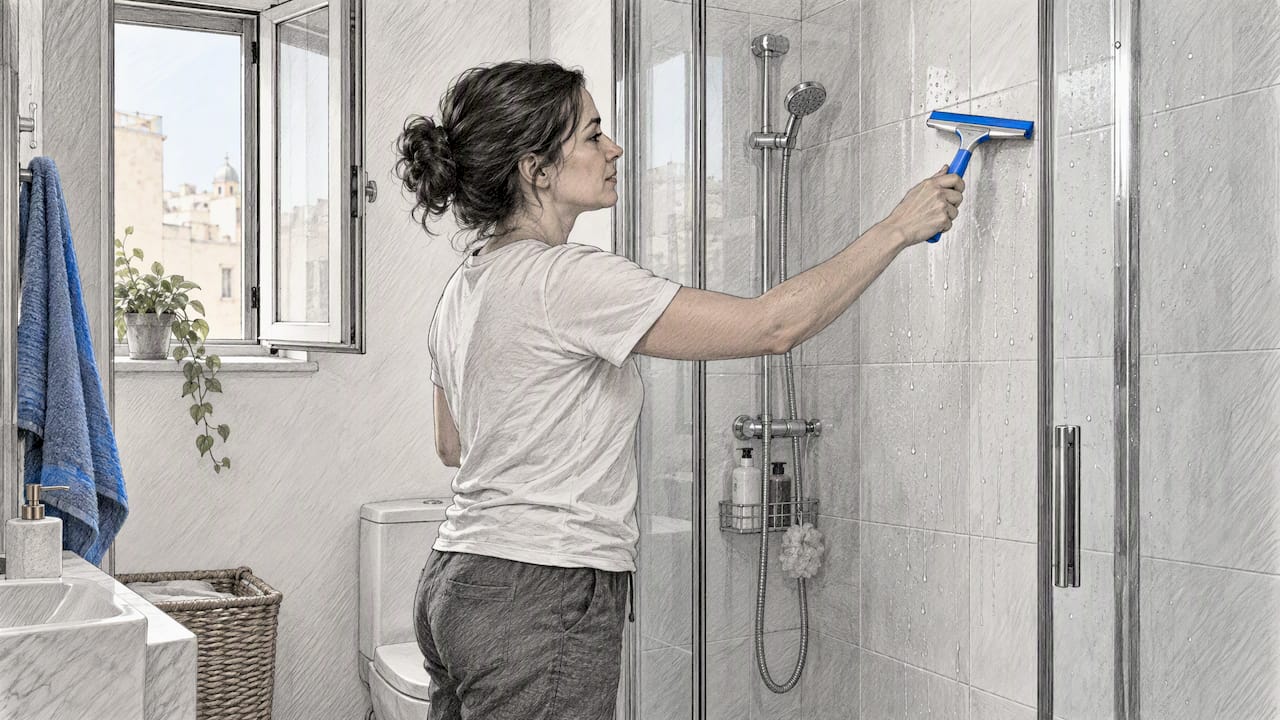
Keep damp and mould out of a Malta apartment by drying surfaces as part of your routine: squeegee the shower after use, run the extractor or open a window after cooking and showering, and wipe condensation off window frames in winter. Indoor humidity should stay below 60 percent, and a cheap hygrometer shows you where you stand.
Humidity does more damage than dust in Maltese flats, especially from October to February, when stone walls stay cold and condensation forms behind furniture. The U.S. EPA says indoor relative humidity should stay below 60 percent, ideally between 30 and 50 percent. A dehumidifier in the bedroom during the humid months often does more than any cleaning product.
Damp-absorbing fixed carpet does not belong in a bathroom, as the Swiss Federal Office of Public Health notes in its advice on household disinfectants. If black spots keep coming back on walls or around windows after you clean them, the cause is usually ventilation or insulation, not your routine. That is the moment to bring in specialists who diagnose the building itself, such as the team behind this mould and condensation solution, which is based in the UK. For Malta-specific advice, read our guides to controlling humidity in Malta apartments and black mould in Malta bathrooms.
How should you adjust the schedule to your life?
Adjust the schedule by keeping the daily reset fixed and changing only the weekly part. Busy professionals can merge five weekday themes into two evening sessions, parents should expect the kitchen floor and table every day, shared flats work best with named tasks per person, and tenants moving out need a separate deep clean.
Busy professionals
Keep the daily reset and cut the weekly plan to two sessions: bathroom and kitchen on one evening, floors and dusting on another. Push monthly jobs to a booked session. Our office cleaning tips for busy professionals share more shortcuts.
Parents
Expect to clean the kitchen floor and table daily. Store cleaning products out of children’s reach and keep wet areas dry. Our quick cleaning tips for busy parents are written for exactly this stage of life.
Pets and shared flats
Vacuum twice a week instead of once, and give each flatmate named days. A schedule only works if everyone sees it, so stick it on the fridge or pin it in the group chat.
Moving out
A tenant’s last clean is its own project, and in Malta the deposit terms sit in your lease under the Private Residential Leases Act (Cap. 604). Our end-of-tenancy cleaning checklist lists what landlords check, from the oven to window tracks, and our 14-day move-out countdown shows how to time it.
Rather skip the heavy jobs? Most households that keep a schedule going do two things: a tiny daily habit, and a decision in advance about which jobs they will not do themselves. The oven, the windows and the full deep clean are the usual ones to hand over.
Finding a reliable cleaner in Malta the traditional way often means scrolling Facebook groups, making phone calls, chasing quotes and hoping the person who turns up does a good job.
Rozie was built to remove that friction. You pick a date, select the extras you need, and verified cleaners send you offers with exact prices before you accept. Every booking is backed by 7-day payment protection and up to EUR 1,000,000 in professional liability insurance.
Here is the full booking process in under 60 seconds:
Compare Cleaning Offers on Rozie →
When is it worth booking a cleaner instead?
Booking a cleaner is worth it when the monthly jobs keep sliding, when you are moving out, hosting guests or coming back from a long trip, or when a busy month leaves no evening free. One booked session resets the apartment, and your daily and weekly routine keeps it that way afterwards.
On Rozie you post one request and verified cleaners in Malta send offers with exact prices, usually within 5 to 15 minutes. You compare offers, check ratings and reviews, chat in the app and accept the one that fits. Extras such as inside the fridge, inside the oven, kitchen cabinets, inside windows and the balcony or terrace are added when you post. For a regular visit, see regular home cleaning in Malta. For a one-off big reset, see our deep cleaning service. If you rent out your place, our Airbnb and holiday-let turnover service keeps changeovers smooth.
Typical offers in Malta
Regular clean, one-bedroom flat
EUR 40 to 65
Deep clean, studio or one-bedroom flat
EUR 55 to 95
Typical ranges from our cleaning cost guide for Malta, not prices set by Rozie. Each cleaner’s offer shows the exact price for your home before you accept.

Keep the routine, hand over the heavy bits. Post your request on Rozie, compare exact offers from verified cleaners across Malta, and get back the weekend your schedule was meant to protect.
FAQ
How often should I clean my apartment?
Clean the kitchen and bathroom once or twice a week and do a short reset every day. Floors and dusting are usually weekly, while the fridge, oven and inside windows can wait for a monthly slot. Households with children, pets or several people may need to clean more often.
What is the simplest weekly cleaning schedule?
Give each weekday one job: bathroom on Monday, dusting on Tuesday, vacuuming on Wednesday, kitchen and mopping on Thursday, catch-up on Friday. Add a 10-minute daily reset of dishes, counters and rubbish. That keeps most small apartments tidy in 15 to 30 minutes a day.
Which seasonal cleaning jobs matter most in Malta?
Clean the balcony and the outside of windows after the spring Saharan dust, and check behind furniture and around window frames for damp before the October to February humid season. Descale taps and showerheads monthly all year, because Malta’s tap water is hard.
Can I use vinegar on Maltese limestone floors?
No. Vinegar and other acidic cleaners etch Globigerina limestone and marble and leave dull, rough patches. Use a pH-neutral stone cleaner on stone and keep descalers for chrome, tiles and glass.
Do I need to disinfect my apartment every week?
No. Ordinary household cleaning removes most germs from surfaces, so routine disinfection is generally unnecessary. Disinfectant is for particular situations, such as illness at home. Ask a doctor if someone in your household has a weakened immune system.
How much does a cleaner cost for an apartment in Malta?
Typical offers for a regular clean of a one-bedroom flat in Malta are around EUR 40 to 65, and a deep clean of a studio or one-bedroom flat around EUR 55 to 95. On Rozie each cleaner’s offer shows the exact price for your home before you accept.
Sources
- Haushaltshygiene, gesund.bund.de
- Hygiene im Privatbereich, Umweltbundesamt
- Weniger ist mehr: umweltfreundlich reinigen, Umweltbundesamt
- Reinigungsplan, Verbraucherzentrale NRW
- Putzplan, Action CH
- Press release on housework, Vorwerk Austria (2024)
- Putzplan, dm Austria
- Zeit sparen beim Putzen, Bosch Austria
- Desinfektionsmittel im Wohnbereich, Swiss Federal Office of Public Health
- When and How to Clean and Disinfect Your Home, CDC
- Mold Course Chapter 2, U.S. EPA