

In this guide
How many cars are on Malta’s roads in 2026?
How do you buy a used car in Malta?
How much does car rental in Malta cost?
What are the driving rules in Malta?
How does parking work in Malta?
Can I use my foreign driving licence in Malta?
What should you know about everyday driving in Malta?
My honest take on driving in Malta
Key takeaways at a glance
If you only read the table, here is what most newcomers and long-term residents need to know about driving life in Malta in 2026:
How many cars are on Malta’s roads in 2026?
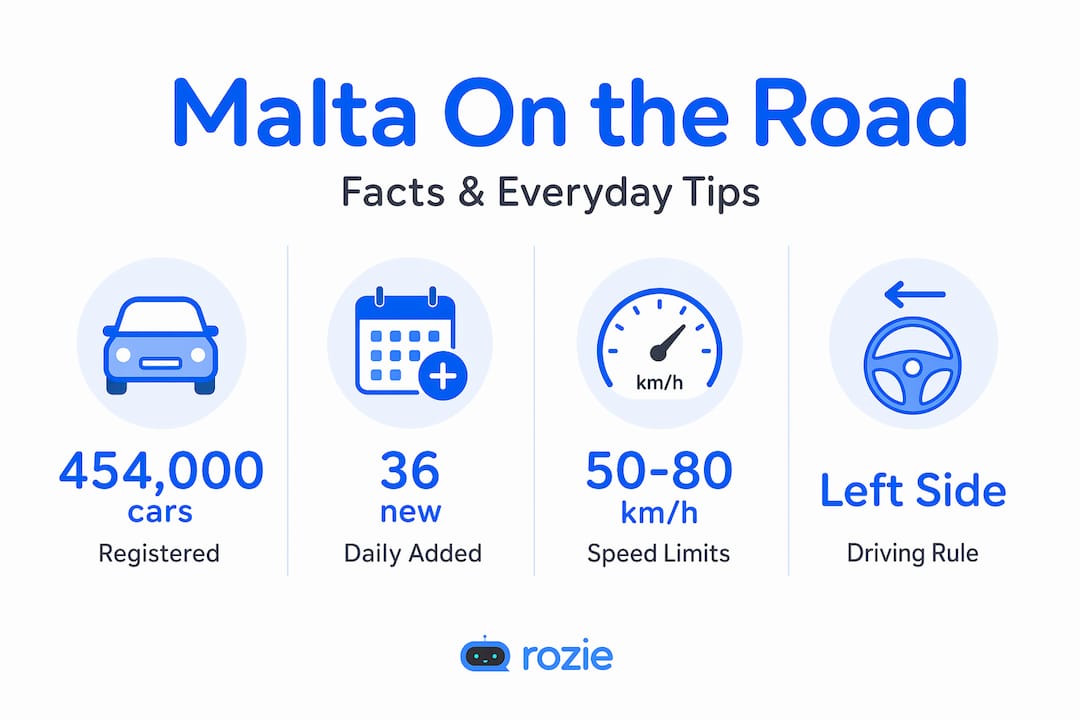
Malta ended the first quarter of 2026 with 460,648 licensed motor vehicles, growing at a net rate of 36 vehicles per day, according to the National Statistics Office. Passenger cars made up 73.3% of that stock; the rest split between motorcycles, e-bikes, and commercial vehicles. With a resident population of about 574,000, that works out to roughly 0.80 vehicles per person — one of the densest vehicle-to-resident ratios in Europe.
What this means on the ground is simple: peak-hour traffic is real, parking competition is real, and the “five-minute drive” that Google Maps shows you in the morning often becomes a 25-minute drive between 7:30 and 9:00. The government’s transport strategy has tried to push public transport and shift drivers toward electric vehicles — 23,387 electric and plug-in hybrids were on the road by end of Q1 2026, about 5.1% of total stock — but the underlying trend is still more cars added than removed.
Why this matters for newcomers.
Most expats arriving from northern Europe underestimate how saturated Malta’s road network is. The island is 316 km² with ~460,000 cars. London has more cars in absolute terms, but it also has 1,572 km² of land and a dense Underground. Plan your day around traffic windows from week one.
How do you buy a used car in Malta?
Buying a used car in Malta in 2026 is meaningfully easier than it was a few years ago. The transfer of ownership can now be completed digitally through a licensed insurance agent: the seller and buyer attend together, complete the paperwork, and the agent files the transfer with Transport Malta. Standard private sales no longer require either party to queue at a Transport Malta office. Edge cases — inheritance, personalised plates, fleet transfers — still go through Transport Malta directly.
Registration fees scale with the vehicle’s engine size, CO₂ emissions, and age, which is why older, smaller-engine cars stay cheap to put on the road. Insurance for a standard private car typically lands between €300 and €700 per year, with younger drivers and recent licence holders sitting at the upper end. Diesel is still common in older stock but the government is pushing electric: 2026 grants reach up to €12,000 for larger families buying a new EV, on top of full exemptions from registration and circulation taxes.
What to check before you buy
Beyond the obvious price negotiation, there are five practical checks most buyers in Malta either skip or rush:
- Valid VRT certificate. Malta requires periodic Vehicle Road Test inspections. Ask to see the current certificate, not a copy.
- No outstanding fines. Confirm the plate carries no unpaid contraventions before signing — they can transfer with the vehicle.
- Salt corrosion. Coastal exposure rusts undercarriages and brake lines faster here than inland Europe. Get a mechanic on a lift.
- Air conditioning. Replacing an A/C compressor in a Maltese summer car is non-trivial. Test it on a hot day before you commit.
- Resale realism. Maltese used-car prices stay surprisingly high because import duties on new cars are steep. Don’t expect bargain depreciation curves.
Pro tip
If the budget allows, bring a licensed mechanic to the pre-purchase inspection. €40–€60 spent on a proper check has saved more buyers from corroded brake lines and tired clutches than any online listing photo ever has.
How much does car rental in Malta cost?
Car rental in Malta swings hard with the season. A compact car averages €11–€17 per day in February but €22–€36 per day in August — roughly a 50% peak premium. Booking four to six weeks ahead for summer travel is sensible, not paranoid, because inventory genuinely runs short in July and August when leisure visitors compete with long-stay digital nomads for the same fleet.
Seasonal rates and booking windows
Here is the practical pattern Malta car rental customers see most years. Treat the rates as benchmarks for compact economy cars; SUVs and automatics run 30–50% higher in every column.
What to check before you collect the keys
A few rental-specific issues catch people out more often than they should, especially first-time visitors:
- Manual vs automatic. Manual is the default in Malta’s rental fleet and is cheaper. If you need automatic, book it weeks ahead — supply is limited and summer demand is brutal.
- Insurance excess. Basic agreements often carry an €800–€1,500 excess. A full collision damage waiver brings that to zero or near zero, and on Malta’s tight roads that buffer is usually worth it.
- Age limits. Most agencies require drivers to be 21 or older; some apply a young driver surcharge up to age 25.
- Photo the car. Walk around with your phone and record everything — including the roof and the underside near each wheel arch. Existing scratches are common on rental fleets here, and you want timestamped proof.
Pro tip
If you’re staying for a week or less and only need a car for a day trip to Gozo or Mdina, day-by-day rentals are often cheaper than a full weekly hire plus airport parking. Add up the total cost both ways before defaulting to “rent for the whole stay.”
What are the driving rules in Malta?
Malta drives on the left with right-hand-drive vehicles, a legacy of British rule that confuses almost every visitor from mainland Europe for the first day or two. The most common adjustment point is roundabouts, where the give-way direction feels counterintuitive until it becomes muscle memory. Speed limits are 50 km/h in built-up areas and up to 80 km/h on main arterials, with both fixed cameras and mobile enforcement; NSO data from 2024 recorded 43,761 speed-camera contraventions for the year, which gives a sense of how active enforcement is.
Some practical points that aren’t in the rule book:
- Headlight flash etiquette. On narrow village roads, drivers commonly flash headlights once to signal “you go first.” It looks chaotic from the outside but works smoothly once you learn it.
- Phone use. Hands-free is mandatory. Penalties for using a handheld phone while driving are routinely enforced.
- Drink-driving. Malta’s limit is 0.08 g/100 ml for general drivers and 0.02 for new and professional drivers. Enforcement is real, especially on weekend nights in Paceville.
- Seatbelts. Compulsory in all seats, including the rear.
How does parking work in Malta?
Malta’s parking system uses a colour-coded line system that catches out almost every newcomer. According to local rental guides, yellow-line violations regularly result in clamping or towing with recovery fees that quickly outweigh the inconvenience of looking for a legal spot.
- White lines — free parking with no time restrictions unless signage states otherwise.
- Blue lines — resident or pay-and-display zones; you need a permit or to pay via the app/meter.
- Yellow lines — no parking, full stop. Clamping and towing are the standard response.
Three localities are particularly brutal for parking: Sliema, St Julian’s, and Valletta. During peak hours, even legal spots fill within minutes of becoming available. Many residents simply give up and use paid car parks — the Floriana car park for Valletta visits, or one of the multi-storey options near The Point in Sliema. Outside the harbour conurbation, parking gets dramatically easier; Mosta, Naxxar, Mellieha, and most of Gozo are mostly stress-free.
Key takeaway: If you’re heading into Sliema, St Julian’s, or Valletta on a weekend, plan to use a paid car park or skip the car entirely. The time saved hunting for a legal spot is rarely worth the saved euros.
Can I use my foreign driving licence in Malta?
EU, EEA, and UK licence holders can exchange their licence for a Maltese one without retaking any tests, at a fee of €7 per remaining year of validity. Non-EU licence holders can drive on their original licence for up to 12 months as residents, after which a full Maltese licence is required. Visitors on short stays generally don’t need to do anything beyond carrying their existing licence.
Getting a Maltese licence from scratch involves a learner’s permit, theory test, practical test, and a probationary period after passing. Total cost is usually €108–€125 depending on lessons taken and how many attempts the practical takes. Driving schools are concentrated in Birkirkara, Mosta, and the Northern Harbour district.
A small thing that trips visitors up.
If your home licence is paper-only or doesn’t show a clear English equivalent, an International Driving Permit issued in your country before you arrive will save arguments at the rental counter. It costs about €15–€25 in most jurisdictions and is valid for one year.
What should you know about everyday driving in Malta?
Knowing the rules is one thing. Living with Malta’s roads day to day is another. A few patterns are worth absorbing early:
For most longer-stay residents, the buy-versus-rent decision flips at around the four-to-six-week mark. Shorter than that, weekly rentals stay competitive and you skip insurance, registration, and parking-permit administration. Longer, and ownership starts to make financial sense even after you account for circulation tax and the inevitable VRT inspection. If you’re still weighing whether the island works for your situation overall, our Malta location guide for expats covers the bigger picture beyond just transport.
If you’re heading to Gozo for more than a day or two, the ferry plus a Gozo-side rental is usually cheaper and faster than queuing to bring your own car across, especially in summer. Gozo’s car-rental market is small but functional, with most agencies clustered near Mġarr Harbour.
For short trips inside Valletta, Sliema, or St Julian’s, the realistic answer is often “don’t drive.” The walk from a Floriana car park to most of Valletta is 10–15 minutes; circling for street parking can easily take 25. The bus network from Sliema to Valletta runs frequently and skips the harbour bottleneck entirely.
Seasonal traffic patterns
Summer brings tourist traffic on top of normal commuter flow. August turns the coastal roads around St Julian’s, Bugibba, and Marsaskala into slow-moving processions on weekend evenings. For beach trips, leaving before 10 a.m. or going mid-week saves the worst congestion. October to February is mostly calm except around the Christmas shopping weeks in Sliema and Valletta.
If you’re new to the island and still figuring out alternatives for short trips, our taxi-in-Malta guide walks through when ride-hailing apps beat driving yourself, which mostly comes down to Paceville on a Friday night and airport runs on a tight schedule.
My honest take on driving in Malta
After enough kilometres on these roads, I’ve come to one conclusion most people don’t want to hear: the network isn’t designed for the volume of cars currently using it. Nearly half a million vehicles on 316 km² of island doesn’t add up in anyone’s favour, and switching everyone to electric — useful as it is for air quality — doesn’t fix the underlying space problem.
The drivers who adapt fastest are the ones who stop fighting the environment. That means accepting that you’ll wait for someone reversing out of a tight spot, that the “short trip” Google promises is often twice as long, and that patience is genuinely the most useful skill on these roads. Get aggressive on Maltese village lanes and you’ll meet a tour bus driver who has done this same route every day for fifteen years and will simply hold his ground until you reverse.
On buying: go small, go a bit older if budget matters. A five-year-old compact hatchback handles Malta brilliantly, costs less to insure, and slots into gaps that defeat anything larger. On renting: prioritise insurance coverage over saving €5 per day. The roads are tight, and even careful drivers pick up scratches in the first week.
What visitors consistently underestimate is how personable local driving culture is once you learn the unwritten cues. The headlight flash, the patient wave, the willingness to reverse 30 metres so someone else can come through. It’s not aggressive. It’s just different.
— Alex
Keeping your car (and home) in shape
One thing nobody warns new Malta residents about: the same Saharan dust events and salt-laden coastal air that coat your car windscreen every few weeks are also coating your balcony, your windows, and your living-room floor. If you live anywhere from Sliema to Bugibba, you’ll notice the dust film inside the apartment within days of opening windows during a red-dust episode.
Finding a reliable cleaner the traditional way in Malta usually means scrolling Facebook groups, sending messages, chasing quotes, and hoping the person who turns up actually does a good job. Rozie was built to remove that friction: you post the job once, verified cleaners send offers with exact prices within minutes, and every booking is backed by 7-day payment protection and professional liability insurance up to €1,000,000 per occurrence, underwritten by Lloyd’s Insurance Company S.A. Here’s the full Rozie booking flow in under 60 seconds:

FAQ
How many cars are registered in Malta in 2026?
Malta had 460,648 licensed motor vehicles at the end of Q1 2026, according to the National Statistics Office, growing at a net rate of 36 vehicles per day. Passenger cars make up 73.3% of that stock.
How much does car rental in Malta cost in summer?
Compact-car rentals in Malta typically run €22–€36 per day during July and August, compared with €11–€17 in February. Booking five to seven weeks ahead is recommended for peak-summer travel because inventory genuinely runs short.
Can I use my foreign driving licence in Malta?
EU, EEA, and UK licence holders can exchange their licence for a Maltese one without retesting, for €7 per remaining year of validity. Non-EU licence holders can drive on their original licence for up to 12 months of residency before needing a full Maltese licence.
Which side of the road does Malta drive on?
Malta drives on the left with right-hand-drive vehicles. Many village roads physically fit only one car at a time, and drivers commonly use a single headlight flash to indicate they’re giving way.
What do the coloured parking lines mean in Malta?
White lines mean free parking with no time restriction unless signed otherwise. Blue lines indicate resident or pay-and-display zones requiring a permit or payment. Yellow lines prohibit parking entirely, and violations typically result in clamping or towing.
Is it worth owning a car as an expat in Malta?
For stays under four to six weeks, weekly rentals usually win on cost and admin. Beyond that, ownership becomes more practical, especially if you live outside the Sliema–St Julian’s–Valletta corridor where bus service is reliable.
Are electric vehicles popular in Malta?
Electric and plug-in hybrids reached 5.1% of Malta’s vehicle stock at the end of Q1 2026, or about 23,387 vehicles. Government grants of up to €12,000 for larger families, plus full exemptions from registration and circulation tax, are accelerating adoption in 2026.