

In this guide
How does Malta’s childcare system actually work?
Who qualifies for the Free Childcare Scheme?
How much does childcare cost outside the free scheme?
What safety and quality standards must centres meet?
When do parents need to look beyond the free scheme?
How should families balance childcare hours with home time?
Malta has one of the most generous early-years systems in the EU, and yet many parents — especially expats arriving mid-career, or first-time parents juggling new schedules — struggle to navigate it confidently. The terminology alone takes a minute to absorb: FES centres, scheme-registered private centres, kindergarten intakes, transfer declarations, eligibility based on social security contributions. None of it is particularly complicated once you’ve sat with it. But nobody hands you a single, plain-English overview when you need one. This guide is that overview.

How does Malta’s childcare system actually work?
Malta’s childcare system has three distinct tiers, and knowing what each one is saves a lot of confusion when you start calling around. The free, state-funded layer covers children from 3 months until they’re eligible for kindergarten (around age 3). The mid-tier is a network of privately operated centres that participate in the Free Childcare Scheme — same age range, same free hours for eligible parents, but more locations and longer operational hours in some cases. The third tier sits entirely outside the scheme: fully private centres, extended-hours providers, and individual nannies who you pay directly.
The state-run layer is operated by the Foundation for Educational Services (FES), which runs childcare centres in Malta and Gozo registered with the Department of Quality Standards in Education. FES centres typically operate two shift patterns — a standard 7:30am–4pm window and a longer 6am–6pm window in select locations. That extended window is genuinely useful if you commute into Valletta or work shift-based hours. Beyond FES, scheme-registered private centres set their own hours, which means you can sometimes find a centre closer to home or work that still falls under the free scheme.
The key thing to understand: scheme-eligible families get free care during the hours they’re at work or studying, plus reasonable commute time. Anything outside those hours — late afternoons, evenings, weekends — falls back on you to arrange and pay for, either through extended-hours providers or in-home help. That gap is where most of the cost questions come up.
Who qualifies for the Free Childcare Scheme?
The scheme is open to working parents and parents in full-time, recognised education. According to Jobsplus, who administers it, “parents in work” means both parents (or a single parent) employed and paying social security contributions, while “parents in education” means parents pursuing a recognised qualification — at the University of Malta, MCAST, ITS, or any institution where the course is recognised by the MFHEA. Single parents, self-employed parents, and parents not in employment due to terminal illness can also qualify under specific evidence requirements. One important exclusion: parents currently on parental leave or career breaks are not eligible during that period.
Here’s how the application actually plays out, step by step:
📋 Step 1 — Confirm your child’s age.
The scheme covers children from 3 months until they become eligible for state Kindergarten 1 (which has two intakes: 1 October and 1 February). Once eligible for kinder, scheme funding terminates.
🏢 Step 2 — Pick a participating centre.
You apply directly through the centre, not through a separate government portal. The full list of registered centres is published by Jobsplus and updated periodically.
📄 Step 3 — Gather documents.
Employees need three recent payslips and an employer declaration of average weekly hours. Self-employed parents need their warrant or VAT registration plus social security proof. Students need a course attendance statement. Single parents need either the child’s birth certificate or a court decree.
✅ Step 4 — Submit through the centre.
The centre forwards your application to the Free Childcare Unit, which determines eligibility. Once approved, your covered hours are free of charge, and the centre cannot ask for any additional payment during those hours beyond a reasonable one-off registration fee and food costs.
💡 Pro tip
If you and your partner are both eligible — one working, one studying, for instance — your combined approved hours stack. That can dramatically reduce the gap between scheme-covered care and the hours you actually need someone watching the child. If your child is absent for more than 25% of booked hours, you may have to pay for those missed hours, even if the absence is due to illness, so check the centre’s specific terms before signing.
How much does childcare cost outside the free scheme?
For families who don’t qualify, opt out, or need hours that fall outside the scheme, private childcare in Malta is unregulated on price — meaning fees vary significantly between centres. The Government’s main offset is an income tax deduction of up to €2,000 per child per year, which you claim against fees actually paid during the year. For families paying for after-hours care while still using the scheme during working hours, that deduction is the most practical lever for managing the total bill.
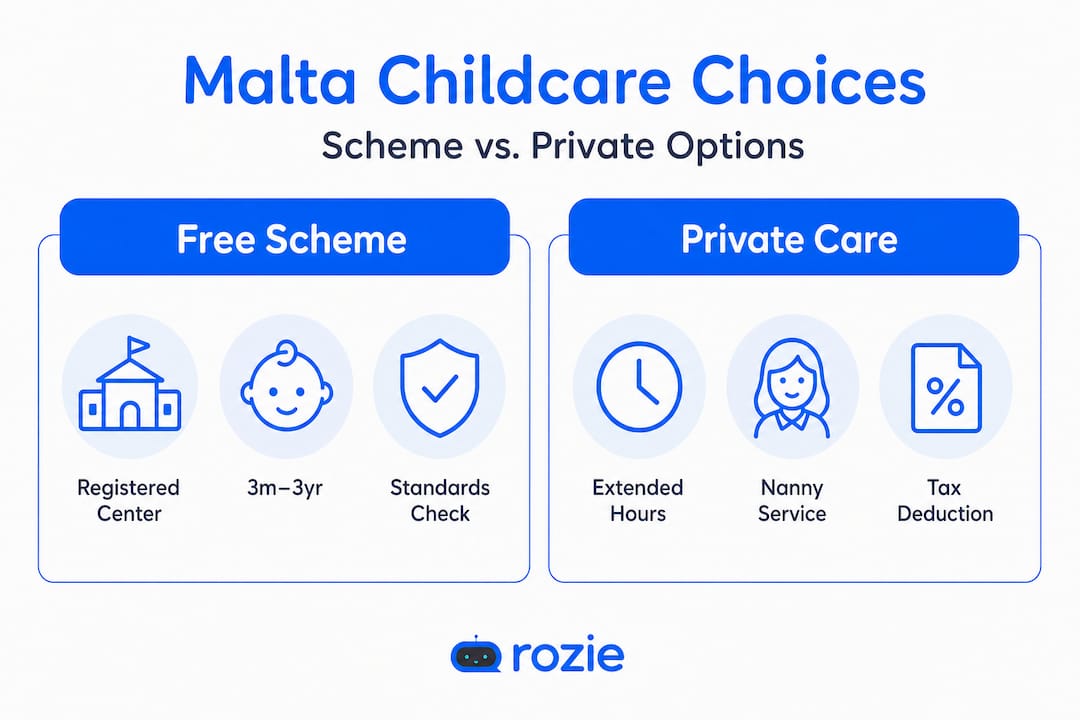
Here’s how the typical cost picture looks for a family using the scheme during work hours and topping up with private hours in the evenings or on a Saturday:
💰 Annual childcare cost picture (illustrative)
Scheme covered hours only
€0
Top-up private hours (varies)
€500–€3,000+
Up to €2,000 of qualifying fees can be deducted against your income tax, per child per year.
If you’re hiring a nanny instead of using a centre, you’re moving outside the scheme entirely — but you’re also gaining flexibility that no centre can match. Hourly rates vary widely depending on whether you book through an agency or independently, and whether the nanny is providing solo care or supporting a parent who’s home but working. For families weighing this option, our guide to finding a reliable nanny in Malta walks through agency vetting, contract structure, and what to expect.
What safety and quality standards must centres meet?
Every registered centre in Malta operates under the National Standards for Child Day Care Facilities, enforced by the Directorate for Quality and Standards in Education. The standards cover staff qualifications, child-to-carer ratios, physical space requirements, hygiene practices, programme content, and emergency procedures. A centre that’s registered isn’t just operating legally — it’s operating under regular inspection.
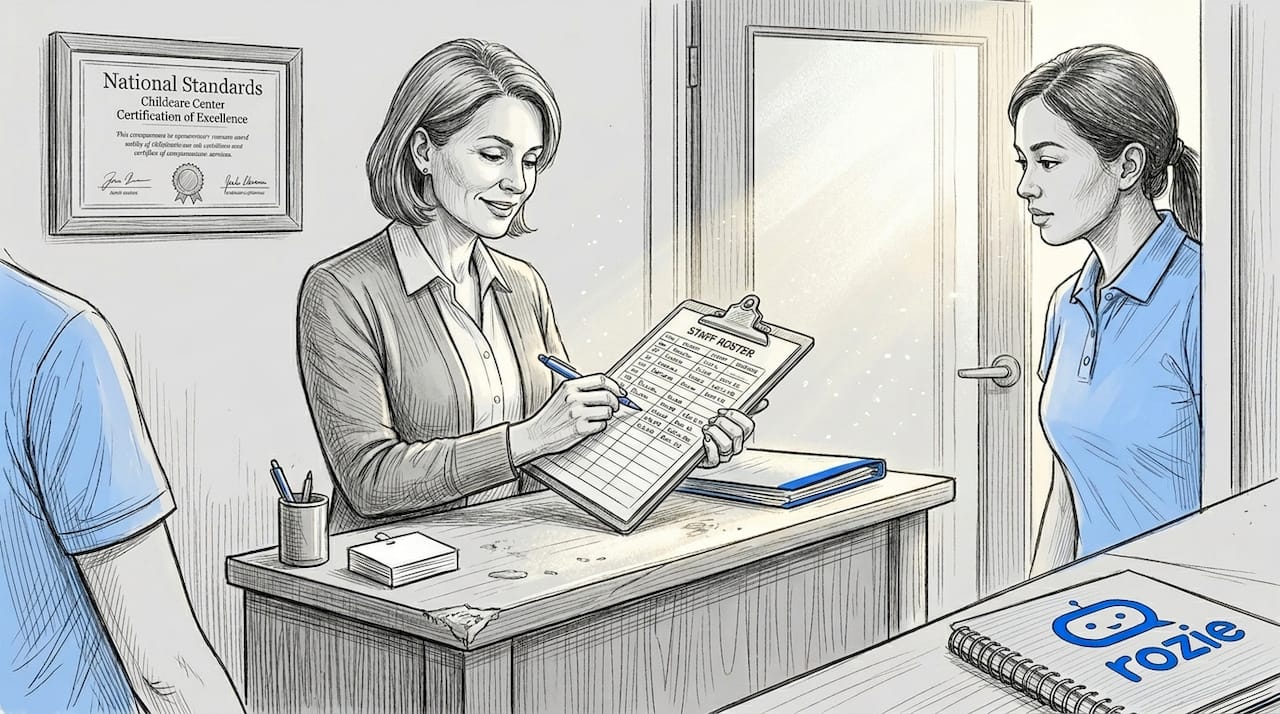
What that means in practice when you’re touring a centre:
👩🏫 Qualified staff at every level.
Carers are required to hold a recognised early-years qualification, and managers hold a higher-level diploma. Ask to see staff credentials — a quality centre will be happy to share.
📐 Defined space and ratios.
National Standards specify minimum space per child and maximum staff-to-child ratios that vary by age band. Walk the rooms during the time slot your child would actually attend, not just during a quieter tour window — ratios should look comfortable, not stretched.
🧒 Play-based learning programme.
National Standards emphasise developmentally appropriate, play-based activities. Ask how the centre structures the day, what language is used with the children, and how progress or settling-in is communicated to parents.
🚪 Secure access and clear protocols.
Look for controlled entry, signed pickup procedures, and a clear written policy for illness, allergies, and emergencies. If a centre seems reluctant to share these documents or discourages an unscheduled walk-through, treat that as a meaningful signal.
Key takeaway: A registered centre is a strong baseline, but registration alone doesn’t tell you whether your child will thrive there. The visit is what tells you that. Trust the room, the carers’ tone with the children, and the way the manager answers your harder questions — those signals matter as much as the paperwork.
When do parents need to look beyond the free scheme?
The Free Childcare Scheme is genuinely generous, but it’s structured around a fairly conventional working pattern — Monday-to-Friday, daytime, predictable hours. Any deviation from that, and you’re going to need something extra. Here are the most common scenarios where families end up combining scheme care with private arrangements:
- Late finishes or evening shifts. If your work runs past 4pm consistently and you’re not at a centre that operates the longer 6am–6pm window, you’ll need either an extended-hours private centre or an in-home option for the gap.
- Frequent travel or irregular schedules. A nanny — or a flexible mix of family help and a part-time nanny — adapts to a week-by-week schedule in a way no centre can.
- Multiple young children with different needs. Sometimes a centre works for one child but not another (settling difficulty, additional needs, illness frequency). A blended setup gives you more levers to pull.
- Saturday or Sunday work. The scheme covers weekday work hours; weekends fall outside it entirely.
- School holidays for older siblings. When your toddler is in childcare but a sibling is suddenly home from school, you may need a few hours of in-home cover to keep things running.
The most common pattern Malta parents settle into is a hybrid: scheme-covered care during core working hours, plus a flexible private arrangement (an extended-hours centre, a part-time nanny, or family help) for the edges of the day. The working parents’ survival guide on the Rozie blog walks through how families actually structure these weeks, including how they coordinate with schools and after-school clubs once the older kids enter the picture.
How should families balance childcare hours with home time?
This is the question most guides skip past, and it’s the one parents often wish someone had raised earlier. The scheme is structured around enabling work, which is a legitimate and valuable goal. But “maximise the free hours” is not automatically the same as “best outcome for the child.” A widely discussed opinion piece in the Malta Independent raised the research finding that very long hours in formal care — beyond roughly 20–35 hours per week, depending on the study — may carry small but measurable socio-emotional costs by school age, particularly when care quality is uneven.
That research is not an argument against childcare. The same body of evidence shows clear benefits from high-quality early-years care, especially for children from less advantaged backgrounds. What it does suggest is that quality matters more than quantity, and that the total balance of structured and unstructured time across a child’s whole week is worth being intentional about.
The honest take: A child in a warm, attentive centre for 25 hours a week will likely thrive more than the same child in a mediocre centre for 45 hours. Centre quality and home time are both real ingredients — neither one cancels the other out.
In practice, this is mostly a logistics problem. Parents who pull off a sustainable rhythm tend to do a few things consistently: they map out the actual week (childcare hours, commute, evening routines, weekend), they protect at least one slow morning or unstructured afternoon, and they find ways to take pressure off the household so the time at home isn’t entirely consumed by chores. Cleaning, laundry, and weekly upkeep don’t pause because the family is stretched — but they’re often the first things busy parents outsource, and reasonably so. Many Rozie users mention exactly this when they sign up: not enough hours in the day, and the cleaning was the obvious thing to hand off first.
Finding a reliable cleaner in Malta the traditional way means scrolling through Facebook groups, making phone calls, chasing quotes, and hoping the person who shows up actually does a good job. Most working parents don’t have time for that — and it’s exactly the friction Rozie was built to remove. You post a request, verified cleaners send you offers within minutes, and you compare prices and accept the one you prefer. Every booking is backed by up to €1,000,000 in professional liability insurance underwritten by Lloyd’s. Here’s the full booking flow in under 60 seconds:
Get Cleaning Offers on Rozie →
Bringing it together: childcare and home support
The Malta families with the most sustainable rhythms tend to think of childcare as one piece of a bigger support stack rather than the only piece. Quality scheme-covered care during work hours forms the foundation. Flexible top-up arrangements — extended hours, a nanny for irregular slots, family help — fill the gaps. And the household itself runs lighter when at least the recurring upkeep isn’t being squeezed into already-full evenings. For more on home upkeep, our cleaning cost guide for Malta is a useful reference, alongside our family-life pieces like Malta for kids and the best beaches in Malta for slow-day weekends. You can also browse more Malta lifestyle and home guides on the Rozie blog.
Download Rozie — Book in 60 Seconds →
Frequently asked questions
What age range does Malta’s free childcare cover?
The Free Childcare Scheme covers children from 3 months until they become eligible for state Kindergarten 1 — which has two intakes per scholastic year, on 1 October and 1 February. Eligibility ends when your child reaches the kindergarten age threshold, regardless of which type of school they go on to attend.
How do I apply for the Free Childcare Scheme?
You apply directly through your preferred registered centre, not through a separate government office. The centre forwards your application to the Free Childcare Unit. You’ll need three recent payslips and an employer declaration of your weekly hours, your ID, your child’s birth certificate, and (for students) a course attendance statement from the educational institution.
What if I’m not eligible — can I still get help with costs?
Yes. Parents who pay for private childcare can claim an income tax deduction of up to €2,000 per child per year against fees actually paid during the year. This is claimed through your annual income tax return — the Office of the Commissioner for Revenue publishes the exact form and current capping each year.
Am I eligible for the scheme while on parental leave or career break?
No. Parents currently on parental leave or career break are not eligible during that period. Free childcare is, however, extended during maternity leave, but ordinary parental leave does not qualify. Once you return to work and resume social security contributions, you can re-apply.
Can I book more hours than the scheme covers?
Yes. You can book additional hours beyond your scheme-approved entitlement, but those extra hours are charged at the centre’s private rate and paid directly to the centre. Many families do this for late finishes, irregular weeks, or to keep continuity during school holidays.
How do I know a childcare centre is high quality, not just legal?
Registration with the Directorate for Quality and Standards in Education is a strong baseline — it covers staff qualifications, ratios, space requirements, and inspection. Beyond that, visit during the time slot your child would attend, ask to see staff credentials, walk the rooms (don’t just sit in the office), and pay attention to how carers speak to the children. The visit tells you more than the paperwork.
Are there any developmental concerns with long childcare hours?
Research is mixed but suggests that very long hours in formal care — beyond roughly 20–35 hours per week, depending on the study — may carry small socio-emotional costs by school age, particularly when care quality is uneven. The takeaway isn’t that childcare is harmful; it’s that quality and the total weekly balance of structured and unstructured time both matter, and are worth being thoughtful about.
Recommended
- Malta with Kids: The Working Parent’s Survival Guide
- Flexible Cleaning Plans: Everything You Need to Know | Rozie – Malta’s Best Cleaning Services
- How to Choose a Cleaning Service in Malta (2026 Guide)
- What is flexible cleaning schedules? 2026 guide for busy homes | Rozie – Malta’s Best Cleaning Services