


In this guide
What childcare options are legally available in Malta?
How should you prepare before searching for a nanny?
Where can you actually find trustworthy nannies in Malta?
How do you interview, vet, and onboard a nanny safely?
What hidden risks come with informal nanny arrangements?
What childcare options are legally available in Malta?
Malta offers three distinct childcare arrangements, each governed by different rules. Choosing the wrong type for your situation is the single most common mistake — a private nanny suits irregular hours but turns you into a registered employer, while an FES centre is free for working parents but operates on fixed hours that rarely match expat work schedules.

A private nanny works exclusively for your household, usually in your home and on outings. You get full flexibility and a one-to-one ratio, but you also become a domestic employer under Malta’s Employment and Industrial Relations Act (Cap. 452), which means written employment terms, social security contributions, and compliance with the national minimum wage (currently around €5.34 per hour, with the weekly minimum at €221.78 for 2026).
A registered childminder cares for a small group of children — usually four to six — in their own home. Costs are lower than a private nanny because the carer’s time is split, but oversight is less standardised than at a centre. Always verify that the childminder operates legally and has registered with the relevant authorities before booking.
A Foundation for Educational Services (FES) childcare centre is the regulated, government-subsidised option. FES operates 14 centres across Malta and Gozo for children aged three months to three years, all following the National Standards for Early Childhood Education and Care Services (0–3 years) 2021. For working parents who qualify, the service is essentially free — but waiting lists at popular centres in Sliema, Mosta, and Pembroke can stretch several months.
For most expat families in Sliema, Swieqi, St Julian’s, or Pembroke working unpredictable hours or remote schedules, a private nanny ends up being the practical choice — even though it’s the most paperwork-heavy option. Maltese families with two parents working standard 08:00–17:00 jobs often combine an FES place during the day with a relative or part-time childminder for any outliers.
How should you prepare before searching for a nanny?
Skipping preparation is where most families lose months of time and end up with the wrong fit. Before posting a single advert or messaging a single candidate, you need clarity on three things: what the job actually involves, what you’re prepared to pay, and what kind of person you want around your child every day.
Start with a written role description. Vague briefs attract vague applicants. A useful job description covers:
- Specific duties — school pickup, meal preparation, light tidying of children’s areas, homework help, taking the children to the playground at Independence Garden in Sliema or to swim lessons
- Working hours and pattern — full-time live-out, three school-day afternoons, or flexible cover for two working parents
- Gross salary and frequency — weekly or monthly, plus how overtime, school holidays, and public holidays are handled
- Annual leave entitlement — Malta’s statutory minimum is 27 working days plus public holidays for full-time staff
- Probation period and notice — typically six months for new domestic employment, with one week’s notice during probation
- House rules — screen time, snacks, allergies, pet handling, and your parenting style
💡 Pro tip: build a simple scoring sheet
Before any interview, create a one-page scoring sheet with your must-haves (right to work in Malta, paediatric first-aid certification, two recent references, willing to provide a police conduct certificate) and your nice-to-haves (Maltese or English language preference, swimming ability, driving licence, experience with children of your child’s age). Score each candidate out of 10 against both lists. This single sheet prevents you from being charmed into hiring someone who doesn’t actually meet your real requirements.
The other side of preparation is honest reflection on the temperament you want. A highly experienced nanny who runs a tight schedule may not suit a household that thrives on spontaneity. A relaxed and warm carer may struggle with a child who needs firm structure. Write down three adjectives describing how your home actually runs — then look for those traits in candidates rather than getting distracted by impressive CVs that don’t match your style.
Where can you actually find trustworthy nannies in Malta?
Malta is small enough that word-of-mouth still carries real weight, but the channels available vary widely in screening rigour. Picking the right channel is half the battle — the wrong one can waste weeks and expose you to candidates with no verifiable history.

Specialist nanny agencies are the most expensive route but the most thorough. Reputable agencies handle identity verification, reference calls, right-to-work documentation, and increasingly police conduct certificate checks before any candidate reaches you. The downside is volume — Malta’s small market means an agency may have only two or three candidates that actually match your requirements at any given moment.
Expat groups on Facebook (Expats in Malta, Mums in Malta, Malta Expats) and the Internations Malta community are excellent for honest peer feedback, but treat any names that appear there as a starting point only. A glowing recommendation from a family with one preschooler in Mellieha tells you very little about how the same nanny will fare with your three school-aged kids in Birkirkara.
🚩 Early red flags to take seriously.
A candidate who dodges questions about previous employers, can’t supply ID or proof of right to work in Malta, hesitates when asked about a police conduct certificate, or has unexplained multi-month gaps in their work history is sending you a signal. None of these are automatic disqualifiers, but each one warrants a direct conversation before you proceed.
How do you interview, vet, and onboard a nanny safely?
This is where most families either build a strong foundation or leave gaps that cause problems six months later. The biggest single predictor of a successful long-term nanny relationship is the rigour of the initial vetting — not the warmth of the first meeting.

Run the process in this exact order:
- Phone screen first (15 minutes). Confirm availability, salary expectations, right to work in Malta, and willingness to provide a police conduct certificate. If anything is a deal-breaker, you’ve saved a full interview.
- Structured in-person interview (45–60 minutes). Ask scenario questions: “How would you handle a tantrum at the supermarket in Sliema?” “What would you do if my child refused to eat anything you prepared for three days?” “Tell me about a time you disagreed with a parent and how you handled it.” Listen for specifics, not generalities.
- Verify two references by phone, not email. Email references are easy to manufacture. A real conversation reveals tone, hesitations, and what isn’t said. Ask: “Would you hire her again? Why or why not?” “How did she handle small disagreements with you?” “What would you have liked her to do differently?”
- Check documents in person. Verify ID, residence permit if applicable, paediatric first-aid certification, and any childcare qualifications. Take photographs of each document with the candidate’s permission for your records.
- Request a police conduct certificate. In Malta, a police conduct certificate is issued by the Malta Police on application. A confident candidate will offer this without prompting; reluctance here is the single biggest red flag in the entire process.
- Run a paid trial day. Three to four hours, paid at the agreed rate, with you present. Watching how a candidate actually interacts with your child reveals more in 90 minutes than any interview can.
- Issue a written employment contract. Under Malta’s Employment and Industrial Relations Act (Cap. 452), regular paid domestic workers must be engaged under written terms. The Department of Industrial and Employment Relations (DIER) publishes the minimum wage rates and conditions you must comply with — including the 2026 weekly minimum of €221.78 for adults.
Key takeaway: The families who report the most stable, long-lasting nanny relationships are almost always the ones who took the formal route from day one — written contract, police certificate, paid trial. Clarity at the start eliminates the slow erosion of trust that informal arrangements quietly produce.
Once the contract is signed, register as an employer with the Commissioner for Revenue if you haven’t already, and set up monthly social security contributions. This sounds intimidating but is genuinely straightforward — most accountants in Malta handle the entire setup for around €100–150, and ongoing monthly admin is roughly €30–50.
What hidden risks come with informal nanny arrangements?
Here is the uncomfortable pattern: the families who struggle most with nanny relationships rarely made an obvious bad decision. They hired someone warm, trusted their gut, skipped the contract because it felt overly formal, and assumed everything would work itself out because “she seems lovely.”
Informal arrangements feel easier in week one. No paperwork, no awkward salary conversation, just a friendly handshake and a WhatsApp message confirming hours. But every situation that wasn’t agreed in writing becomes a fresh negotiation later. What counts as overtime? Who covers the August school holidays when you both have to work? What happens when your child is sick and the nanny is uncomfortable being there? When pay rises happen, by how much and how often?
Without written answers, every novel situation creates friction. The friction accumulates. Six months in, the relationship that started so easily is now a low-level source of weekly stress.
There is also a safety dimension that gets quietly ignored. Without a police conduct certificate or formal references, you have no verified record of who is spending unsupervised time with your children. This isn’t about assuming the worst about people — it’s about making decisions that match the level of trust you’re extending. You wouldn’t hand your house keys to a stranger because they seemed nice; the same standard should apply to childcare.
The same principle applies more broadly to anyone you bring into your home regularly — cleaners, dog walkers, gardeners, repair tradespeople. Verified, contracted, and documented arrangements consistently produce better outcomes than informal ones, regardless of how warm the personal connection feels at the start.
For working parents juggling these decisions across multiple service providers, our guide on organising household tasks for busy Malta families covers practical frameworks for what to keep in-house and what to outsource without losing your weekends.
How do you keep the rest of family life running smoothly?
Securing the right nanny is genuinely a milestone — but it solves one slice of the household-management problem. The rest of family life keeps running: the school run, the food shop, the laundry pile, and the deep cleaning that limestone floors and Malta’s hard water demand. Most working parents we speak to don’t burn out from one big task; they burn out from the cumulative weight of small ones.
Cleaning is usually the next thing parents outsource after childcare, and the dynamics are remarkably similar. You want someone trustworthy, verified, available on your schedule, and accountable if something goes wrong. The traditional route in Malta — scrolling through Facebook groups, making phone calls, chasing quotes, and hoping the person who turns up actually does a good job — is the same exhausting cycle you’ve already lived through with the nanny search. Most busy parents don’t have the patience for it twice.
That’s the gap Rozie was built to close on the cleaning side. You pick a date, choose any extras (fridge, oven, terrace, inside windows), and within minutes verified cleaners send you competitive offers with the exact price for your job. You compare profiles, ratings, and prices and accept the one you prefer. Every booking is backed by up to €1,000,000 in professional liability insurance underwritten by Lloyd’s Insurance Company S.A., plus 7-day payment protection — the same kind of formal accountability layer the nanny contract gives you, applied to home cleaning. Here’s the full booking process in under 60 seconds:
Get Cleaning Offers on Rozie →
For a fuller picture of what cleaning typically costs in Malta and how to evaluate providers, see the Malta cleaning cost guide and the broader guide to choosing a reliable cleaning company. If you’re still settling into Malta and weighing the full picture of household running costs, the real cost of living in Malta in 2026 walks through the numbers most published guides miss — including hard water, humidity, and the recurring household costs that catch new arrivals off guard.
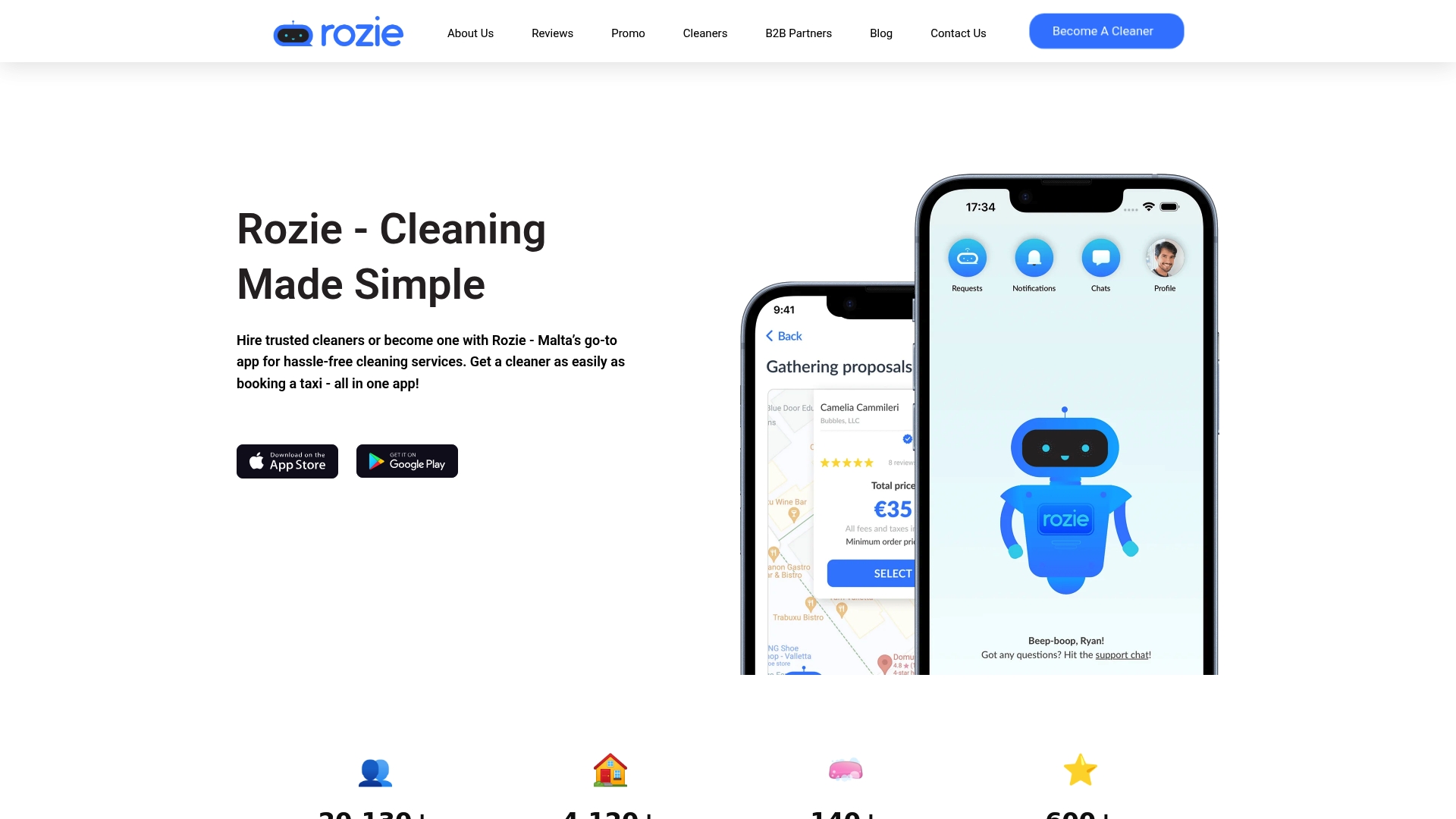
Browse Verified Cleaners on Rozie →
Not enough hours in the day? That’s the #1 reason 22,700+ people across Malta use Rozie to book verified cleaners — the same kind of formal accountability you’d want from any household hire, applied to cleaning. Compare offers from insured professionals in minutes, with €1,000,000 in Lloyd’s-backed insurance on every booking.
Download Rozie — Book in 60 Seconds →
Frequently asked questions
Are background checks legally required for nannies in Malta?
There is no nationwide legal requirement for criminal background checks specifically for private nannies in Malta. However, you can — and should — request a police conduct certificate from every candidate. The certificate is issued by the Malta Police on application and is the standard document that reputable nanny agencies require during their vetting. A candidate who refuses or hesitates to provide one is signalling something important.
What documents do I legally need to give a nanny when I hire them?
Under Malta’s Employment and Industrial Relations Act (Cap. 452), you must provide written employment terms covering job duties, working hours, salary, leave entitlement, probation period, and notice. The Department of Industrial and Employment Relations (DIER) provides templates and guidance on its website. For live-in arrangements, the contract should also explicitly separate working time from personal time and define accommodation arrangements.
How much does a private nanny actually cost in Malta?
Private nanny rates in Malta typically run €7–15 per hour gross depending on experience, qualifications, and the number of children. Salary survey data places the average annual gross salary for a full-time nanny in the €15,500–17,000 range, with experienced nannies in coastal localities like Sliema or St Julian’s commanding the higher end. On top of the gross wage you also pay employer’s social security contributions of 10% up to the statutory ceiling.
Can expats access free FES childcare in Malta?
Yes, expats with valid residency in Malta can apply for the FES Free Childcare Scheme if both parents (or a single parent) are employed, self-employed, or in formal study. The service covers children aged three months to three years across 14 FES centres in Malta and Gozo, with applications submitted through the FES online portal. Major intake periods are October and February, but applications stay open year-round.
What questions should I ask in a nanny interview?
Beyond experience and availability, focus on scenario questions: how would they handle an emergency, a tantrum, a child who refuses to eat, or a disagreement with you about routines? Ask for at least two contactable references from recent employers, ask whether they’re comfortable providing a police conduct certificate, and ask what they would expect from you as an employer. The candidate’s questions back to you reveal as much as their answers to yours.
Do I need to register as an employer if I hire a nanny part-time?
If you pay a domestic worker regularly — even part-time — for a defined schedule of work that you direct, you are generally treated as an employer under Maltese law. This means PE number registration with the Commissioner for Revenue, monthly social security contributions, and FS3 documentation at year-end. A local accountant can usually handle the full setup for around €100–150 and ongoing monthly admin for €30–50.
What other home services do working parents in Malta typically outsource?
Beyond childcare, the most commonly outsourced services for working parents are home cleaning (especially deep cleaning every 3–6 months for limestone floors and hard-water bathroom buildup), occasional Airbnb-style turnover cleaning if hosting, and laundry collection services. Platforms like Rozie handle the cleaning side with verified professionals, transparent offer-based pricing, and 7-day payment protection — useful for parents who’ve already worked through the trust questions with a nanny and don’t want to re-run the same vetting cycle for cleaning.
Recommended
- Reliable Maid Service Malta: 2026 Verification Guide
- How to Find Trusted Cleaners in Malta (2026 Guide) | Rozie – Malta’s Best Cleaning Services
- How to Find a Trusted Cleaner Near You in Malta (2026 Guide) | Rozie – Malta’s Best Cleaning Services
- How to Choose a Cleaning Service in Malta (2026 Guide)