



In this guide
What legal steps must you complete when signing a Malta lease?
How do you inspect and document the apartment’s condition?
How do you set up utilities in a Malta apartment?
What is the step-by-step move-in process, from signing to settling?
Why the move-in clean is the one task worth outsourcing
What legal steps must you complete when signing a Malta lease?
Every private residential lease in Malta must be registered with the Housing Authority, must include a signed photographic inventory, and runs for at least one year if it is a long let. Under the 2024 amendments (Act XX of 2024), the registration deadline moved from 10 to 30 days, and an unregistered contract is null and void — so verify registration yourself before you hand over any money.
Registration is the landlord’s legal obligation, done online through the Housing Authority’s rentregistration.mt portal for a small administrative fee. Historically leases had to be registered within 10 days, but Act XX of 2024 extended that window to 30 days from the start of the lease. If your landlord fails to register, you are legally entitled to register the lease yourself and claim the cost back — and since 1 September 2025, a €120 late-registration fee applies to any contract submitted more than 30 days after signing. Confirm the current fee on the portal, because older guides quoting a flat figure are out of date.
The Private Residential Leases Act 2020 (Cap. 604) sets the rest of the framework. A long private residential lease must be for at least one year, and any shorter term is treated as a one-year lease unless it qualifies as a defined short let. On renewal, rent increases are capped under the current rules, and notice periods are specific: a landlord who wants the property back must give three months’ notice by registered letter, while a tenant on a one-year lease can usually withdraw after six months with the required written notice. You can read the full Act on legislation.mt and the registration rules on the Housing Authority site.
The inventory is now mandatory — furnished or not.
Since the 2024 reform, every registered lease must include a signed inventory backed by photographs, submitted with the contract. If it is missing, the Housing Authority can reject the registration and the contract is treated as invalid. This applies even to unfurnished units, where the inventory documents the bare condition of the walls, floors, and fittings.
On deposits, the norm in Malta is one month’s rent, sometimes two for higher-end or unfurnished properties — this is market practice, not a strict legal cap. Crucially, Malta has no formal deposit-protection scheme comparable to the UK or Ireland, so there is no third party holding your money. The deposit is usually returned within a reasonable period after you vacate (around 30 days is typical), minus documented damage beyond normal wear. That absence of a protection scheme is exactly why the inventory and your own photos matter so much.
Before signing, gather these documents:
- Valid passport or national ID card
- Proof of income (pay slips, employment contract, or bank statements)
- Residence permit or visa documentation if you are a non-EU national
- Reference letter from a previous landlord, if you have one
Agency fees vary by agent, so ask for a written breakdown before you commit, and never pay any fee — deposit, rent, or commission — without a signed receipt.
Pro tip
Ask your landlord for the contract number once registration is submitted, and check it on rentregistration.mt yourself. Registrations pass through a vetting process that can take up to ten working days, so start following up in writing if nothing appears — a paper trail protects you if the registration stalls.
How do you inspect and document the apartment’s condition?
Inspect on the day you view and again on move-in day, checking for damp and mould, water pressure, working air conditioning, and appliance faults, then record everything with photos and a continuous video. In Malta, pay special attention to limescale from hard water, humidity-driven mould, and salt residue in coastal flats — these are the faults generic checklists written for other countries completely miss.
Most renters find listings through Facebook groups and property sites such as maltapark.com and djar.ai, and because rent prices vary significantly by location, where you look shapes your monthly budget. If you are still searching, our honest guide to finding an apartment in Malta covers the search in depth. Once you have chosen a place, the priority shifts to inspecting it properly and documenting what you find.
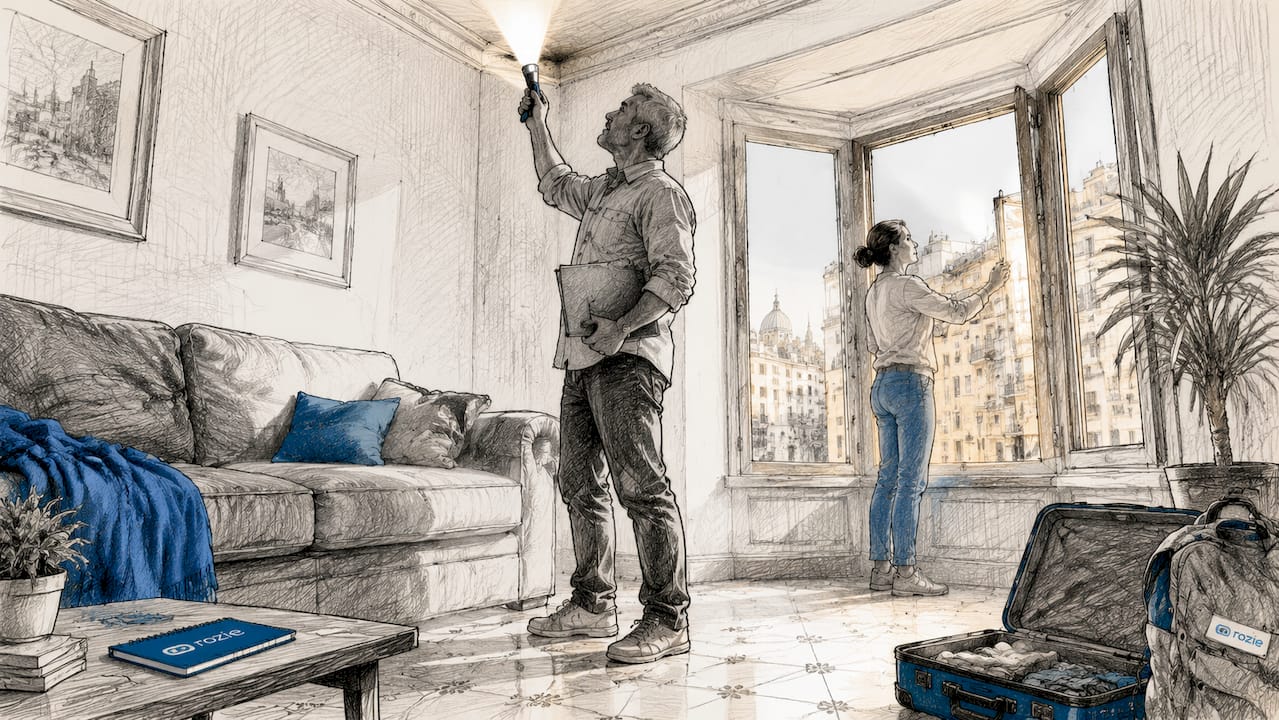
When you view an apartment, work through this list in order:
- Check walls and ceilings for damp patches, mould, or water stains
- Test every tap for water pressure and hot-water response time
- Switch on all air conditioning units and confirm they cool and heat
- Test every electrical socket and light fitting
- Open and close all windows and doors to check for warping or broken locks
- Listen for noise from neighbouring units, traffic, or nearby bars
- Run each kitchen appliance individually (oven, fridge, washing machine)
- Inspect floors, tiles, and any fitted furniture for existing damage
Malta’s building materials add one more consideration. Much of the island’s older housing uses porous globigerina limestone, which is pH-sensitive and easily etched, so note any stone floors or surfaces during the inspection — they will need pH-neutral care later, never vinegar or acidic cleaners.
Pro tip
Record a continuous video walkthrough of the whole apartment on move-in day, with the date visible, and take it with your landlord present. A timestamped video plus a landlord-signed inventory makes a later deposit dispute almost impossible to win against you.
How do you set up utilities in a Malta apartment?
Electricity and water in Malta are both billed by ARMS Ltd on a single account, so you register once using a change-of-consumer form with your ID, registered lease, and current meter readings. The step most newcomers miss is applying for the residential tariff and registering the number of occupants — get this wrong and you will quietly pay the higher domestic rate for months.
ARMS (Automated Revenue Management Services) is the joint billing arm of Enemalta, the electricity supplier, and the Water Services Corporation, which supplies the water. Both utilities appear on one ARMS bill. As a tenant, utilities must be registered by the tenant promptly after signing: submit the change-of-consumer form (with your lease and ID) online or at an ARMS customer care office, and provide current meter readings so you are not billed for the previous tenant’s consumption. Full forms and details are on the ARMS website.
Residential vs domestic: the tariff trap.
Malta bills at a lower “residential” tariff for your primary home and a higher “domestic” tariff for properties with no residents registered. If the account stays in the landlord’s name or lists the wrong number of occupants, you lose the residential rate and the per-person eco-reduction. After your first bill arrives, check that it shows “Residential” and the correct occupant count.
Sort out connectivity in the same first week. GO, Melita, and Epic all offer fibre packages, typically from around €25–50 a month, and installation can take one to two weeks, so book it early. Pick up a local prepaid SIM (ID or passport required) for immediate mobile data while your home internet is being installed. Malta has no natural-gas grid, so if the apartment cooks with gas it uses bottled LPG cylinders delivered to the door; many modern flats use electric hobs instead.
Key takeaway: Register the ARMS account in your own name on the residential tariff, with the right number of occupants, and photograph the meters on day one. This single habit prevents both inherited-consumption charges and months of overpaying on the wrong tariff.
What is the step-by-step move-in process, from signing to settling?
Work through the move-in in order: sign the lease and get a receipt, confirm registration, complete the inventory check, set up your ARMS account, arrange internet and a SIM, book a move-in clean before the furniture arrives, update your address with Identità, then move furniture in. Doing these in sequence prevents the utility gaps and deposit disputes that catch most new arrivals.
- Sign the lease and pay the deposit. Get a signed receipt for every payment and never transfer money without a paper trail.
- Confirm lease registration. Check rentregistration.mt within the registration window. If it is missing, follow up in writing immediately and remember you can register it yourself at the landlord’s cost.
- Complete the inventory check. Cross-reference the signed, photographic inventory in person and photograph every room before you move a single box in.
- Set up electricity and water. Submit the ARMS change-of-consumer form with your lease, ID, and meter readings, and apply for the residential tariff.
- Arrange internet and mobile. Compare fibre packages from GO, Melita, and Epic before committing, and grab a prepaid SIM for the gap before installation.
- Book a move-in clean. Even a freshly painted Malta flat carries construction dust, limestone residue, and hard-water stains between tenants. A thorough clean before the furniture arrives makes the space livable from day one — if you would rather not chase a cleaner on short notice, you can book a verified apartment cleaner in advance, and our Malta cleaning cost guide shows what a move-in clean should run.
- Update your address. Notify Identità (the national identity and residency authority), your bank, and your employer. A missed Identità update can affect residency status and official post.
- Set up furniture and appliances. For furnished flats, tick every item against the inventory. For unfurnished units, measure doorways and stairwells first — Malta’s older buildings have narrow, winding stairs that defeat many large sofas.
A few tasks worth handling in the first week: register with a local GP or health centre; get a personalised Tallinja bus card, which gives residents free public transport across the islands; locate your nearest pharmacy, supermarket, and bus stop; save your landlord’s number and confirm the preferred way to reach them; and test the smoke detectors. For the wider arrival to-do list beyond the apartment itself, the first week in Malta checklist is a useful companion, and if you are still budgeting the whole move, our breakdown of what it really costs to live in Malta sets realistic numbers.

Why the move-in clean is the one task worth outsourcing
Finding a reliable cleaner in Malta the traditional way often means scrolling Facebook groups, texting numbers, chasing quotes, and hoping the person who turns up actually does a thorough job — not what you want in the middle of a stressful move, when you have keys in one hand and a moving van outside.
Rozie was built to remove that friction. You post the job once, pick a date and any extras, and verified cleaners in Malta send you offers with the exact price before you accept, so you compare and choose rather than wait on a single quote. Every booking is covered by 7-day payment protection and up to €1,000,000 in professional liability insurance underwritten by Lloyd’s Insurance Company S.A., and a professional move-in cleaning sets a documented clean baseline that makes recovering your deposit far easier when you eventually move out. You can browse more local guides in the Cleaning in Malta archive.
Here is the full booking process in under 60 seconds:

Book a Move-In Clean on Rozie →
What are the most common move-in mistakes in Malta?
The costliest mistakes are paying a deposit before viewing in person, signing an unregistered lease, and skipping the inventory check — each one hands leverage to a bad landlord or a scammer. Add missing the utility-tariff setup and misreading your notice period, and you have the five errors that turn a smooth move into a months-long headache.
Key takeaway: A signed, photographic inventory is the single most effective tool a Malta tenant has. With no formal deposit-protection scheme on the island, your own documentation is what stands between you and an unfair deduction.
- Paying before viewing. No legitimate landlord asks for payment before a signed contract and an in-person viewing. If someone pressures you to pay remotely, walk away.
- Signing an unregistered lease. An unregistered contract offers zero legal protection and is null and void. Verify registration before your first rent payment.
- Ignoring communal fees. Many Malta apartments sit in blocks with shared maintenance costs. Ask specifically whether communal fees are included in the rent or billed on top.
- Missing the utility window and tariff. Delays in transferring the ARMS account can leave you without service, and leaving it on the domestic tariff quietly inflates every bill. Start the process the day you get your keys.
- Misunderstanding notice periods. Notice rules under Cap. 604 are specific — a landlord reclaiming the property gives three months by registered letter, and a tenant on a one-year lease can generally exit after six months with written notice. Check your contract and never rely on a verbal agreement.
If a utility is not working on move-in day, document the fault in writing to your landlord immediately — a timestamped message records that the problem predates your occupancy. For protecting your deposit at the other end of the tenancy, the end-of-tenancy cleaning checklist is worth bookmarking now.
Key takeaways
A successful Malta apartment move-in depends on legal verification, thorough documentation, and prompt utility setup — done in the right order, before you unpack a single box.
FAQ
What is a move-in checklist for a Malta apartment?
A move-in checklist for a Malta apartment is a structured list of legal, administrative, and practical tasks to complete before and immediately after moving in. It covers lease registration, the signed inventory, ARMS utility setup, address updates with Identità, and a move-in clean, all done in a deliberate order to protect your deposit and avoid service gaps.
How long does a landlord have to register a lease in Malta?
Under the 2024 amendments, the landlord must register the lease within 30 days of the start date, extended from the previous 10-day deadline. An unregistered contract is null and void. If the landlord fails to register, the tenant can register it at the landlord’s cost, and a €120 late fee applies to contracts submitted more than 30 days after signing.
How much is the security deposit for a Malta rental?
Security deposits in Malta typically equal one month’s rent, though some landlords request two months for unfurnished or higher-end apartments. This is market practice rather than a strict legal cap, and Malta has no formal deposit-protection scheme, so the deposit is usually returned around 30 days after you vacate, minus documented damage.
What utilities do I need to set up when moving into a Malta apartment?
Electricity and water are both billed by ARMS Ltd on a single account, so you submit one change-of-consumer form with your ID, registered lease, and current meter readings. Apply for the residential tariff and register the correct number of occupants. Arrange fibre internet from GO, Melita, or Epic early, since installation can take one to two weeks.
Why is the inventory list so important in Malta?
A signed inventory with photos protects tenants from unfair deposit deductions and is now mandatory under the 2024 law for both furnished and unfurnished units. Without it, a landlord can claim pre-existing damage was caused by the tenant, and with no formal deposit-protection scheme on the island, disputes are very hard to resolve.
Should I book a professional clean before moving in?
A move-in clean is worth booking because Malta flats accumulate construction dust, limestone residue, and hard-water stains between tenants, and the previous tenant’s cleaning is rarely thorough. A professional clean before the furniture arrives sets a documented, hygienic baseline. On Rozie, you post the job once and verified cleaners send exact-price offers within minutes for you to compare before accepting.