

In this guide
Is Malta actually a walkable place?
Which areas in Malta are best to explore on foot?
Where can you walk car-free? Pedestrian streets and the Silent City
What are the best walking routes in Malta?
How is Malta becoming more walkable? The Vjal Kulħadd plan
What should families and walkers know about terrain?
Is Malta actually a walkable place?
Yes — in the right areas. Malta is small, roughly 27 km end to end, and its harbour towns pack shops, schools and transport within a short walk of most homes. Free buses and harbour ferries for residents stretch that range further. The honest limit is that rural and many southern villages spread out, and Malta’s high car density makes some streets less pleasant on foot.
Malta squeezes one of the highest car densities in the EU onto a tiny footprint, which makes driving slow and parking scarce in exactly the places newcomers most want to live. In the harbour corridors — the Gżira–Sliema–St Julian’s strip and the Valletta–Three Cities ring — walking, buses and ferries genuinely cover daily life. Elsewhere, a car earns its keep. Valletta itself is walkable end to end in about 20 minutes across roughly a 1 km peninsula, so a single trip can take in the bakery, the pharmacy and a government office without a bus. If you are weighing a car-free move rather than just a good walk, our guide to the best areas to live in Malta without a car goes deeper on transport and real costs.
Which areas in Malta are best to explore on foot?
Valletta, Sliema, the Three Cities and St Julian’s are Malta’s best urban areas for getting around on foot, with Gżira and Msida close behind. All cluster around the two natural harbours, where supermarkets, pharmacies, offices and bus stops sit within a few minutes’ walk. Each has a different character, from Valletta’s baroque grid to Sliema’s flat seafront promenade.

Here is how the most walkable areas compare for life on foot:
- Valletta: Compact, culturally dense and made for wandering. The flat main spine is effortless; the steep, staircased side streets are not. Best for people who enjoy urban energy and the architecture underfoot.
- Sliema: A flat seafront promenade lined with shops, supermarkets and cafés. The most practical area for everyday walking and the easiest with a stroller or shopping bags.
- St Julian’s: Lively and coastal, walkable for dining and nightlife, with good bus links and easy reach to international schools nearby.
- The Three Cities (Birgu, Senglea, Cospicua): Quiet marina-side walking with far fewer tourists than Valletta. Lovely for an evening stroll, with the harbour ferry doing the work a car would.
- Gżira and Msida: More residential and improving fast, close to the University of Malta and major bus routes, and squarely inside the Marsamxett walking corridor.
One quiet upside of all this walking is that daily errands stop eating into your car time. The trade-off is that an active, out-all-day routine still leaves a home that needs upkeep — something many Malta residents book through Rozie, where verified cleaners send offers within minutes so a clean flat does not have to cost a weekend.
Where can you walk car-free? Pedestrian streets and the Silent City
Mdina, Malta’s medieval walled capital, is the island’s most genuinely car-free place — known as the Silent City, it bars almost all traffic, so you wander its limestone lanes on foot alone. Valletta’s main shopping spine, Republic Street, is largely pedestrianised too, and the Vjal Kulħadd programme is now closing selected streets to cars in towns like Msida and Naxxar.
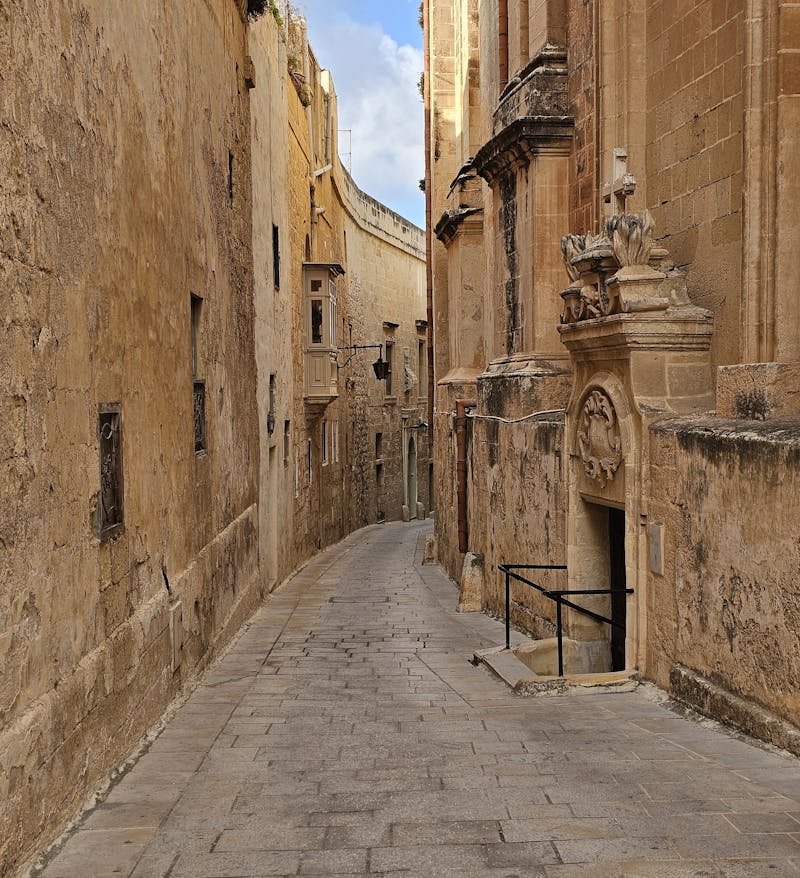
Mdina is the clearest example of how good walking in Malta can feel when cars are taken out of the equation. Inside the bastions, narrow shaded lanes open onto sudden views over the countryside, and with traffic restricted to residents and essential vehicles, the loudest sound is usually your own footsteps. It pairs naturally with neighbouring Rabat, which is walkable from the same bus stop. Closer to the harbours, Valletta’s pedestrian core and a growing list of part-time pedestrian zones mean more of the island’s daily life is being handed back to people on foot rather than to parked cars.
What are the best walking routes in Malta?
Malta’s best walks range from flat seafront strolls to dramatic clifftop trails. The Sliema promenade and the Three Cities marinas are easy and scenic; the Dingli Cliffs along Triq Panoramika and the Marfa Ridge reward you with open Mediterranean views. Most are reachable by public bus, so you do not need a car to walk the island’s finest coastline.
The Dingli Cliffs are the standout. At around 253 metres, they are the highest point in Malta, and the clifftop road, Triq Panoramika, gives you several kilometres of walkable path in both directions from the St Mary Magdalene Chapel, looking out over open sea and the tiny islet of Filfla. It is quiet enough that many people who go simply come to walk. Buses 201 from Rabat and 56 from Valletta drop you nearby, though parts of the route share the road with traffic, so keep children close on those stretches.
Pro tip
Walk the cliffs in the morning or out of season. Malta’s coastal routes have almost no shade, and between June and September the midday sun makes the same walk far harder than it looks on the map.
How is Malta becoming more walkable? The Vjal Kulħadd plan
Malta is investing real money to make streets more walkable. Vjal Kulħadd, a €10 million Infrastructure Malta programme, funds pedestrian zones, cycle lanes, tree planting and traffic-calming across the island, with its first projects rolling out from 2025. Towns like Msida and Naxxar are seeing streets closed to cars, and a separate active-mobility plan is linking walking routes to bus and ferry hubs.
The scheme was launched with a €10 million government fund inviting local councils and NGOs to propose people-friendly redesigns. The first 14 projects are already underway: Triq Oscar Zammit in Msida is becoming a pedestrian street, Triq John Ayde in Naxxar is being redesigned around walkers and indigenous trees, and towns including Attard, Żebbuġ and Siġġiewi are gaining pedestrian zones, cycle paths and green space. Alongside it, Infrastructure Malta’s active-mobility work is building safer pedestrian and cycle connections, starting with the Grand Harbour area, to make walking a default choice rather than a last resort.
The honest caveat is that infrastructure alone does not change behaviour. Urban-design experts caution that prettier streets only go so far without parallel measures that make driving through residential areas less attractive. Malta still has a deep car culture to work through, but the direction of travel is clear, and for anyone choosing where to walk or live, the trajectory matters as much as today’s reality.
Worth checking before you commit to a street.
If a street near you is on the Vjal Kulħadd list, it is likely to become noticeably more pleasant to walk over the next couple of years — and local demand tends to follow pedestrianisation, so it is worth factoring into a move.
What should families and walkers know about terrain?
Walkability in Malta is not just about distance — it is about hills and steps. Valletta and the Three Cities sit on slopes, with many side streets staircased and few lifts in older buildings. For anyone with a stroller, heavy shopping or mobility needs, that terrain matters more than the map suggests, so it is worth testing your daily route in person before you commit.
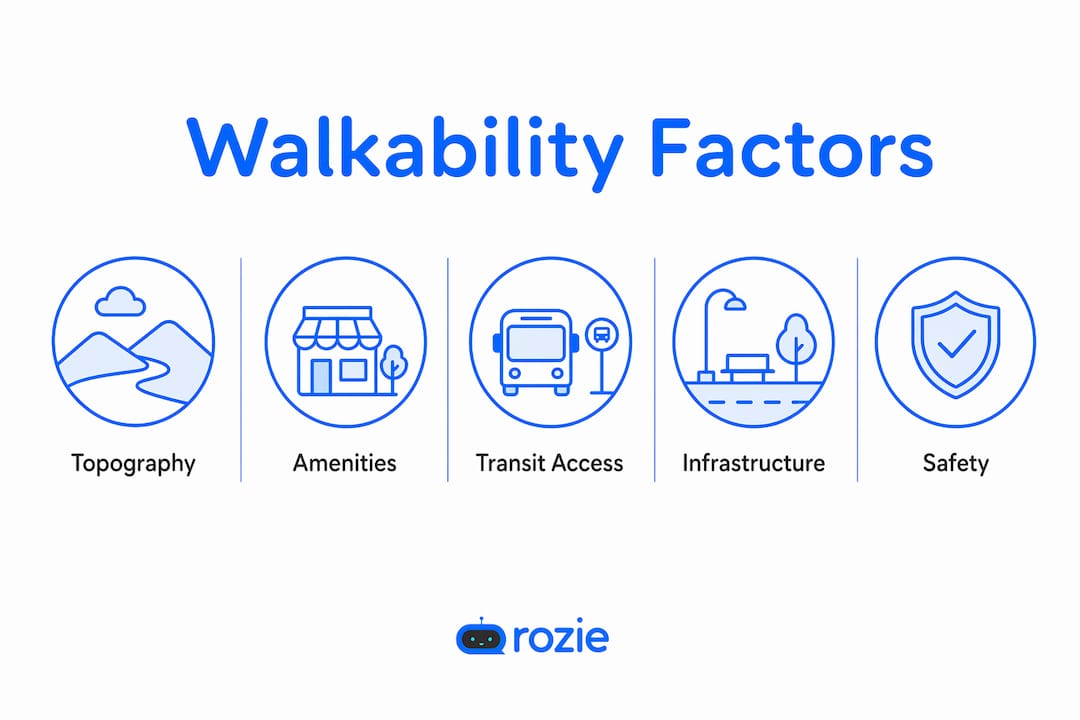
The simplest way to judge a neighbourhood is what I call the carry test: walk your most common daily route while carrying a loaded shopping bag or pushing a stroller. If it feels difficult once, it will feel exhausting after six months. Beyond terrain, a few practical things shape day-to-day walkability:
- School proximity: Malta’s international schools cluster around St Julian’s, Pembroke and Swieqi, so living within walking distance of your child’s school transforms the morning.
- Bus stop distance: Living within a five-minute walk of a major route dramatically expands your car-free range across the island.
- Ferry access: Near the Sliema, Valletta or Three Cities terminals, the harbour ferries replace long cross-town journeys in minutes.
- Supermarket density: Sliema and St Julian’s have the highest concentration of supermarkets and pharmacies within an easy walk.
Families weighing a specific neighbourhood will find more detail in our honest rental guide, which covers how location shapes daily life when the island is small enough that the wrong street means a frustrating commute.
What walking Malta on foot taught me
I have spent time on foot in both Valletta and Sliema, and the difference between them is not only topography — it is a different relationship with your neighbourhood. In Valletta, every walk feels like a small event: the architecture, the light, the history underfoot. It is genuinely special. But after a few weeks the stairs and slopes become part of your daily calculation, and you start thinking twice about the heavy grocery run.
Sliema does not have that romantic charge, but it works. The promenade is there every morning, the supermarket is three minutes away, the bus stop is around the corner. And Mdina taught me something different again — that the quietest, most memorable walking in Malta happens where cars simply are not allowed in. What encourages me most is the direction the island is heading. The Vjal Kulħadd projects and the active-mobility plans show the government understands what residents actually need, even if the car culture still has a long way to unwind. So choose your area based on how you really live, not how you imagine you will. Walk the routes. Test the hills. Malta rewards that kind of honest preparation.
— Alex
Key takeaways
Come home to a clean flat after a day on your feet
Key takeaway: Living in a walkable part of Malta means more time outdoors and less behind the wheel — but a full, active week still leaves a home that needs upkeep.
Finding a reliable cleaner in Malta the traditional way usually means scrolling Facebook groups, texting numbers, chasing quotes and hoping whoever turns up does a proper job.
Rozie was built to remove that friction. You post the job once, pick a date and the extras you need, and verified cleaners send you offers with the exact price before you accept. Every booking comes with 7-day payment protection and professional liability insurance of up to €1,000,000 per occurrence, underwritten by Lloyd’s Insurance Company S.A. — and Rozie covers the deductibles, so you pay no excess.
Here is the full booking process in under 60 seconds:

Whether you want a regular weekly clean or a one-off deep clean after moving into a new neighbourhood, you can browse the latest cleaning guides for Malta, see what a clean typically costs, or read how to choose the right cleaner before you book. Your neighbourhood already works for you — let the home upkeep take care of itself.
Compare Cleaning Offers on Rozie ->
Frequently asked questions
Is Malta walkable?
Malta is very walkable in its harbour towns. Valletta, Sliema, the Three Cities and St Julian’s let you reach shops, cafés and transport on foot in minutes, and the walled city of Mdina is almost entirely car-free. Rural areas and many southern villages are more spread out, where a car is genuinely useful.
Which is Malta’s most walkable city?
Valletta is Malta’s most walkable city, covering roughly 1 km end to end in about 20 minutes on its flat main spine. Mdina is the most car-free, since traffic is heavily restricted inside its walls. Sliema is the most practical for everyday errands thanks to its flat seafront and dense amenities.
What is the Vjal Kulħadd initiative?
Vjal Kulħadd is a €10 million Infrastructure Malta programme that funds pedestrian zones, cycle lanes, tree planting and traffic-calming across selected streets and squares. Its first 14 projects began rolling out from 2025, including pedestrianised streets in towns such as Msida and Naxxar.
What are the best walking routes in Malta beyond the cities?
The Dingli Cliffs and Marfa Ridge are Malta’s top scenic walking routes outside the urban areas. The clifftop Triq Panoramika path at Dingli runs for several kilometres at the island’s highest point, and both areas are reachable by public bus from Valletta or Sliema, so you do not need a car.
Is Valletta accessible for families with strollers?
Valletta’s main spine is manageable with a stroller, but many side streets are steep and staircased, and older buildings rarely have lifts. Families should walk their intended daily routes in person before choosing Valletta or the Three Cities as a base.
How do residents keep up with home cleaning while living an active, walkable life in Malta?
Many Malta residents who spend their days out on foot book a verified cleaner through Rozie rather than lose a weekend to housework. You post the job once, and cleaners send offers with the exact price within minutes, so you can compare and accept with payment protection in place.