

In this guide
What causes balcony dust in Malta?
Which Malta localities get the most balcony dust?
How dangerous is balcony dust to your health?
How do you clean a dusty balcony in Malta?
How do you keep balcony dust out of your home?
What causes balcony dust in Malta?
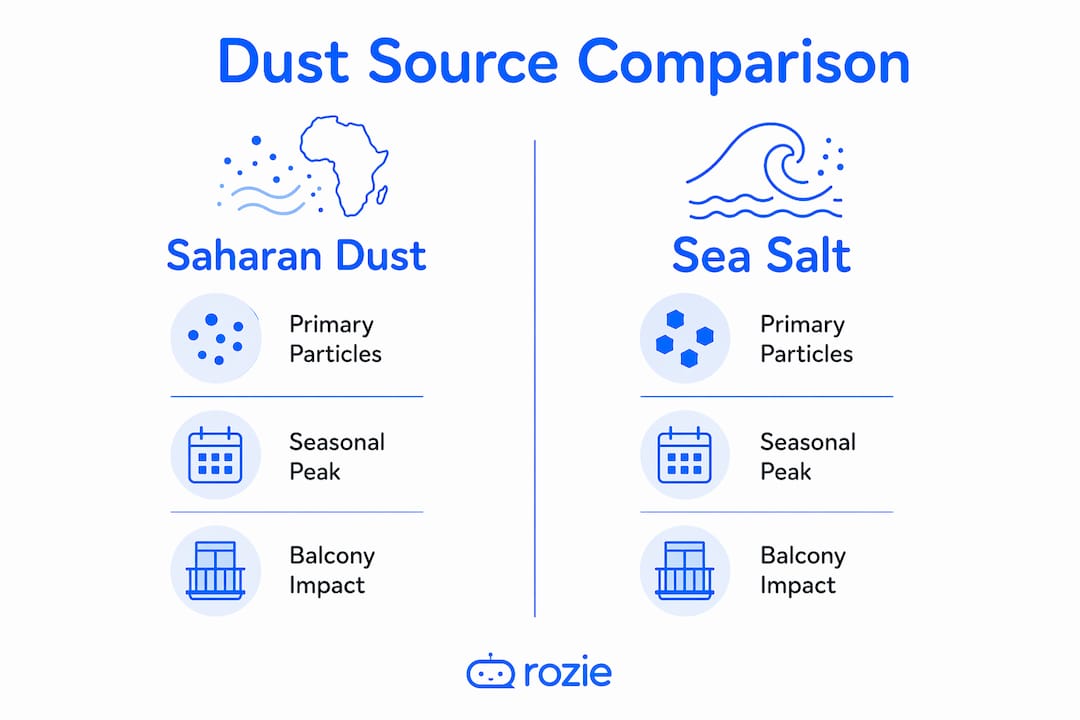
Balcony dust in Malta comes from three overlapping sources: Saharan dust events — known locally as il-qilla — sea-salt aerosols carried in from every direction, and local particles from construction sites, traffic, and festa fireworks. Dust events are most frequent in spring and autumn, which is why a Maltese balcony needs an ongoing routine rather than a one-off deep clean.
Saharan dust is the biggest single driver. Southerly winds carry fine mineral particles north across the Mediterranean and deposit a visible orange-red film on every exposed surface, often overnight and with no warning. Sea salt is the constant second layer: salt aerosols are hygroscopic — they absorb moisture and bond with other particles — which is why coastal balcony grime feels sticky rather than powdery and resists a dry broom.
Local sources top the mix up year-round. Construction sites generate fine limestone and cement dust, traffic adds carbon and rubber particles, and festa fireworks leave sulfur compounds and metal residues that settle on balconies for days after the celebrations — a summer-long factor in most towns, since festa season runs from June to September. For the wider seasonal picture, see our guide to surviving summer in Malta.
The source tells you the method. Saharan deposits need wet removal so the fine particles are trapped rather than resuspended, salt residue needs a fresh-water rinse, and construction dust usually needs a mild pH-neutral detergent scrub.
Which Malta localities get the most balcony dust?
Coastal towns like Sliema, St Julian’s, Gzira, and Bugibba take the heaviest combined load of salt spray and dust, while the inner-harbour band records Malta’s worst traffic particulate. The Environment and Resources Authority’s Air Quality Plan designates an Air Quality Management Area covering Pietà, Floriana, Msida, Marsa, Ħamrun, Qormi, Luqa, and Paola after repeated PM10 exceedances at the Msida monitoring station.
One detail specific to the harbour area: traditional closed wooden balconies (gallariji) in Valletta, Senglea, and Birgu trap dust inside louvres and window tracks. Vacuum the tracks before any wet wipe so the gritty particles do not scratch the glass or grind into the paintwork.
How dangerous is balcony dust to your health?
Fine dust is a genuine health risk, not just a nuisance. During Saharan dust intrusions, PM10 levels can exceed WHO recommended limits by more than 12 times, and the finer PM2.5 fraction travels deep into the lungs, triggering inflammation in healthy adults and serious flare-ups in anyone with asthma, COPD, or cardiovascular disease.
Particulate matter affects more people than any other pollutant, according to the WHO’s ambient air quality fact sheet, precisely because the smallest particles pass from the lungs into the bloodstream. In a country with il-qilla events several times a year, that makes dust management a health habit, not a cosmetic one.
Who should be most careful.
Children, older residents, pregnant women, and anyone with asthma, COPD, or heart disease should stay indoors with balcony doors closed during peak episodes. Check ERA’s hourly air quality index before opening up the balcony for the morning.
Pro tip
Never dry-sweep during or right after a dust event. Dry sweeping sends PM2.5 particles back into the air — and into your home. Wait until the event passes, then trap the dust with a damp microfiber cloth or a wet mop instead of redistributing it.
The dust also carries a property cost. A film of mineral and salt deposits cuts solar panel and solar water heater output until the panels are rinsed, corrodes metal railings and hinges, and stains porous Globigerina limestone — the soft local stone absorbs the deposits, and the surface erodes a little more with every uncleaned event.
How do you clean a dusty balcony in Malta?
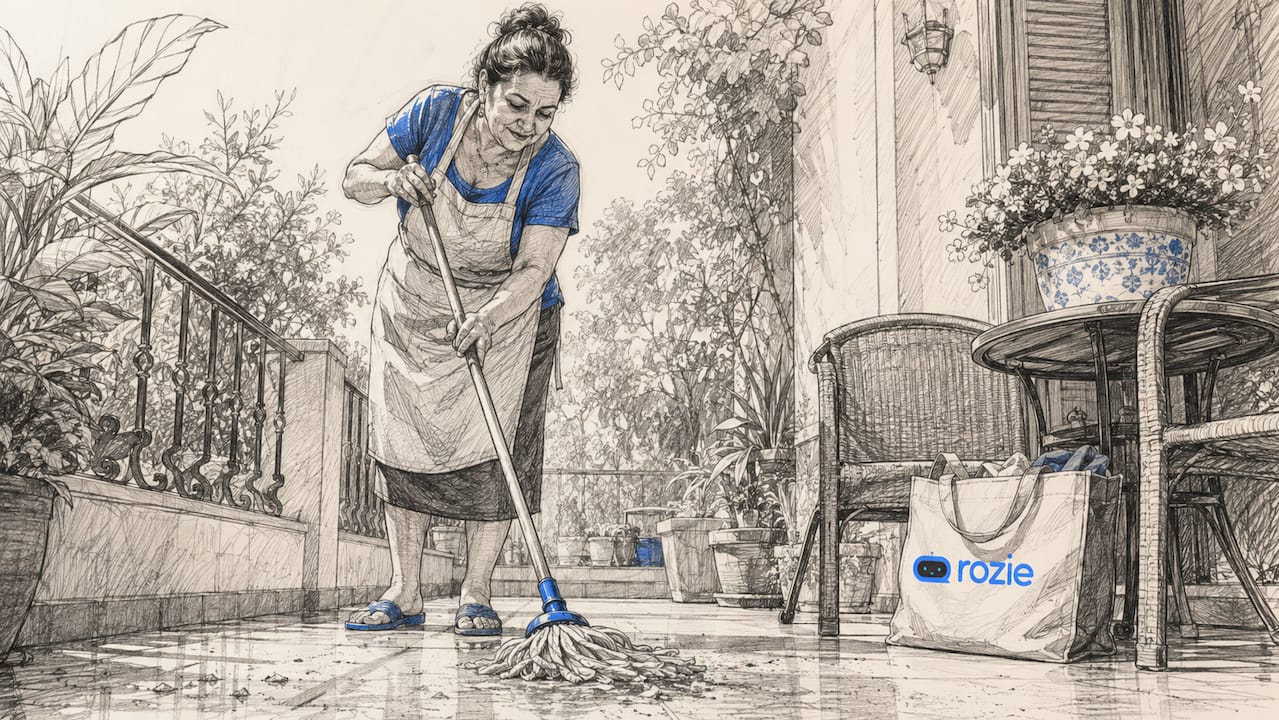
Wet methods beat dry sweeping every time, because they capture particles instead of scattering them. The workable rhythm for Malta: a weekly damp sweep and wash as the baseline, a rinse within 24–48 hours of every il-qilla event, a monthly pH-neutral scrub, and a same-day wipe-down after the local festa.
- After a dust event (within 24–48 hours): rinse the floor with water first to wet the dust layer, then mop with a damp microfiber cloth. Never use a pressure washer on limestone — the jet erodes the soft stone.
- Weekly routine: sweep with a slightly damp broom, wipe railings, furniture, and window ledges with a microfiber cloth, then rinse the floor with a bucket of fresh water to lift salt film.
- Monthly deep clean: scrub the floor with a mild pH-neutral detergent, clean the balcony door tracks and window frames, and check the weatherstripping for gaps.
- After a festa: damp-wipe fireworks residue off all surfaces within a day and rinse thoroughly — the deposits are chemically active and should not sit on metal or stone.
For balcony window cleaning, use a squeegee with a microfiber sleeve and a bucket of clean water with a little dish soap, working top to bottom. After a dust event, vacuum the frames and tracks first — wiping abrasive Saharan grit straight off the glass causes micro-scratches.
Mind the limestone.
Globigerina limestone is porous and pH-sensitive, so never use vinegar or any acidic cleaner on stone floors, sills, or facades. Stick to pH-neutral products such as Lithofin or HG, both easy to find at PAVI and Smart Supermarket.
Pro tip
Keep a dedicated balcony cleaning kit outside, in a small storage box. Bringing a dust-covered mop or broom indoors transfers the particles straight onto your floors and furniture — the exact problem you were trying to solve.
For the indoor side of a dust event — sills, floors, and soft furnishings — our apartment cleaning checklist covers the room-by-room sequence, and there are more cleaning in Malta guides for specific surfaces and seasons.
Rather skip the scrubbing? On Rozie you post the job once, add the balcony or terrace extra, and verified cleaners send offers with exact prices within minutes — you compare before you accept. Typical rates are in the cleaning cost guide for Malta.
Compare Cleaning Offers on Rozie →
How do you keep balcony dust out of your home?
Sealing the balcony door and window gaps is the single most effective structural step, because even small openings feed a steady stream of fine particles into living spaces during an event. Pair it with recirculated air conditioning, HEPA filtration indoors, and ventilation timed to clean-air windows rather than habit.
Self-adhesive foam weatherstripping is cheap, sold in most Maltese hardware stores, and worth replacing every year — Malta’s sun and salt air degrade foam faster than cooler climates do. While you are at it, check the balcony door track: a track full of grit stops the door sealing fully even with fresh stripping.
Set the air conditioning to recirculation mode during dust events so the unit stops drawing in outdoor air loaded with PM2.5, and clean the AC filters monthly through spring and autumn. A clogged filter cuts cooling efficiency and pushes trapped particles back into the room.
True HEPA air purifiers capture 99.97% of fine particulate matter and are the most reliable indoor protection during heavy episodes — one in the bedroom, one in the main living area, on high during events and low as the daily baseline. The impact of cleaning on indoor air quality is measurable too: homes that pair prompt balcony cleaning with filtration hold visibly lower particle counts than homes relying on ventilation alone.
Ventilate during low-dust windows — typically early morning on calm, clear days — and check the air quality index first. Airing the flat in the middle of an event undoes hours of filtering in minutes.
What mask works during a Saharan dust event?
Only properly fitted N95 or KN95 masks effectively block fine PM2.5 particles during outdoor exposure. Surgical and cloth masks provide negligible protection at this particle size — a common and costly assumption during spring events, especially for anyone who has to commute through them.
When should you hire a professional balcony cleaner in Malta?
DIY handles the weekly routine, but heavy or bonded buildup is a different job. Professional cleaning services provide specialized equipment — wet vacuums, pH-neutral stone products, proper glass tools — and two to four visits a year, timed to Malta’s dust cycle, cover what routine maintenance misses.
- Post-construction debris: fine silica and cement dust needs wet-vacuum extraction and the right products to remove safely rather than smear around.
- Prolonged neglect: if the balcony has gone through several uncleaned dust events, the salt and mineral layers have bonded and need a proper deep clean.
- Rental and short-let turnover: landlords and hosts need a documented, thorough clean between tenants or guests — especially after summer festa season.
- Stained limestone: heavy buildup calls for a careful pH-neutral deep clean; badly eroded or etched stone is a job for a stone-care specialist rather than a cleaner.
Timing matters more than frequency. A spring clean after the peak Saharan season and an autumn clean before the winter rains are the two highest-value appointments; a post-festa clean in summer covers the third major dust source.
On Rozie, balcony and terrace cleaning are extras added to a general or deep cleaning request, and each cleaner’s offer shows the exact price for your specific job before you accept. A one-line booking note such as “dust event last week — please wet-clean the balcony first” gets you sharper offers; the deep clean prep checklist shows what else to include. When comparing offers, favour vetted cleaning professionals who use wet methods and understand what is actually sitting on a Maltese balcony — a cleaner who dry-sweeps a post-Saharan floor is doing more harm than good.
Finding that person the traditional way means scrolling Facebook groups, texting numbers pulled from a comment thread, and chasing quotes from cleaners who may or may not turn up.
Rozie removes that friction. You post the job once, add the balcony or terrace extra, and verified cleaners send you offers with exact prices within minutes — you compare and accept before anything is charged. Every booking includes 7-day payment protection and professional liability insurance up to €1,000,000 per occurrence, underwritten by Lloyd’s Insurance Company S.A. — Rozie covers all deductibles, so you pay no excess.
Here is the full booking process in under 60 seconds:
Key takeaway: in Malta, the 24–48 hours after a dust event are when cleaning is easy — salt and mineral deposits bond to surfaces within days. Rinse promptly, keep dust out with sealed gaps and HEPA filtration, and book a professional balcony clean two to four times a year, timed to the dust cycle.
Book a balcony clean on Rozie
Keeping up with Malta’s dust cycle is a real commitment. Rozie connects you with verified cleaners across Malta and Gozo who handle post-Saharan buildup, salt residue, and pH-sensitive limestone the right way.

You post the request once, pick the date and extras, and book a verified cleaner online in minutes — cleaners typically send offers within 5–15 minutes, and you compare exact prices before accepting. Support runs over WhatsApp, and every booking is backed by 7-day payment protection and €1,000,000 liability insurance. No calls, no quote-chasing, no unverified strangers in your home.
Download Rozie – Book in 60 Seconds →
Frequently asked questions
What is the main cause of balcony dust in Malta?
Saharan dust and Mediterranean sea salt are the two biggest sources, with local construction, traffic, and festa fireworks adding to the buildup year-round. Saharan events, known locally as il-qilla, peak in spring and autumn.
How often should I clean my balcony in Malta?
A weekly damp sweep and wash is the baseline, plus a rinse within 24–48 hours of every Saharan dust event. A professional balcony deep clean two to four times a year covers what routine maintenance misses.
Is balcony dust in Malta dangerous to health?
It can be, especially during active dust events, when PM10 levels in Malta can climb far above WHO recommended limits. Residents with asthma, COPD, or heart conditions, children, and older people should stay indoors during peak episodes.
What mask should I wear during a Saharan dust event in Malta?
A properly fitted N95 or KN95 mask is the only type that reliably filters fine PM2.5 particles. Surgical and cloth masks offer negligible protection against Saharan dust.
How do I stop balcony dust from entering my home?
Seal the gaps around balcony doors and windows with weatherstripping, run the air conditioning on recirculation during dust events, and use a True HEPA air purifier in the bedroom and main living area. Ventilate only when Malta’s air quality index shows clean air.
Recommended
- Balcony Window Cleaning Malta: DIY & Pro Guide 2026
- After Builders Cleaning Malta: 3-Phase Process Cuts Time 30% | Rozie – Malta’s Best Cleaning Services
- Post Renovation Cleaning Malta 2026: Cut Mistakes by 40% | Rozie – Malta’s Best Cleaning Services
- Balcony Cleaning Service Malta: Costs, Tips & Booking (2026)